TALLINN: Turkey’s EU affairs minister accused Germany of trying to use the EU as a “tool” in its festering row while German lawmakers arrived in Turkey on Friday to visit soldiers stationed in the central Turkish province of Konya.
Minister Omer Celik welcomed the diplomatic rebuff offered by a number of the bloc’s foreign ministers to German Chancellor Angela Merkel’s call for Turkey’s EU membership talks to be terminated.
The EU has voiced major concerns about Turkey’s crackdown in the wake of last year’s failed coup, with European Commission President Jean-Claude Juncker warning that Ankara was “withdrawing from Europe by giant steps.”
Relations between Berlin and Ankara have have deteriorated since last year’s failed coup tried to overthrow President Recep Tayyip Erdogan, and the subsequent crackdown.
During an election debate on Sunday Merkel said she would ask the EU to end Turkey’s accession talks.
Celik said Germany risked tarnishing the EU’s reputation by dragging it into a row between individual countries.
“Those who are at the moment coming up with fresh arguments (against Turkey joining) are actually trying to use the EU in order to tackle bilateral problems,” Celik told reporters at a gathering of EU foreign ministers in Tallinn.
“The EU should not be used as a tool to counter the bilateral problems of any of the countries.”
Merkel’s remarks on Sunday drew a furious response from Turkish President Recep Tayyip Erdogan, who compared them to “Nazism.”
But a number of EU ministers urged a more measured response than Merkel suggested, warning against rushing into hasty action against Turkey, which is an important member of NATO and a key partner for Europe in tackling the migrant crisis.
Celik said the ministers’ caution showed there was no “environment” to stop the negotiations, which have made only slow progress since they began in 2005.
Relations between Ankara and Berlin deteriorated sharply after the coup attempt, which was followed by the crackdown in Turkey during which over 50,000 people have been arrested, including German citizens.
Angry rhetoric has flown in both directions and Erdogan has called on ethnic Turks in Germany not to vote for Merkel’s party in national elections later this month.
Celik said it was time to move on from the recriminations.
“I can tell you we are definitely uncomfortable in terms of the arguments put forward by German politicians. They cannot spend a day without having some kind of remarks to our president and politicians,” he said.
“I think this is a vicious cycle that we need to break and we should definitely focus on the future.”
German lawmakers visit Turkey
While relations remain tense between the NATO allies, German lawmakers arrived in Turkey to visit soldiers stationed in the central Turkish province of Konya.
Some 20-30 German troops have remained at Konya as part of an Airborne Warning and Control System (AWACs) mission, part of the US-led coalition’s campaign against the Daesh group in neighboring Syria and Iraq.
The delegation had initially been due to come to Turkey in July for the routine visit, but the trip was blocked by Ankara.
NATO Secretary-General Jens Stoltenberg then intervened and the visit was organized by the alliance, rather than Germany.
NATO’s deputy secretary-general, Rose Gottemoeller, is leading the delegation including seven German MPs from different parties, according to the Bundestag.
“We expressly welcome the fact that this visit could take place,” Germany foreign ministry spokesman Martin Schaefer said.
“A visit is a visit. It is already good... We will see how things continue,” he said, adding that these types of visits organized within the NATO framework could not constitute “a lasting and sustainable political solution.”
The row over MPs’ access to German troops on Turkish soil boiled over in June when Berlin pulled out 260 troops from Incirlik base in southern Turkey and relocated them to Jordan, after Ankara repeatedly thwarted lawmakers’ efforts to visit.


![]()
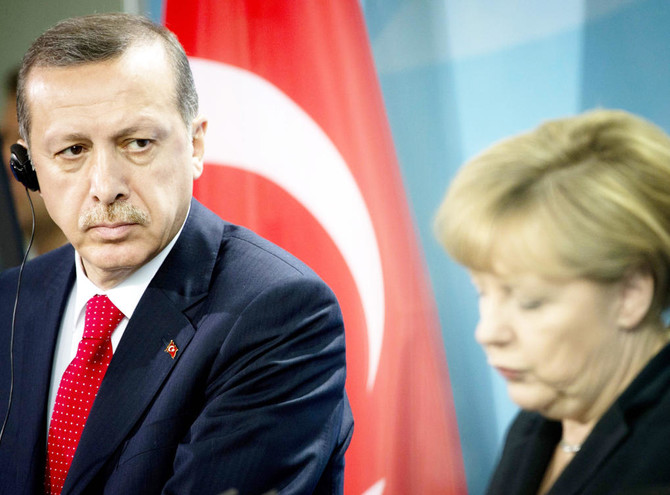
Turkey accuses Germany of using EU as ‘tool’ in row
Turkey accuses Germany of using EU as ‘tool’ in row


Latest updates


Recommended


© 2026 SAUDI RESEARCH & PUBLISHING COMPANY, All Rights Reserved And subject to Terms of Use Agreement.