Human flood of Rohingya tell of 5-day trek to safety

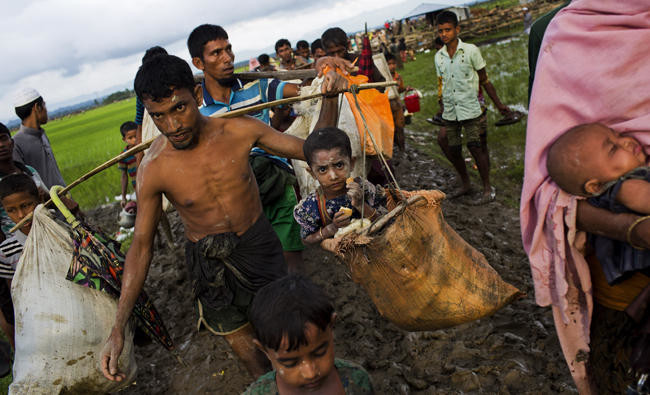
A Rohingya ethnic minority refugee from Myanmar carries a child in a sack and walks through rice fields after crossing over to the Bangladesh side of the border near Cox's Bazar's Teknaf area on Sept. 1, 2017. (AP Photo/Bernat Armangue)
Updated 07 September 2017
Follow

Human flood of Rohingya tell of 5-day trek to safety

COX’S BAZAR, Bangladesh/ANKARA: At times, it resembles a flash flood — not of water, but of humanity. On the banks of the River Naf that separates Myanmar from Bangladesh, the Rohingya refugees pour in by the thousand, day and night, hungry, dehydrated and exhausted.
No one even knows how many there are. The UN refugee agency estimates nearly 150,000. Local officials in Cox’s Bazar district in Bangladesh’s border with Myanmar believe it is nearer 200,000. All have fled bloodshed and persecution in Rakhine state in Myanmar, and many possess only the clothes they stand up in.
“It reminds me of the time of independence in 1971, when we fled to India to save our lives from the Pakistani military,” says Abdur Rahman, 70, a local farmer.
“The Rohingya refugees are compelled to rush to the Bangladesh border with the minimum amount of luggage and kitchen utensils. Sometimes, they arrive completely empty handed.”
Mohammad Nurul Amin, 32, a grocery shop owner in the village of Miajong in Rakhine, walked for five days with 14 members of his family, just to reach safety. The journey has already cost him the equivalent of $73, a large sum of money in rural Myanmar
“This amount was taken by the boatmen, since the family had to cross two rivers and a canal,” he says.
The situation in Rakhine, Amin said, is desperate. “There is not a single house in my locality which was not set ablaze by the Myanmar army. Young men were slaughtered brutally and piles of dead bodies were torched by petrol bombs. It had become hell.”

Turkey extends a helping hand
Turkey, meanwhile, extended a helping hand to the Muslim minority on humanitarian and diplomatic platforms.
Following the telephone discussion of Turkish President Recep Tayyip Erdogan with Myanmar State Counselor Aung San Su Kyi on Monday, Myanmar allowed Turkish aid agency (Turkish Cooperation and Coordination Agency/TIKA) to distribute 1,000 tons of aid to Rohingya Muslims in Rakhine State, Turkey’s presidential spokesman Ibrahim Kalin announced.
Kalin also said that Turkey plans to deliver aid initially to 100,000 families in coordination with the governments of Myanmar and Bangladesh.
TIKA will be the first foreign agency to distribute aid to the Rohingya Muslims despite Myanmar government’s doubts about the international aid organizations that were accused by Kyi of helping terrorism in the country.
On the diplomatic front, Turkish Foreign Minister Mevlut Cavusoglu and Turkey’s First Lady Emine Erdogan are expected to visit Cox’s Bazar district to observe the on-site situation of thousands of Rohingya who have taken shelter there.
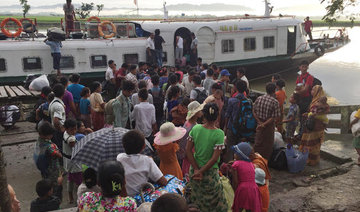
UN’s top court opens Myanmar Rohingya genocide case

Updated 6 sec ago
Follow

UN’s top court opens Myanmar Rohingya genocide case

  • The Gambia filed a case against Myanmar at the UN’s top court in 2019
  • Verdict expected to impact Israel’s genocide case over war on Gaza

DHAKA: The International Court of Justice on Monday opened a landmark case accusing Myanmar of genocide against its mostly Muslim Rohingya minority.

The Gambia filed a case against Myanmar at the UN’s top court in 2019, two years after a military offensive forced hundreds of thousands of Rohingya from their homes into neighboring Bangladesh.

The hearings will last three weeks and conclude on Jan. 29.

“The ICJ must secure justice for the persecuted Rohingya. This process should not take much longer, as we all know that justice delayed is justice denied,” said Asma Begum, who has been living in the Kutupalong refugee camp in Bangladesh’s Cox’s Bazar district since 2017.

A mostly Muslim ethnic minority, the Rohingya have lived for centuries in Myanmar’s western Rakhine state but were stripped of their citizenship in the 1980s and have faced systemic persecution ever since.

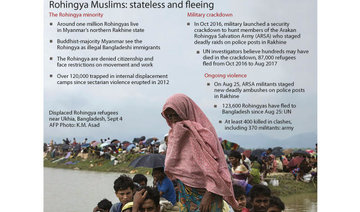
In 2017 alone, some 750,000 of them fled military atrocities and crossed to Bangladesh, in what the UN has called a textbook case of ethnic cleansing by Myanmar.

Today, about 1.3 million Rohingya shelter in 33 camps in Cox’s Bazar, turning the coastal district into the world’s largest refugee settlement.

“We experienced horrific acts such as arson, killings and rape in 2017, and fled to Bangladesh,” Begum told Arab News.

“I believe the ICJ verdict will pave the way for our repatriation to our homeland. The world should not forget us.”

A UN fact-finding mission has concluded that the Myanmar 2017 offensive included “genocidal acts” — an accusation rejected by Myanmar, which said it was a “clearance operation” against militants.

Now, there is hope for justice and a new future for those who have been displaced for years.

“We also have the right to live with dignity. I want to return to my homeland and live the rest of my life in my ancestral land. My children will reconnect with their roots and be able to build their own future,” said Syed Ahmed, who fled Myanmar in 2017 and has since been raising his four children in the Kutupalong camp.

“Despite the delay, I am optimistic that the perpetrators will be held accountable through the ICJ verdict. It will set a strong precedent for the world.”

The Myanmar trial is the first genocide case in more than a decade to be taken up by the ICJ. The outcome will also impact the genocide case that Israel is facing over its war on Gaza.

“The momentum of this case at the ICJ will send a strong message to all those (places) around the world where crimes against humanity have been committed,” Nur Khan, a Bangladeshi lawyer and human rights activist, told Arab News.

“The ICJ will play a significant role in ensuring justice regarding accusations of genocide in other parts of the world, such as the genocide and crimes against humanity committed by Israel against the people of Gaza.”