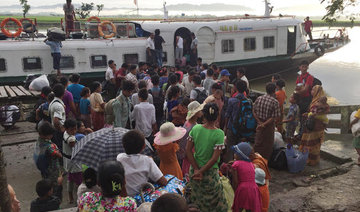
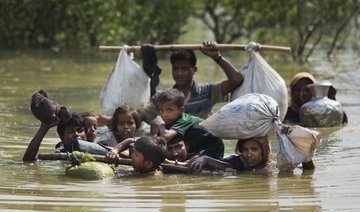
ANKARA: As nearly 150,000 Rohingya Muslims have fled to neighboring Bangladesh and tens of thousands were internally displaced due to a risk of ethnic cleansing in Myanmar, Turkey extends a helping hand to the Muslim minority on humanitarian and diplomatic platforms.
Following President Recep Tayyip Erdogan’s telephon conversation with Myanmar State Counselor Aung San Su Kyi on Monday, Myanmar allowed Turkish Cooperation and Coordination Agency (TIKA), a Turkish aid agency, to distribute 1,000 tons of aid to Rohingya Muslims in Rakhine State, Turkey’s presidential spokesman Ibrahim Kalin announced. Kalin also said that Turkey plans to deliver aid initially to 100,000 families in coordination with the governments of Myanmar and Bangladesh.
TIKA will be the first foreign agency to distribute aid to the Rohingya despite the Myanmar government’s doubts about the international aid organizations that were accused by Kyi of helping terrorism in the country.
On the diplomatic front, Turkish Foreign Minister Mevlut Cavusoglu and Turkey’s First Lady Emine Erdogan are expected to visit Cox’s Bazar district in Bangladesh’s border with Myanmar on Sept. 6-8 to observe the on-site situation of thousands of Rohingya who have taken shelter there. In a speech in Istanbul at the weekend, Erdogan accused Myanmar of committing genocide against Muslims.
Dr. Altay Atli, a research associate specializing on the Asia-Pacific region at Sabanci University's Istanbul Policy Center, said humanitarian aid has become a crucial instrument of Turkish foreign policy and a major source of Turkey’s normative power abroad.
“In 2016, Turkey was the second largest source of humanitarian aid in the world, with a total of $6 billion distributed to various regions in need,” Atli told Arab News. According to Atli, Turkey’s leading role in the Rohingya issue has two components: Humanitarian aid, including an open check offered to Bangladesh to cover the costs of the refugees, and diplomatic initiatives, such as taking the issue to the UN and mobilizing the Organisation of Islamic Cooperation (OIC). “These two components, implemented together, can be effective,” he said.
Turkey also brought the Myanmar issue to the agenda of Asian Parliamentary Assembly’s Standing Committee meeting on Social and Cultural Affairs that was held through Aug. 31–Sept. 2, and was attended by various delegations including UAE. On the insistence of the Turkish delegation, Myanmar is included in the list of countries on the verge of humanitarian catastrophe, besides Syria, Iraq, and Yemen.
But, Atli underlined, Turkey cannot solve the problem on its own, as the Myanmar government needs to change the way it treats the Rohingya, and this requires coordinated action from the international community.
“The international community needs to show the Myanmar government that they need to solve this problem, otherwise there will be consequences including economic ones,” he said. Moreover, Atli believes Turkey’s aid to the region is perceived well by regional actors.
“Turkey is not seen as a rival or competitor in this region, but rather as a contributor, especially since Turkey’s expansive aid to the region after the tsunami disaster of 2004,” he said.
It is not the first time that Turkey is involved in humanitarian relief for Rohingya Muslims. Since 2012, when communal violence broke out between Buddhist and Muslim populations, Turkish aid agencies, NGOs and the government were very active in terms of humanitarian assistance, with high-level politicians visiting refugee camps and mediating with the government in Myanmar for the resolution of the crisis.
“Since the eruption of violence in Myanmar, Turkey used various platforms to draw attention to the plight of Rohingya Muslims. However, it is very hard to say at this point whether Turkey was single handedly able to mobilize the international community,” Senem Cevik, expert on political communication from University of California Irvine, told Arab News.
According to Cevik, the effects of Turkey’s efforts in mobilizing the international community will depend on Rohingya’s place in global agenda and news coverage.
“In the Myanmar case, the regime has blocked all UN aid to civilians with an exception of Turkey,” she said.
“At a critical time when there are multiple refugee crises across the globe and inept global response, Turkey’s eagerness to provide aid to Rohingya Muslims will be well received by the international community and it can be seen as Turkey’s compassion toward Muslim communities.”


![]()

Turkish aid agency offers a lifeline to Rohingya Muslims
Turkish aid agency offers a lifeline to Rohingya Muslims

Latest updates


© 2026 SAUDI RESEARCH & PUBLISHING COMPANY, All Rights Reserved And subject to Terms of Use Agreement.