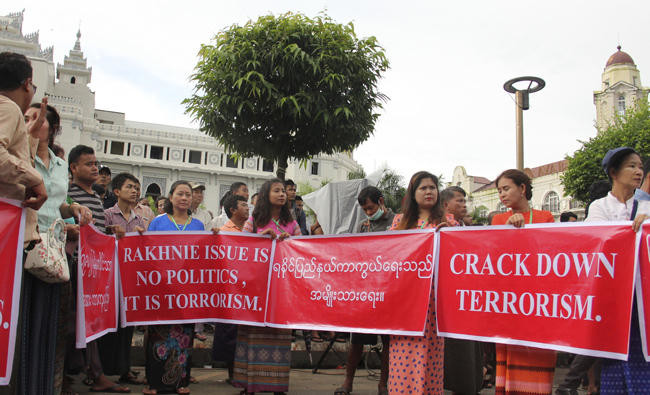
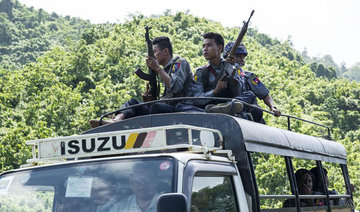
BANGKOK: Several hundred Buddhist nationalists, including monks, rallied in Myanmar’s largest city on Wednesday to urge stronger action against insurgents from the Muslim Rohingya minority for attacks on police last week.
The attacks in Rakhine state in western Myanmar have spiraled into chaotic violence, with more than 100 dead and villages torched.
At least 18,000 Rohingya have fled the violence and crossed into Bangladesh in less than a week, with hundreds stranded in a no man’s land at the countries’ border, the International Organization for Migration said Wednesday.
The army, responding to last Thursday’s attacks, launched what it called clearance operations against the insurgents, but advocates for the Rohingya say they are attacking and burning Rohingya villages, shooting civilians and causing others to flee.
The government blames Rohingya insurgents and their sympathizers for the continuing violence. Government figures put the death toll since last week at a minimum of 103, including 12 members of security forces, 77 people described as insurgents and 14 civilians. There were reports of additional deaths Wednesday.
Rohingya advocates fear the death toll for civilians is much higher.
Most of Myanmar’s estimated 1 million Rohingya live in northern Rakhine state. They face severe persecution in the Buddhist-majority country, which refuses to recognize them as a legitimate native ethnic minority, leaving them without citizenship and basic rights.
Longstanding tension between the Rohingya Muslims and ethnic Rakhine Buddhists erupted in bloody rioting in 2012. That set off a surge of anti-Muslim feeling throughout the country.
Wirathu, a Buddhist monk and leader of the anti-Muslim movement who is known for virulent sermons, told Wednesday’s protesters in Yangon that only the military can control the situation in northern Rakhine.
He criticized the civilian government of Aung San Suu Kyi for not responding quickly to the army’s call Tuesday for a meeting of the National Security and Defense Council, which could declare a state of emergency in Rakhine and give the military absolute authority to enforce it. The military holds a majority on the council, which was created by the 2008 military-drafted constitution.
“Only the military’s commander in chief can protect the lives and the properties of the people,” Wirathu said. “The military is the only one that can give a lesson to tame the Bengali terrorists.” Myanmar nationalists use the term Bengali for Rohingya because of a belief they migrated illegally from Bangladesh, even though many families have been in Myanmar for generations.
Wirathu also denounced international aid groups that the government has accused, without evidence, of giving assistance to the Rohingya insurgents. The allegations have circulated widely on social media.
The Information Ministry said Wednesday that 45 homemade bombs were detonated and seven villages, one security post and two neighborhoods in the township of Maungdaw were burned down on Sunday and Monday.
Maungdaw, in the northern part of Rakhine state, is a center of the violence, though villages over a much wider area were also hit.
Sanjukta Sahany, a spokeswoman for the International Organization for Migration in Cox’s Bazar, Bangladesh, on the border with Myanmar, said the Rohingya crisis was not just an issue between Myanmar and Bangladesh but of international concern.
Ali Hossain, Cox’s Bazar district’s top government official, told The Associated Press that its resources were under huge stress after some 87,000 Rohingya entered Bangladesh since October last year and another 18,000 since last Friday.
The UN refugee organization on Tuesday urged Bangladesh to continue to allow Rohingya fleeing violence to seek safety. It said it was ready to help Bangladesh with assistance for the refugees.
Bangladesh Prime Minister Sheikh Hasina asked the United States on Wednesday to pressure Myanmar so its government would stop pushing Rohingya toward Bangladesh, her spokesman said.
Hasina made the request during talks with Alice Wells, US acting assistant secretary of state for South and Central Asia, said Ihsanul Karim, Hasina’s press secretary.
The insurgent raids last Thursday were deadlier than an attack by the militants on three border posts last October that killed nine policemen and set off months of brutal counterinsurgency operations against Rohingya communities. Human rights groups accused the army of carrying out massive abuses, including killing, rape and burning down more than 1,000 homes and other buildings.

Myanmar Buddhists seek tougher action against Rohingya
Hegseth says US ‘can’t stop everything’ that Iran fires even as he asserts air dominance
WASHINGTON (AP): Defense Secretary Pete Hegseth acknowledged Wednesday that some Iranian air attacks may still hit their targets even as he asserted that US military superiority is quickly giving it control of the Islamic Republic’s airspace.
The US has spared “no expense or capability” to enhance air defense systems to protect American forces and allies in the Middle East, Hegseth told reporters at the Pentagon days after the US and Israel attacked Iran in a war that has widened throughout the region.
“This does not mean we can stop everything, but we ensured that the maximum possible defense and maximum possible force protection was set up before we went on offense,” he said.
The acknowledgement that additional drone or missile strikes in the region could cause damage and harm to troops comes as President Donald Trump and top defense leaders have warned that additional American casualties were expected in a conflict that could last months.
US service members “remain in harm’s way, and we must be clear-eyed that the risk is still high,” Gen. Dan Caine, chairman of the Joint Chiefs of Staff, said at the same press conference.
Six soldiers were killed when an Iranian drone strike hit an operations center Sunday in the heart of a civilian port in Kuwait, miles away from the main Army base. The husband of one of the slain soldiers, who was part of a supply and logistics unit based in Iowa, says the center was a shipping container-style building and had no defenses.
Hegseth also signaled a possible longer time frame for the conflict than has previously been floated by the Trump administration, saying it could last eight weeks but that the US has the munitions and the equipment to beat Iran in a war of attrition. He declined to set a specific time range, saying the specific duration of the war would depend on how it unfolds.
“You can say four weeks, but it could be six, it could be eight, it could be three,” he said. “Ultimately, we set the pace and the tempo. The enemy is off balance, and we’re going to keep them off balance.”
More forces continue to arrive in the region, including jet fighters and bombers, Hegseth said, and the US “will take all the time we need to make sure that we succeed.”
Tehran has vowed to completely destroy the Middle East’s military and economic infrastructure — signaling the war was nowhere near over and could expand further.
President Donald Trump said this week the campaign are likely to last four to five weeks but that he was prepared “to go far longer than that.”
The US has spared “no expense or capability” to enhance air defense systems to protect American forces and allies in the Middle East, Hegseth told reporters at the Pentagon days after the US and Israel attacked Iran in a war that has widened throughout the region.
“This does not mean we can stop everything, but we ensured that the maximum possible defense and maximum possible force protection was set up before we went on offense,” he said.
The acknowledgement that additional drone or missile strikes in the region could cause damage and harm to troops comes as President Donald Trump and top defense leaders have warned that additional American casualties were expected in a conflict that could last months.
US service members “remain in harm’s way, and we must be clear-eyed that the risk is still high,” Gen. Dan Caine, chairman of the Joint Chiefs of Staff, said at the same press conference.
Six soldiers were killed when an Iranian drone strike hit an operations center Sunday in the heart of a civilian port in Kuwait, miles away from the main Army base. The husband of one of the slain soldiers, who was part of a supply and logistics unit based in Iowa, says the center was a shipping container-style building and had no defenses.
Hegseth also signaled a possible longer time frame for the conflict than has previously been floated by the Trump administration, saying it could last eight weeks but that the US has the munitions and the equipment to beat Iran in a war of attrition. He declined to set a specific time range, saying the specific duration of the war would depend on how it unfolds.
“You can say four weeks, but it could be six, it could be eight, it could be three,” he said. “Ultimately, we set the pace and the tempo. The enemy is off balance, and we’re going to keep them off balance.”
More forces continue to arrive in the region, including jet fighters and bombers, Hegseth said, and the US “will take all the time we need to make sure that we succeed.”
Tehran has vowed to completely destroy the Middle East’s military and economic infrastructure — signaling the war was nowhere near over and could expand further.
President Donald Trump said this week the campaign are likely to last four to five weeks but that he was prepared “to go far longer than that.”
© 2026 SAUDI RESEARCH & PUBLISHING COMPANY, All Rights Reserved And subject to Terms of Use Agreement.