

UNICEF says Israel denied entry to aid convoy for Gaza 

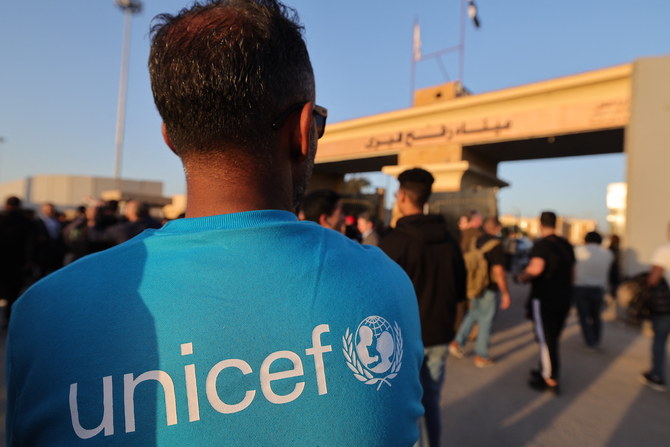
A UNICEF worker looks on by Egypt's eastern border with the Gaza Strip during the visit of UN security council ambassadors in Rafah on December 11, 2023. (File/AFP)
Short Url
Updated 15 June 2024
Follow

UNICEF says Israel denied entry to aid convoy for Gaza 

  • UNICEF spokesman James Elder said such denials are “consistent and relentless,” with hundreds of similar incidents documented

LONDON: UNICEF has reported that one of its aid convoys was denied entry to northern Gaza this week, despite possessing all the necessary documents, in what the organization’s spokesman described as a common occurrence.

In an interview with the BBC’s “Today” program, UNICEF spokesman James Elder, who was in one of the aid lorries attempting to travel from southern to northern Gaza on Wednesday, said that despite having all the required paperwork it took the convoy 13 hours to travel approximately 40 kilometers (30 miles). After spending eight hours at checkpoints, they were ultimately denied entry to northern Gaza, he said, “so 10,000 children who were going to benefit from nutritional supplies, medical supplies, did not.”

Elder said the reasons behind the decision were unclear, but noted that such denials are “consistent and relentless,” with hundreds of similar incidents documented.

The Israeli army responded by claiming that the documentation for the UNICEF vehicle in the convoy was incorrectly filled out and accused Elder of presenting a “partial picture.”

While waiting at one of the checkpoints, Elder said he witnessed a group of around eight men attempting to catch fish with a single net. “Suddenly we heard a tank coming down, we heard... automatic fire,” he said. “We saw two fishermen fleeing, one was shot in the back, one in the neck.”

The UN spokesman added that the WHO, which had paramedics in the convoy, requested permission from the Israeli Defense Forces to provide medical support to the injured men, but this request was denied. He later saw the fishermen’s wounds when their colleagues were allowed to retrieve their bodies.

Elder, who had last been in Gaza six weeks previously, said the situation is far worse now. “It’s the first time I’ve seen a real level of despondency,” he said. “They’re so despairing, they’re so broken, they’ve lost so many family members. They have nothing left.

“It’s very unsettling to see a child when their parent can’t protect them, it’s heartbreaking when a parent can’t protect their child,” he continued. “Increasingly I’m hearing people say, ‘I just want this over, I’m happy if there’s an airstrike on me tonight.’”


Sudan returns to east African bloc after two years

Updated 6 sec ago
Follow

Sudan returns to east African bloc after two years

  • Decision comes two years after Sudan froze its IGAD membership over a decision to invite rival paramilitary chief Mohamed Hamdan Dagalo to a summit
KHARTOUM: Sudan on Monday announced it was returning to east African bloc IGAD, two years after freezing its membership over a decision to invite rival paramilitary chief Mohamed Hamdan Dagalo to a summit.
“The government of the Republic of Sudan will resume its full activity in the membership” in the Djibouti-based Intergovernmental Authority on Development (IGAD), the foreign ministry said in a statement.
Sudan had suspended its membership in January 2024 after the bloc invited the head of rival paramilitary group the Rapid Support Forces (RSF) to a summit in Uganda to discuss the country’s brutal conflict.
The RSF has been at war with Sudan’s army since April 2023 in a conflict that has killed tens of thousands, displaced 11 million and caused one of the world’s worst humanitarian crises.
The foreign ministry cited a statement by IGAD which reaffirmed “its full recognition of Sudan’s sovereignty and the unity of its lands and people” and pledged “non-interference in member states’ internal affairs.”
The decision to rejoin IGAD follows a meeting in January between the bloc’s executive secretary, Workneh Gebeyehu, and Sudan’s Prime Minister Kamil Idris.
Following the meeting, the bloc issued a statement saying it “condemns all forms of violations committed by the Rapid Support Forces and reaffirms its full support for the unity and sovereignty of the Republic of the Sudan, as well as its existing national institutions.”
The nearly three-year conflict has effectively split Sudan between army-controlled areas in the north, east and center, and those controlled by the paramilitaries in the west and parts of the south.
The RSF has also formed a rival parallel administration in Nyala, the South Darfur state capital, but it has received no international recognition.
IGAD on Monday welcomed Sudan’s decision to return, describing it as “a reaffirmation of regional solidarity and collective commitment to peace, stability, and cooperation across the region.”