

UK ‘morally incoherent’ in supplying arms to Israel, aid to Gaza: Oxfam chief

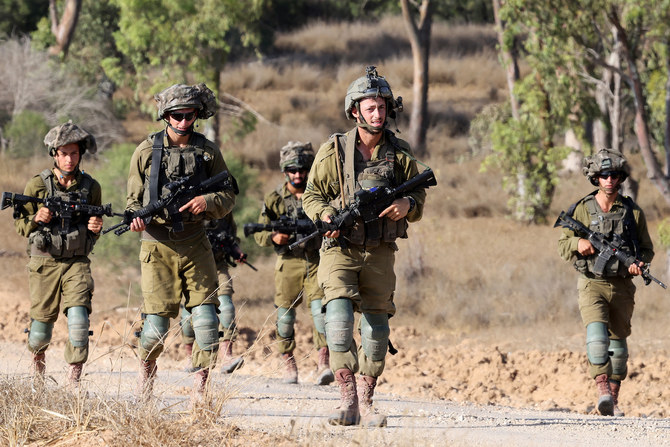
Israeli army soldiers patrol around a position along Israel's southern border with the Gaza Strip on June 13, 2024. (File/AFP)
Short Url
Updated 16 June 2024
Follow

UK ‘morally incoherent’ in supplying arms to Israel, aid to Gaza: Oxfam chief

  • Halima Begum criticizes stance of Britain, Western leaders

LONDON: Providing arms to Israel while offering humanitarian aid to Gaza at the same time is “intellectually and morally incoherent,” the head of Oxfam GB has told The Guardian.

The remarks followed Oxfam’s approval to formally intervene in a legal challenge opposing UK arms sales to Israel.

The judicial review is being brought by the Palestinian human rights group Al-Haq and the UK-based Global Legal Action Network.

Israel’s assault on Gaza has killed more than 37,000 Palestinians, the majority being women and children, according to the Gazan Health Ministry.

Recent government data shows that the UK issued 108 arms export licenses to Israel between the Oct. 7 attacks and May 31, without rejecting or revoking any during this period.

Halima Begum, Oxfam GB’s chief executive, who recently returned from Israel and the occupied West Bank, criticized the UK’s stance.

She told The Guardian: “Whether you say they are components or whole weapons (being sold) is a moot point, because individual components collectively constitute these devices that are killing so many innocent people.

“The UK needs to stop selling these arms. The government can’t simultaneously give humanitarian aid and talk about its aspirations for peace in the region, then also ship bombs — it’s intellectually and morally incoherent.

“That the law doesn’t prevent the trade seems immaterial. If you knowingly sell weapons that are being used to kill thousands of innocent children and their parents, why would you continue?”

While Begum was unable to enter Gaza due to Israel’s attack on Rafah, she said she was left “shell-shocked” after hearing firsthand accounts of the humanitarian crisis from Palestinian colleagues evacuated from the enclave.

She highlighted historical precedents for the UK and US refusing to arm Israel, noting decisions in 1982 and 2002.

Begum said: “Margaret Thatcher halted weapons exports to Israel during the Lebanon War. Ronald Reagan suspended shipments of cluster munitions in July 1982 and he was reportedly so shocked by images of dismembered Palestinian children in a bombardment on Aug. 12 that he warned Israeli PM Menachem Begin ‘our entire future relations are at stake if this continues.’

“Israel ordered a complete ceasefire before the day was out. So, it wouldn’t be the first time a British or US government has drawn a moral line.”

She added: “Gazan children are being bombed, suffering from malnutrition and facing potential famine and the UK still can’t constrain the Israeli military. It defies belief we’d support this action; our humanity seems to be seeping away.”

Begum also noted that the Global South was largely unified on the need for action regarding Gaza and that it appeared to be “only Western leaders that don’t see what is morally the right thing to do.”

She added: “If you have a friend and their behavior is atrocious, you’re still able to say, ‘Look, as friends, you shouldn’t be doing that.’ That doesn’t mean you can’t offer your support to a friend.

“I feel as though that whole construction around Israel’s right to self-defense, every country has a right to defend themselves, but not at the cost of humanitarian law being ripped up in shreds, without any reference to human rights on the ground.”

The UK government declined to comment.


EU leaders to reassess US ties despite Trump U-turn on Greenland

Updated 22 January 2026
Follow

EU leaders to reassess US ties despite Trump U-turn on Greenland

  • Diplomats stressed that, although Thursday’s emergency EU talks in Brussels would now lose some of their urgency, the longer-term issue of how to handle the relationship with the US remained

BRUSSELS: EU leaders will rethink their ties with the US at an emergency summit on Thursday after Donald Trump’s threat of tariffs and even military action to ​acquire Greenland badly shook confidence in the transatlantic relationship, diplomats said.
Trump abruptly stepped back on Wednesday from his threat of tariffs on eight European nations, ruled out using force to take Greenland, a semi-autonomous territory of NATO ally Denmark, and suggested a deal was in sight to end the dispute.
German Chancellor Friedrich Merz, welcoming Trump’s U-turn on Greenland, urged Europeans not to be too quick to write off the transatlantic partnership.
But EU governments remain wary of another change of mind by a mercurial president who is increasingly seen as a bully that Europe will have to stand up to, and they are focused on coming up with a longer-term plan on how to deal with the ‌United States under this ‌administration and possibly its successors too.
“Trump crossed the Rubicon. He might do ‌it ⁠again. ​There is no ‌going back to what it was. And leaders will discuss it,” one EU diplomat said, adding that the bloc needed to move away from its heavy reliance on the US in many areas.
“We need to try to keep him (Trump) close while working on becoming more independent from the US It is a process, probably a long one,” the diplomat said.
EU RELIANCE ON US
After decades of relying on the United States for defense within the NATO alliance, the EU lacks the needed intelligence, transport, missile defense and production capabilities to defend itself against a possible Russian attack. This gives the US substantial leverage.
The US ⁠is also Europe’s biggest trading partner, making the EU vulnerable to Trump’s policies of imposing tariffs to reduce Washington’s trade deficit in goods, and, as in ‌the case of Greenland, to achieve other goals.
“We need to discuss where ‍the red lines are, how we deal with this bully ‍across the Atlantic, where our strengths are,” a second EU diplomat said.
“Trump says no tariffs today, but does ‍that mean also no tariffs tomorrow, or will he again quickly change his mind? We need to discuss what to do then,” the second diplomat said.
The EU had been considering a package of retaliatory tariffs on 93 billion euros ($108.74 billion) on US imports or anti-coercive measures if Trump had gone ahead with his own tariffs, while knowing such a step would harm Europe’s economy as well ​as the United States.
WHAT’S THE GREENLAND DEAL?
Several diplomats noted there were still few details of the new plan for Greenland, agreed between Trump and NATO Secretary General Mark Rutte late on ⁠Wednesday on the sidelines of the World Economic Forum in Davos, Switzerland.
“Nothing much changed. We still need to see details of the Greenland deal. We are a bit fed up with all the bullying. And we need to act on a few things: more resiliency, unity, get our things together on internal market, competitiveness. And no more accepting tariff bullying,” a third diplomat said.
Rutte told Reuters in an interview in Davos on Thursday that under the framework deal he reached with Trump the Western allies would have to step up their presence in the Arctic.
He also said talks would continue between Denmark, Greenland and the US on specific issues.
Diplomats stressed that, although Thursday’s emergency EU talks in Brussels would now lose some of their urgency, the longer-term issue of how to handle the relationship with the US remained.
“The approach of a united front in solidarity with Denmark and Greenland while focusing on de-escalation and finding an off-ramp has worked,” a fourth EU diplomat said.
“At the ‌same time it would be good to reflect on the state of the relationship and how we want to shape this going forward, given the experiences of the past week (and year),” he said.