Ukraine peace summit says ‘dialogue between all parties’ needed to end war

1 / 2
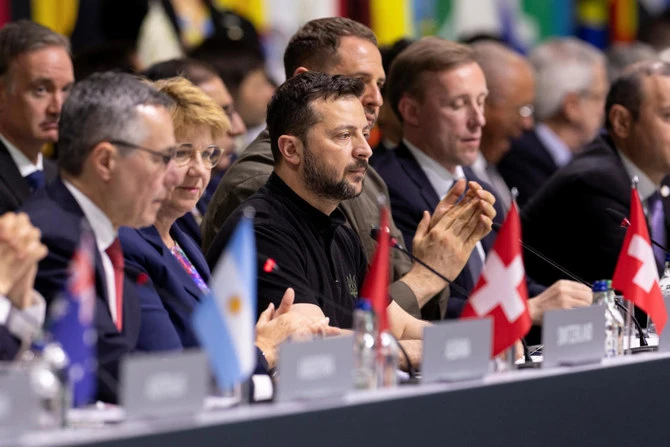
Ukrainian President Volodymyr Zelensky, center, leads other officials during the plenary session of the Summit on Peace in Ukraine in Stansstad near Lucerne, Switzerland on June 16, 2024. (Reuters)
2 / 2
World leaders attending the Ukraine peace summit in Switzerland on June 15, 2024, join a family picture on June 15, 2024. (Pool/AFP)
Short Url
Updated 17 June 2024
Follow

Ukraine peace summit says ‘dialogue between all parties’ needed to end war

  • More than 90 countries had gathered in the Swiss resort of Burgenstock for the summit
  • Moscow was not invited and has rejected the summit as ‘absurd’ and pointless

BURGENSTOCK, Switzerland: Dozens of countries said Sunday that Ukraine’s “territorial integrity” should be respected in any peace deal to end the war, as they said “dialogue between all parties” would be necessary for a lasting settlement.
In a final communique issued at the end of a major two-day diplomatic summit in Switzerland, the vast majority of countries also backed a call for the full exchange of captured soldiers and return of deported Ukrainian children.
But not all attendees backed the document, with India, Saudi Arabia and the United Arab Emirates among those not included in a list of supporting states displayed on screens at the summit.
“We believe that reaching peace requires the involvement of and dialogue between all parties,” the document stated.
It added: “We reaffirm our commitment to ... the principles of sovereignty, independence, and territorial integrity of all states, including Ukraine, within their internationally recognized borders.”
More than 90 countries had gathered in the Swiss resort of Burgenstock for the summit, dedicated to discussing Kyiv’s proposals for a route out of the conflict.
Moscow was not invited and has rejected the summit as “absurd” and pointless.
Kyiv had worked hard to secure attendance from countries that maintain warm relations with Russia.
The final document also called for all prisoners of war to be released in a “complete exchange” and for all Ukrainian children who had been “deported and unlawfully displaced” to be returned to Ukraine.
Kyiv accuses Russia of abducting almost 20,000 children from parts of the east and south of the country that its forces took control of.
Working groups at the summit also addressed the issues of global food security and nuclear safety.
“Food security must not be weaponized in any way,” the declaration stated, adding that access to ports in the Black and Azov Seas was “critical” for global food supply.
And the countries also called for Ukraine to have “full sovereign control” over the Zaporizhzhia nuclear power plant.
Located in the south of Ukraine, the facility is Europe’s largest nuclear energy site and has been controlled by Russian forces since early in the war.
Troops guard Bangladesh depots as fuel crunch hits Asia

Updated 2 sec ago
Follow

Troops guard Bangladesh depots as fuel crunch hits Asia

  • The oil price spike caused by the war in the Middle East has sparked unrest in Bangladesh and exasperation at petrol pumps around Asia
DHAKA: The oil price spike caused by the war in the Middle East has sparked unrest in Bangladesh and exasperation at petrol pumps around Asia, where many economies are heavily dependent on fossil fuel imports.
Even as governments move to limit the impact on fuel prices, lines have formed at petrol stations in countries including Vietnam, Pakistan and the Philippines, although the situation remains stable elsewhere.
In Bangladesh — which imports 95 percent of its oil and gas needs — the military has been deployed at major oil depots, as police patrol in and around filling stations.
“We haven’t received supply from the depot, but the bike riders weren’t convinced and vandalized the station,” said petrol station worker Ashrafuzzaman Dulal told AFP, describing violence on Sunday.
On Tuesday his station Shahjahan Traders, one of the oldest in the capital Dhaka, had hung a banner apologizing because its stock had run out.
The South Asian nation of 170 million people has started fuel rationing, sent students home and scrapped celebratory light displays over the energy crunch.
One man was killed on Saturday night in the southern Bangladeshi district of Jhenaidah after an altercation over refueling with staff.
Following the 25-year-old’s death, angry crowds torched three buses and vandalized a filling station, police said.
- ‘So, so angry’ -
On Tuesday, queues stretched for 1.5 kilometers (nearly one mile) through Dhaka’s city center.
“My boss left the car here and took a rickshaw to reach his destination,” Kamrul Hasan, who was waiting in a vehicle almost at the end of the queue, told AFP.
Filling station worker Akhtar Hossain said he had not stopped for hours.
“Even during the Gulf War, we didn’t experience this sort of rush,” Hossain told AFP.
Oil prices fell Tuesday after US President Donald Trump said the US-Israel war on Iran could end “very soon.”
The previous day, the price of benchmark crude had rocketed past $100 a barrel — its highest level since Russia’s invasion of Ukraine in 2022.
The market instability came as Iran targeted the crude-rich Gulf with missile and drone barrages.
Maritime traffic in the Strait of Hormuz — a key Gulf waterway through which a fifth of global crude passes — has also all but halted since the war broke out.
Thousands of motorbike riders queued for fuel Tuesday in Vietnam, where prices for unleaded gasoline have surged more than 20 percent.
Vietnam has so far avoided mass shortages, with the government scraping duties on many imported petroleum products.
A 57-year-old who gave his name as Tuan told AFP at a Hanoi petrol station that he was “so, so angry.”
“I have been waiting in line for almost one hour. Then my turn came, and they said their system is down,” he said as dozens of drivers waited but others gave up.
- Myanmar price spike -
Vehicles also lined up in scorching heat at Philippine petrol stations this week, as officials warned against hoarding fuel, with similar scenes unfolding in Pakistan and Sri Lanka.
Enrico Guda, a gas station attendant in Metro Manila, said the station had double its usual daily workload as people rushed to fuel up before prices jumped.
In Myanmar, which imports 90 percent of its fuel oil and has long suffered from a fragile energy supply chain owing to the civil war consuming the country, traffic curbs are in place.
From Saturday, half of private vehicles have been ordered off the roads each day to preserve oil stocks.
“Some drivers depend on their vehicles for work and survival... the new system has made it harder for them to run their businesses,” said Hla Htay, 56, a car rental business owner.
In the Myanmar frontier town of Tachileik, an AFP reporter saw signs cross-border supplies from Thailand had been cut — with some petrol stations shut last week after an up-to threefold price spike the day before.
In several other Asian countries, from Japan to Indonesia, as well as China, India and Afghanistan, panic appears not yet to have hit, apart from a few sporadic queues for petrol.
“I used to fill up regularly once a week, but now I try to fill up whenever I find a cheaper gas station,” South Korean businessman Lee In-tae, 42, told AFP in Seoul.