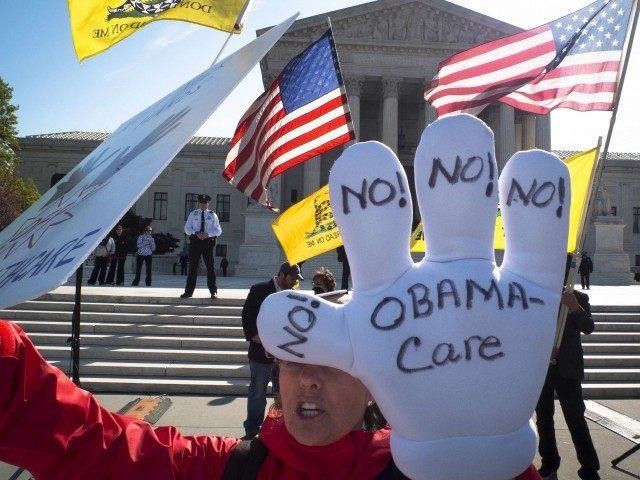
Only a cat seems to have more lives than ‘Obamacare’

Protests held outside the supreme court. (AFP)
Updated 29 July 2017
Follow

Only a cat seems to have more lives than ‘Obamacare’

WASHINGTON: The Senate's surprise vote was only the latest narrow escape for "Obamacare," the social program with nine lives that has survived dozens of congressional attempts to kill it, and two Supreme Court challenges.
Not to mention the massive computer crash when HealthCare.gov was launched.
The saga of the Affordable Care Act illustrates how difficult it is to do away with a government program once millions are benefiting. In the latest episode, three Republican lawmakers broke with their president and leadership to join Democrats and deliver a dramatic defeat to repeal efforts.
Sens. John McCain of Arizona, Susan Collins of Maine and Lisa Murkowski of Alaska were backed by GOP governors worried about constituents losing coverage, hospitals that didn't want to go back to being stuck with bills for the uninsured, doctors trying to keep patients healthier, and people with pre-existing conditions fearful they might be exposed to coverage denials because they let their policy lapse for a few months.
"It came down to people who didn't like 'Obamacare' realizing this was going to take away their chances for coverage," said former Rep. Henry Waxman, a Los Angeles Democrat who helped write much of the 2010 overhaul under former President Barack Obama.
Despite its problems — rising premiums, shaky insurance markets — the ACA extended coverage to about 20 million people, reducing the nation's uninsured rate to a historic low near 9 percent. It delivered by combining two approaches: subsidized private insurance, and a Medicaid expansion for low-income people that 31 states have accepted. The GOP bills would have dramatically reduced spending on both, leaving anywhere from 16 million to more than 30 million uninsured. The legislation also threatened to undermine protections for people with medical problems.
Never hugely popular, "Obamacare" actually saw an increase in support as the "repeal and replace" debate intensified.
An Associated Press-NORC Center for Public Affairs Research poll picked up what could potentially be a bigger shift in public attitudes. The July poll showed that 62 percent of Americans think it's a federal government responsibility to make sure all Americans have health insurance, a 10 point increase from 52 percent who said that in March. Among independents, there was a 13-point increase.
H.W. Brands, a professor of U.S. history at the University of Texas at Austin, said people have little investment in a program's success before they experience its benefits.
"Whichever fan of the welfare state first applied the term 'entitlements' to these benefits was brilliant," said Brands. "People come to think they are entitled to them, and heaven help the politician who tries to take them away."
Said Robert Blendon of the Harvard T.H. Chan School of Public Health: "Getting rid of the law became getting rid of coverage for 30 million people. When faced with taking insurance cards away from 20 million to 30 million people, dislike of the law in no way justified taking those cards away."
Obama's office issued a statement Friday calling attention to the broader benefits of the ACA, including free preventive care and a greater focus on improving the quality of hospitals.
Those get less notice than the coverage expansion, but affect more people. For example, contraceptives are now provided free of charge to most women, a policy the Trump administration is seeking to narrow. And when people with employer coverage get routine colonoscopies, they no longer face a copayment for the test.
"It's about the dreams protected, and the untold misery and ruin prevented," said the statement from Obama's office.
President Donald Trump, however, does not seem ready to acknowledge anything good in his predecessor's signature domestic program.
Trump talks about "Obamacare" as if it's on the verge of collapse, which does not reflect reality everywhere. The Medicaid expansion, which has added about 11 million to the insurance rolls, operates more or less on automatic pilot even if costs are a concern. Private insurance markets are in trouble in some states, but not in others. People eligible for ACA subsidies are shielded from premium increases, but not those who buy coverage outside the health law's markets, many of whom face another year of double-digit premium hikes.
Trump tweeted what appeared to be a veiled threat after the Senate vote: "Let ObamaCare implode, then deal. Watch!"
Andy Slavitt, a tech-savvy executive who helped revamp HealthCare.gov for Obama, said both political parties should essentially enter into peace negotiations in the seven-year health care wars.
"It is time for it to stop being Obamacare or Trumpcare," said Slavitt. "We need to make it something that everybody owns."
Much of the public and the private sector already seem headed in that direction, said Slavitt. The question is whether the politicians will join them. Democrats shouldn't be crowing, he said.
"Republicans are the majority party," said Slavitt. "Unless (Democrats) take in ideas from the Republican party and are open to them, we are not going to get to a bipartisan agreement."


Florida braces for frost and possible snow flurries as winter storms hit other parts of the US

Updated 59 min 5 sec ago
Follow

Florida braces for frost and possible snow flurries as winter storms hit other parts of the US

  • The worst seems to be heading toward the Carolinas, but the Sunshine State’s humans, animals and even plants are preparing for winter weather

MIAMI: Florida won’t be getting hit with massive blankets of snow and ice like the rest of the US, but even frosty windshields and a few flurries can feel like Antarctica to people with permanent sandal tans.
The Midwest and South have been getting major winter storms for several days, and a giant cyclone forecast in the Atlantic Ocean is expected to pull that cold weather east as a powerful blizzard this weekend. The worst seems to be heading toward the Carolinas, but the Sunshine State’s humans, animals and even plants are preparing for winter weather.
Florida could experience record cold
Ana Torres-Vazquez, a forecaster with the National Weather Service in Miami, said a cold front earlier this week has already caused temperatures to dip some, but the region could experience record-setting cold this weekend.
“It looks like temperatures across South Florida are dipping into the 30s (Fahrenheit) for most of the metro area and maybe into the 20s for areas near Lake Okeechobee,” Torres-Vazquez said. “And then the windchill could make those temperatures feel even cooler.”
Residents of South Florida are less likely to have heavy coats and other winter clothes, so Torres-Vazquez said it’s important to layer up lighter clothing and limit time spent outside.
Moving north, Tony Hurt, a National Weather Service forecaster for the Tampa Bay area, said there’s a 10 to 20 percent chance of snowfall in that region this weekend.
“Most likely if there’s any snow that does actually materialize, it’ll be primarily in the form of flurries, no accumulations,” Hurt said.
The last two times the area got snow was flurries in January 2010 and December 1989. The record for snowfall was in January 1977, with 2 inches (5 centimeters) of snow about 20 miles (32 kilometers) east of Tampa.
Despite the possibility of snow, Tampa will host the annual Gasparilla Pirate Fest on Saturday. And on Sunday, the Tampa Bay Lightning are set to host the Boston Bruins for an outdoor NHL game at the Tampa Bay Buccaneers’ home NFL stadium.
Few tourists visiting Florida will be swimming in the ocean or laying out on sunny beaches this weekend, but many attractions will remain open. Most of Walt Disney World and Universal Orlando will operate normally, though their water parks will be closed. Most of the state’s zoos and animal parks will also remain open while keepers take steps to protect the inhabitants.
Zoo keepers working to keep animals safe and warm
Zoo Miami spokesman Ron Magill said keepers have been setting up heaters and moving reptiles and smaller mammals to indoor enclosures, while primates like chimpanzees and orangutans are given blankets to keep themselves warm. Big cats and large hoofed animals generally do well in colder temperatures and don’t require much assistance from keepers.
“It can be invigorating for animals like the tiger, so they’ll actually become more active,” Magill said.
Outside the safety of the zoo, Florida’s native wildlife has evolved and learned to survive occasional cold snaps, though casualties will still occur, Magill said. Manatees, for example, have spent decades congregating at the warm-water outflows of about a dozen power plants around Florida.
But invasive, nonnative animals like iguanas and other exotic reptiles will suffer the most, Magill said. Iguanas in South Florida famously enter a torpid state during cold periods and even fall out of trees. They usually wake up when the temperature increases, but many will die after more than a day of extreme cold.
“At the end of the day, they don’t belong here, and that might be nature’s way of trying to clean that up a little bit,” Magill said. “That is a part of natural selection.”
Protecting crops is a priority for farmers
Florida’s agriculture industry is also bracing for the cold. Farmers are working to safeguard their crops as winter harvest continues and spring planting begins in some areas, Florida Fruit & Vegetable Association spokeswoman Christina Morton said.
“Preparations vary by crop and include harvesting and planting ahead of the freeze, increasing water levels in ditches, using overhead irrigation, and, in some cases, deploying helicopters to protect sensitive fields,” Morton said.
The Florida deep freeze comes as the arctic blast from Canada also spreads into southern states where thousands of people remain without power to heat their homes, and people in mid-Atlantic states prepare for possible blizzard conditions as a new storm is expected to churn along the East Coast.
Temperatures in hard-hit northern Mississippi will feel as cold as minus 5 degrees Fahrenheit (minus 21 degrees Celsius) when the expected strong winds are factored in, National Weather Service forecasters say. People in a large part of the southeastern US were under a variety of alerts warning of extremely cold weather on the way.
The storm expected to hit the Eastern Seaboard has prompted more warnings in the Carolinas and nearby states. That storm is expected to bring heavy snow and strong winds, which could create “dangerous, near-blizzard conditions,” the weather service warned.