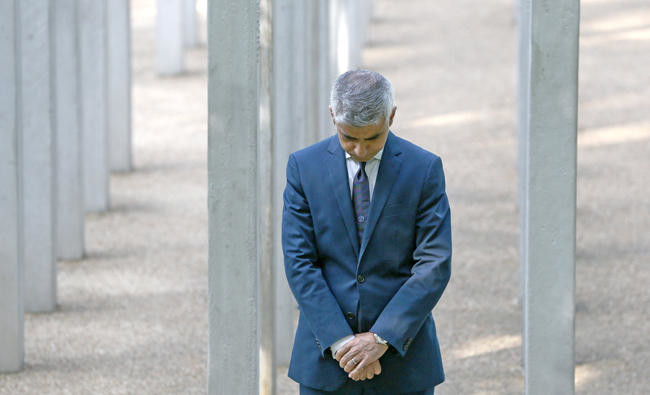
LONDON: The Mayor of London Sadiq Khan has been accused of “flip-flopping” over whether Hezbollah should be completely banned in the UK.
A spokesman for the mayor’s office told Arab News that he had not called for a total ban on the organization, despite a number of media outlets reporting that Khan had agreed to write to the UK’s home secretary to make such representations during an exchange last week in the London Assembly.
London Assembly member Andrew Boff said: “The mayor was explicit in his answer just days ago that he would be writing to the home secretary urging her to ban Hezbollah in its entirety.
“If he is reneging on that commitment it is the third time he has changed his mind on this issue in a matter of weeks. He is flip-flopping in order to give a changing audience what it wants to hear.”
Khan appeared to have agreed to a call by Labour member Andrew Dismore to write to Home Secretary Amber Rudd to make “urgent representations” to ban Hezbollah in its entirety during an exchange in the London Assembly on July 6.
Dismore asked the mayor: “Can I ask you to make urgent representations to the home secretary to make a long overdue decision to proscribe Hezbollah in its entirety as it has been in so many other countries?”
In his response, the mayor said he was “happy to make representations to the home secretary” but without detailing specifics of what he intended to write.
The row erupted following the appearance of Hezbollah flags at the annual Al Quds Day parade in London last month.
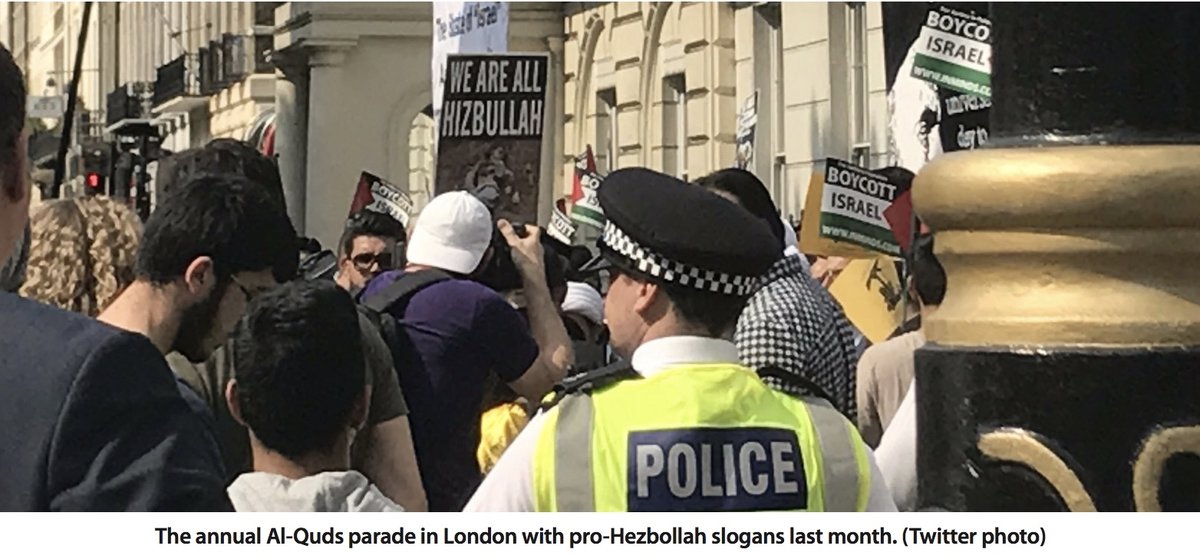
The mayor was questioned in the London Assembly after some marchers waved flags at the parade, which is usually held on the last Friday of Ramadan, and which was originally launched by Iran’s late revolutionary leader, Ayatollah Ruhollah Khomeini.
Hezbollah is also among the 60 groups defined as foreign terrorist organizations by the US Department of State, while the group’s military wing is also named in the EU’s list of terror groups.
The UK government proscribed the military wing of Hezbollah in March 2001. That ban was extended to its Jihad Council in 2008. Those wings of Hezbollah are among 71 banned organizations that also include Hamas.
Hezbollah’s political wing is not however subject to a ban in the UK.
The UK home secretary has the power to proscribe an organization and freeze its assets while membership of such groups carry jail sentences of up to 10 years.
The intervention of the mayor of London has focused attention on the political and military activities of the armed militia that emerged in the wake of the Israeli invasion of South Lebanon in 1982.
Terror experts said that there should be no separation between its political and military wings and that a total ban was necessary.
“Hezbollah is a vicious terror and criminal organization with both American and European blood on its hands,” said David Ibsen, executive director of the Counter Extremism Project, a non-profit organization formed to combat extremist ideologies.
“The idea that there is a separation between Hezbollah’s political and military wings is a dangerous fantasy.”
“Policymakers and security officials who indulge this absurd fiction are only emboldening one of the world’s most proficient terror organizations and facilitating Hezbollah’s penetration of European communities.”
Tally Helfont, the director of the program on the Middle East at the Philadelphia-based Foreign Policy Research Institute believes that the distinction between the military and political wings of Hezbollah is a rhetorical one and reflects “different power levers” all working toward the same hegemonic ambitions.
“It is all smoke and mirrors,” she said. “Countries across the globe, from the United States to the Gulf states, have deemed the activities of this violent organization to be acts of terror, carried out to sow chaos and do the bidding of Iran. Making a distinction between a political wing and a militant wing is simply a matter of perpetuating the false narrative that group is peddling and amounts to a PR win for Hezbollah, and for Iran.”
The Washington-based Foundation for Defense of Democracies (FDD) policy institute says that the separate treatment of Hezbollah’s political and military wings in Europe allows it to use front companies to fundraise and recruit.
“In 2016, the German government exposed a Hezbollah money-laundering operation in Europe that enabled it to amass nearly $2 million a week over two years. In turn, Hezbollah can use this to threaten the very countries that hesitate to fully ban the organization. These terror finance sources should be plugged,” said FDD Senior Vice President Toby Dershowitz.
“It is noteworthy that Hezbollah does not view itself as bifurcated into political and military wings; the group’s top leader — Hassan Nasrallah — fully controls the organization in its entirety.”
The EU designated Hezbollah’s military wing as a terrorist entity in 2013 following the bombing of a bus full of Israeli tourists in the Black Sea city of Burgas in 2013. Five Israeli tourists were killed along with the driver and the bomber.
The Hezbollah media office did not immediately respond to questions when contacted by Arab News.