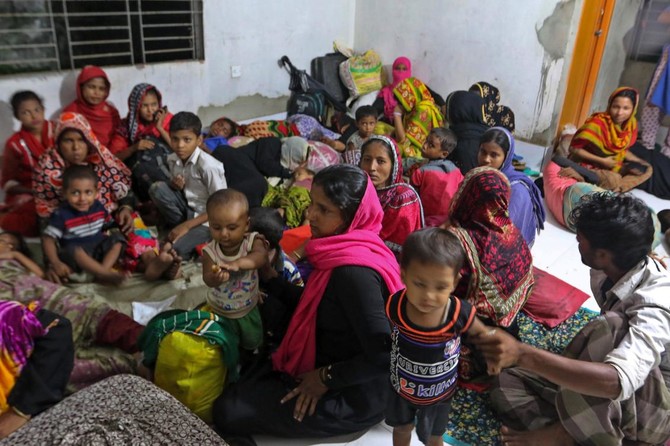
Cyclone wreaks havoc in Bangladesh refugee camps for Myanmar’s Rohingyas

Bangladeshi villagers take refuge in a cyclone shelter following an evacuation by authorities in the coastal villages of the Cox's Bazar district on May 29, 2017 as Cyclone 'Mora' gradually approaches towards the coastline. (AFP)
Updated 30 May 2017
Follow

Cyclone wreaks havoc in Bangladesh refugee camps for Myanmar’s Rohingyas

COX’S BAZAR, Bangladesh: A cyclone battered refugee camps in Bangladesh on Tuesday where hundreds of thousands of Rohingya Muslims from Myanmar have taken refuge from violence at home, as authorities moved at least 350,000 Bangladeshis out of harm’s way.
Cyclone Mora struck the island of Saint Martin and Teknaf in the coastal Bangladeshi district of Cox’s Bazar, where officials said some 200,000 people were evacuated to shelters. In Chittagong district, about 150,000 people were evacuated.
The border area is also home to refugee camps for Rohingyas who have fled their homeland in northwest Myanmar.
Shamsul Alam, a Rohingya community leader, told Reuters that damage in the camps was severe with almost all the 10,000 thatched huts in the Balukhali and Kutupalong camps destroyed.
“Most of the temporary houses in the camps have been flattened,” Alam said.
Omar Farukh, a community leader in Kutupalong camp, said conditions were dire: “Now we’re in the open air.”
Cox’s Bazar district chief Mohammad Ali Hussin said at least 15,000 houses in the district had been destroyed and he had unconfirmed reports of three people killed and dozens injured, including several Rohingya refugees.
Officials in Chittagong reported winds gusting up to 135 kph (85 mph), and said low-lying coastal areas were flooded by a storm surge with waves 2 meters (7 feet) high.
Flights in the area were canceled.
Last October, following a Myanmar army operation launched in response to insurgent attacks, an estimated 74,000 Rohingyas fled to Bangladesh where they joined more than 200,000 who have taken refuge there over the years.
The Bangladeshi government has estimated that in all, there are about 350,000 Rohingyas in Bangladesh.
In predominantly Buddhist Myanmar, where Rohingyas are officially denied citizenship and classified as illegal immigrants, about 120,000 of them have been internally displaced by communal violence over recent years and are living in camps.

‘We’re worried’
A UN official working with Rohingya refugees in Bangladesh said the damage in the camps could not be assessed while the storm was raging.
“Heavily pregnant women have been evacuated but most people in areas like Balukhali and Kutupalong makeshift settlements have stayed,” said the official, who declined to be identified.
“The winds are strong and people there live in flimsy structures, so we’re worried.”
In Myanmar, about 300 houses were damaged in Rakhine State but the extent was unclear, the government said.
But Bangladeshi weather officials said the cyclone was not as bad as they had feared.
“The severity was less than the apprehension,” Shamsuddin Ahmed, a weather official based in Chittagong said.
The cyclone was expected to weaken in Bangladesh by late morning as it moved inland toward India where authorities have warned of heavy rain in the northeastern states of Tripura, Mizoram, Manipur, Nagaland and Arunachal Pradesh.
The cyclone formed after monsoon rains triggered floods and landslides in Sri Lanka, off India’s southern tip, killing at least 180 people in recent days, authorities said, adding 99 people were missing and 112 had been injured.
In the eastern Indian state of Bihar, 24 people have been killed in recent days, either by lightning or in collapsed dwellings.
While the rains bring death and destruction every year, they also underpin life across the region.
Monsoon rains arrived at on India’s southern coast on Tuesday, a weather office source said, making it the earliest since 2011 and setting India up for higher farm output and robust economic growth.


Cambodia shuts Thailand border crossings over deadly fighting

Updated 4 sec ago
Follow

Cambodia shuts Thailand border crossings over deadly fighting

  • Thai Prime Minister Anutin Charnvirakul said Trump “didn’t mention whether we should make a ceasefire” during their Friday phone call
  • Across the border, a Cambodian evacuee said she was “sad” the fighting hadn’t stopped despite Trump’s intervention

BANGKOK: Cambodia shut its border crossings with Thailand on Saturday, after Bangkok denied US President Donald Trump’s claim that a truce had been agreed to end days of deadly fighting.
Violence between the Southeast Asian neighbors, which stems from a long-running dispute over the colonial-era demarcation of their 800-kilometer (500-mile) border, has displaced around half a million people on both sides.
At least 25 people have died this week, including four Thai soldiers the defense ministry said were killed in the border area on Saturday.
The latest fatalities were followed by Phnom Penh announcing it would immediately “suspend all entry and exit movements at all Cambodia-Thailand border crossings,” the interior ministry said.
Each side blamed the other for reigniting the conflict, before Trump said a truce had been agreed.
Thai Prime Minister Anutin Charnvirakul said Trump “didn’t mention whether we should make a ceasefire” during their Friday phone call.
The two leaders “didn’t discuss” the issue, Anutin told journalists on Saturday.
Trump had hailed his “very good conversation” with Anutin and Cambodian Prime Minister Hun Manet on Friday.
“They have agreed to CEASE all shooting effective this evening, and go back to the original Peace Accord” agreed in July, Trump wrote on his Truth Social platform.
The United States, China and Malaysia, as chair of the regional bloc ASEAN, brokered a ceasefire in July after an initial five-day spate of violence.
In October, Trump backed a follow-on joint declaration between Thailand and Cambodia, touting new trade deals after they agreed to prolong their truce.
But Thailand suspended the agreement the following month after Thai soldiers were wounded by land mines at the border.
In Thailand, evacuee Kanyapat Saopria said she doesn’t “trust Cambodia anymore.”
“The last round of peace efforts didn’t work out... I don’t know if this one will either,” the 39-year-old told AFP.
Across the border, a Cambodian evacuee said she was “sad” the fighting hadn’t stopped despite Trump’s intervention.
“I am not happy with brutal acts,” said Vy Rina, 43.

- Trading blame over civilians -

Bangkok and Phnom Penh have traded accusations of attacks against civilians, with the Thai army reporting six wounded on Saturday by Cambodian rockets.
Cambodia’s information minister, Neth Pheaktra, meanwhile said Thai forces had “expanded their attacks to include civilian infrastructure and Cambodian civilians.”
A Thai navy spokesman said the air force “successfully destroyed” two Cambodian bridges used to transport weapons to the conflict zone.
Malaysian Prime Minister Anwar Ibrahim on Saturday urged both sides to “cease all forms of hostilities and refrain from any further military actions.”
Thailand has reported 14 soldiers killed and seven civilian deaths, while Cambodia said four civilians were killed earlier this week.
At a camp in Thailand’s Buriram, AFP journalists saw displaced residents calling relatives near the border who reported that fighting was ongoing.
Thailand’s prime minister has vowed to “continue to perform military actions until we feel no more harm and threats to our land and people.”
After the call with Trump, Anutin said “the one who violated the agreement needs to fix (the situation).”
Cambodia’s Hun Manet, meanwhile, said his country “has always been adhering to peaceful means for dispute resolutions.”