Thai and Cambodian leaders agree to renew a ceasefire after days of deadly clashes, Trump says

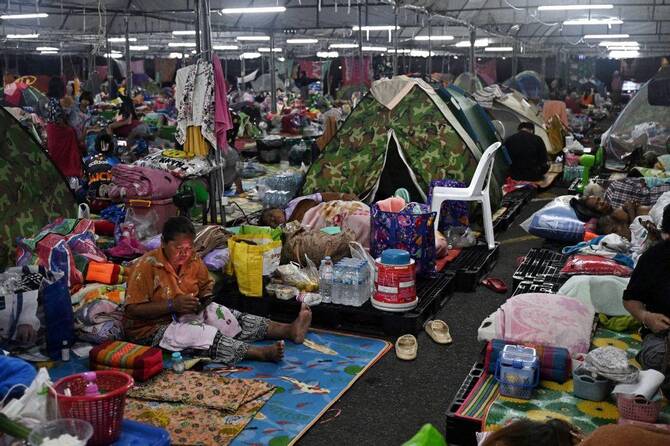
Displaced residents rest at an evacuation center at Chang International Circuit in the Thai border province of Buriram on Dec. 12, 2025. (AFP)
Short Url
Updated 12 December 2025
Follow

Thai and Cambodian leaders agree to renew a ceasefire after days of deadly clashes, Trump says

  • “They have agreed to CEASE all shooting effective this evening,” Trump said
  • Thai and Cambodian officials offered no immediate comment following Trump’s announcement

WASHINGTON: President Donald Trump said on Friday that Thai and Cambodian leaders have agreed to renew a truce after days of deadly clashes had threatened to undo a ceasefire the US administration had helped broker earlier this year.
Trump announced the agreement to restart the ceasefire in a social media posting following calls with Thai Prime Minister Anutin Charnvirakul and Cambodian Prime Minister Hun Manet.
“They have agreed to CEASE all shooting effective this evening, and go back to the original Peace Accord made with me, and them, with the help of the Great Prime Minister of Malaysia, Anwar Ibrahim,” Trump said in his Truth Social posting.
Thai and Cambodian officials offered no immediate comment following Trump’s announcement. Anutin, after speaking with Trump but before the US president’s social media posting, said he reiterated to Trump that Thailand’s position was to keep fighting until Cambodia no longer poses a threat to its sovereignty.

Trump, a Republican, said that Ibrahim played an important role in helping him push Thailand and Cambodia to once again agree to stop fighting.
“It is my Honor to work with Anutin and Hun in resolving what could have evolved into a major War between two otherwise wonderful and prosperous Countries!” Trump added.
The original ceasefire in July was brokered by Malaysia and pushed through by pressure from Trump, who threatened to withhold trade privileges unless Thailand and Cambodia agreed. It was formalized in more detail in October at a regional meeting in Malaysia that Trump attended.
Despite the deal, the two countries carried on a bitter propaganda war and minor cross-border violence continued.
The roots of the Thai-Cambodian border conflict lie in a history of enmity over competing territorial claims. These claims largely stem from a 1907 map created while Cambodia was under French colonial rule, which Thailand maintains is inaccurate. Tensions were exacerbated by a 1962 International Court of Justice ruling that awarded sovereignty to Cambodia, which still riles many Thais.
Thailand has deployed jet fighters to carry out airstrikes on what it says are military targets. Cambodia has deployed BM-21 rocket launchers with a range of 30-40 kilometers (19-25 miles).
According to data collected by public broadcaster ThaiPBS, at least six of the Thai soldiers who were killed were hit by rocket shrapnel.
The Thai army’s northeastern regional command said Thursday that some residential areas and homes near the border were damaged by BM-21 rocket launchers from Cambodian forces.
The Thai army also said it destroyed a tall crane atop a hill held by Cambodia where the centuries-old Preah Vihear temple is located, because it allegedly held electronic and optical devices used for military command and control purposes.
Trump has repeatedly made the exaggerated claim that he has helped solve eight conflicts, including the one between Thailand and Cambodia, since returning to office in January, as evidence of his negotiating prowess. And he’s not been shy about his desire to be recognized with a Nobel Peace Prize.
In an exchange with reporters on Wednesday, he expressed confidence that he could get the two sides back to a truce.
“Every once in a while,” Trump said, “one will flame up again and I have to put out that little flame.”
Another ceasefire that Trump takes credit for working out, between the Democratic Republic of Congo and Rwanda, is also under strain — just after the leaders of the African nations traveled to Washington to sign a peace deal.
A joint statement released by the International Contact Group for the Great Lakes expressed “profound concern” over the situation in Congo’s South Kivu region, where new deadly violence blamed on the Rwandan-backed M23 militia group has exploded in recent days.
The Great Lakes contact group — which includes Belgium, Britain, Denmark, France, Germany, the Netherlands, Sweden, Switzerland, the United States and the European Union — has urged all sides “to uphold their commitments” under the deal signed last week and “immediately de-escalate the situation.”
And Trump’s internationally endorsed plan to end the Israel-Hamas war in Gaza is still not finalized and in limbo, with sporadic fighting continuing while a critical second phase remains a work in progress.


How a Syrian refugee chef met Britain’s King Charles

Imad Alarnab, a chef and restaurant owner who fled Syria in 2015, works at one of his restaurants in central London. (AFP)
Updated 02 March 2026
Follow

How a Syrian refugee chef met Britain’s King Charles

  • Alarnab, 48, said he had asked the king to come to the popular eatery when he met him at Buckingham Palace

LONDON: Pots clanged and oil sizzled inside the London kitchen of Syrian chef Imad Alarnab, as the former refugee who fled his country’s civil war recalled hosting King Charles III.
When the chef left his war-torn homeland in 2015, he never imagined that one day he would watch as cameras flashed and wide-eyed crowds greeted the monarch arriving at his Soho restaurant last year.
Alarnab, 48, said he had asked the king to come to the popular eatery when he met him at Buckingham Palace before an event honoring humanitarian work in 2023.
“I told him ‘I would love for you to visit our restaurant one day’ and he said: ‘I would love to’... I was over the Moon to be honest.”
The chef has come a long way since he arrived in London after an arduous journey from Damascus with virtually no money in his pocket.
Fearing for his life, he had escaped Syria after his family was uprooted again and again by fighting.
His culinary empire — restaurants, cafes, and juice bars peppered across the Syrian capital — had been destroyed by bombing in just six days in 2013.
Alarnab spent three months crisscrossing Europe in the back of lorries, aboard trains, on foot and even on a bicycle before he reached the UK.
“When I left, I left with nothing,” he told AFP, as waiters whirled past carrying steaming plates of traditional Syrian fare.
Starving and exhausted, he spent the last of his money on a train ticket to Doncaster where his sister lived.
“Love letter from Syria”
To make a living, Alarnab initially picked up any odd jobs, such as washing and selling cars, saving enough to bring his wife and three daughters over after seven months.
His love of cooking never left him though. In France, while he was sleeping on the steps of a church, Alarnab had often cooked for hundreds of other refugees.
“I always dreamed of going back to cooking,” he said.
So it wasn’t long before he found himself back in the kitchen, cooking up a storm across London with his sold-out supper clubs, bustling pop-up cafes, and crowded lunchtime falafel bars.
Alarnab’s friends gave him the initial boost for his first pop-up in 2017, and profits from his new catering business then covered the costs of later events.
He now runs two restaurants in the city — one in Soho’s buzzing Kingly Court and another nestled in a corner of the vibrant Somerset House arts center.
“I was looking for a city to love when I found London,” Alarnab said, adding it had offered him “space to innovate” and add his own modern twist to classic Syrian dishes.
Far from home, Alarnab said his word-of-mouth success had grown into a “love letter from Syria to the world” that needs no translation.
“You don’t really need to speak Arabic or Syrian to know that this is the best falafel ever,” he said, pointing to a row of colorful plates.
“There is hope”
For Alarnab, spices frying, dough rising and cheese melting inside a kitchen offered an unlikely escape from the real world.
“All my problems, I leave them outside the kitchen and walk in fresh.”
When he fled Syria, Alarnab thought going back to Damascus was forever off the table.
Yet he returned for the first time in October, almost a year to the day after longtime leader Bashar Assad was toppled in a lightning rebel offensive — ending almost 14 years of brutal civil war.
He walked the familiar streets of his old home, where his late mother taught him to cook many years ago.
“To return to Damascus and for her not to be there, that was extremely difficult.”
Torn between the two cities, Alarnab said he longed to one day rebuild his home in Damascus.
“I wish I could go back and live there. But at the same time, I feel like London is now a part of me. I don’t know if I could ever go back and just be in Syria,” he said.
Although Syrians still bear the scars of war, Alarnab said he had seen “hope in people’s eyes which was missing when I left in 2015.”
“The road ahead is still very long, and yes this is only the beginning — but there is hope.”