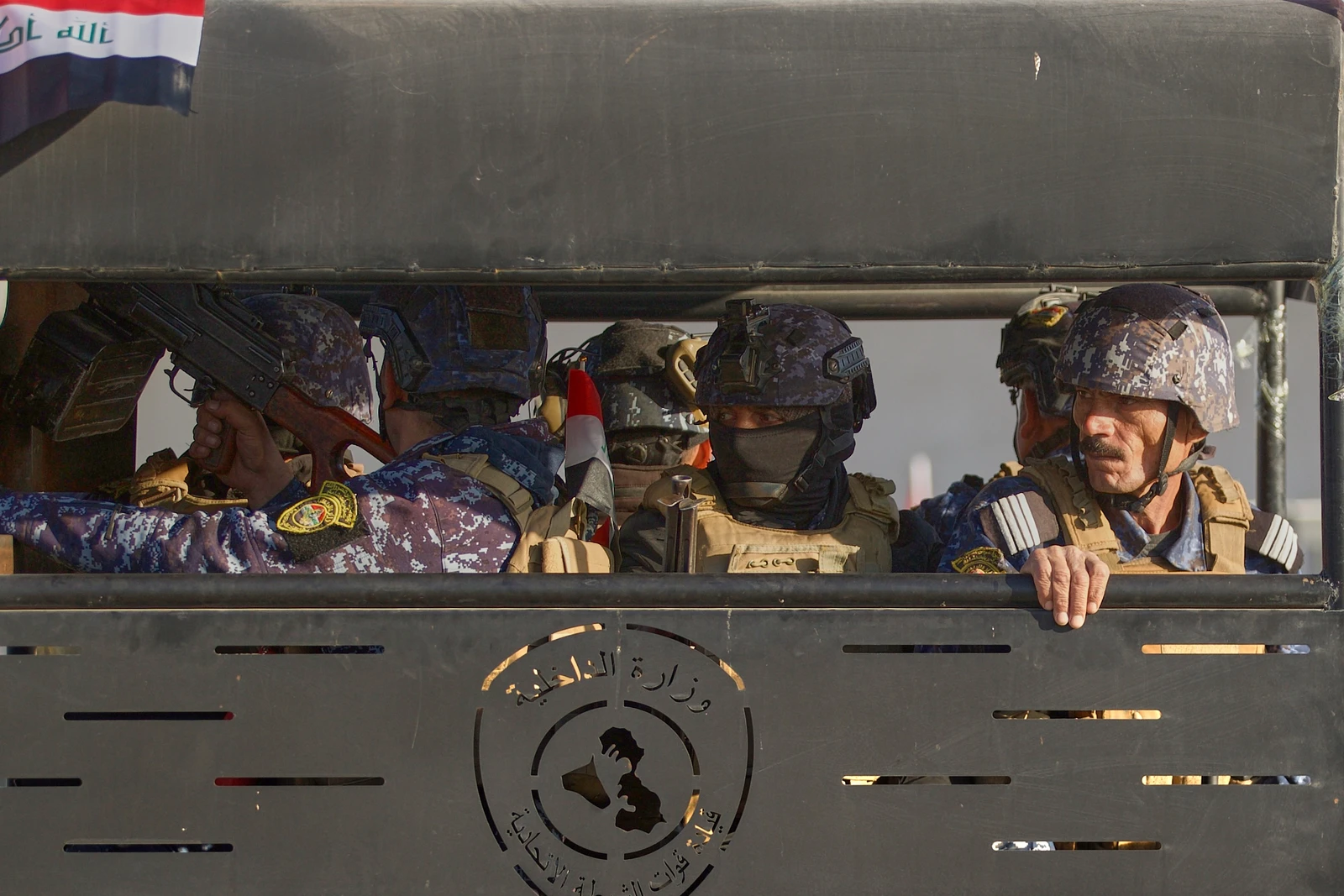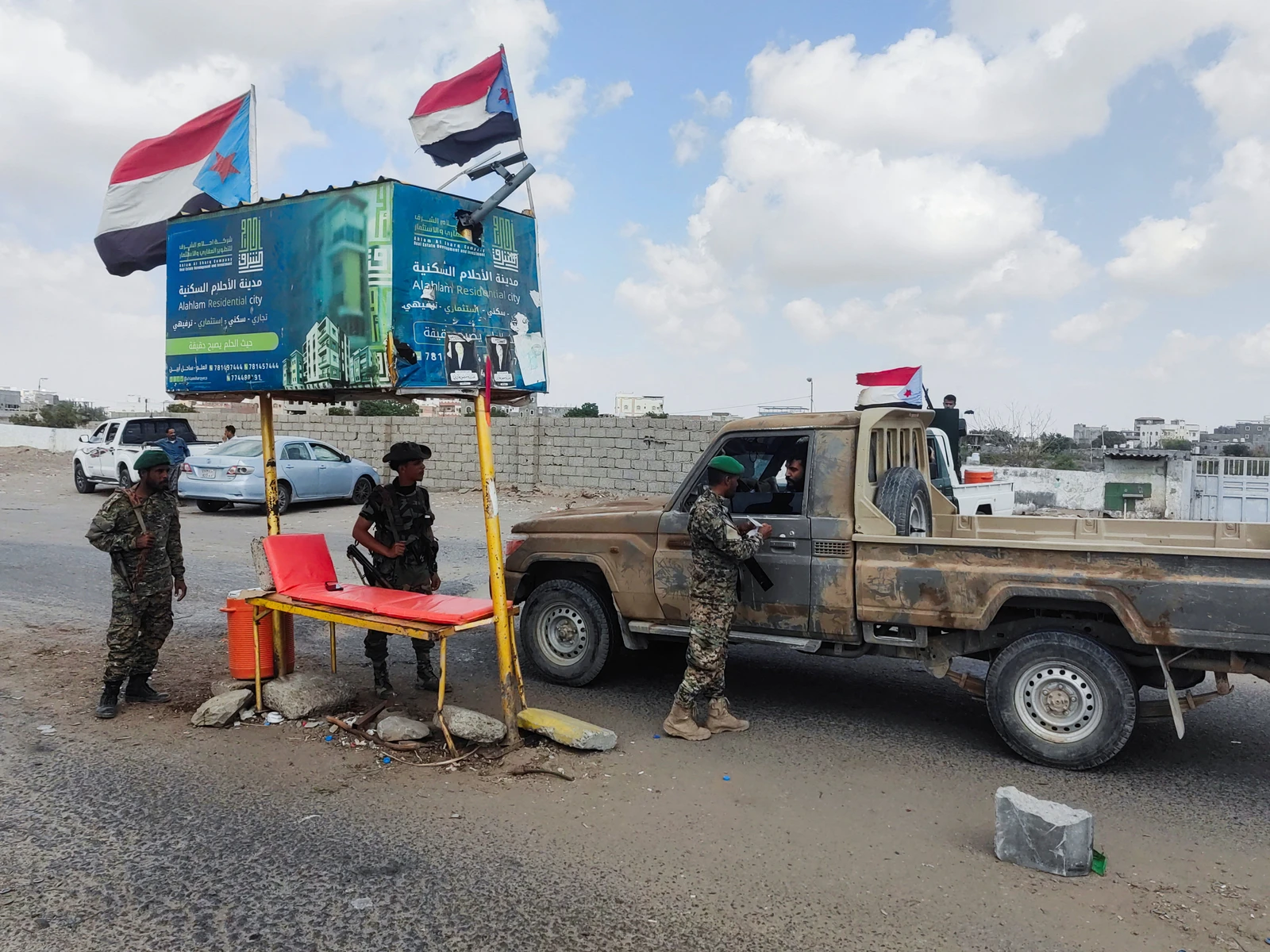
- Govt security forces thwarted plots to assassinate political, military and security officials, Ibrahim Haidan tells Arab News
- He accuses the Houthis of cooperating with Al-Qaeda and Iran-linked smuggling networks as fighting intensifies
Yemeni security forces have uncovered 16 alleged Houthi sleeper cells in government-controlled areas since fighting escalated in September, thwarting plots to assassinate political, military and security officials, Interior Minister Maj. Gen. Ibrahim Haidan told Arab News.
In an exclusive interview, Haidan said pre-emptive operations had helped improve security in areas controlled by Yemen’s internationally recognized government. He accused the Iran-backed Houthis of cooperating with Al-Qaeda and other armed groups to destabilize those areas.
“In recent times, we have transitioned to an advanced phase of proactive and preemptive security operations — a shift that has been instrumental in thwarting numerous terrorist plots by the Houthis,” he said.
Haidan said the operations had led to the arrest of suspects planning attacks on security, military and political leaders in an effort to spread chaos and undermine public order.
The arrests came amid a major Houthi offensive against government forces in Hodeidah and Taiz provinces in early September. Haidan said the escalation prompted security services to go on heightened alert as Houthi operatives gathered intelligence on potential targets and prepared attacks behind government lines.
“Since the onset of the recent military escalation by the Houthi militia in September, security services in the liberated provinces have apprehended 16 terrorist cells,” he said. “Other cells remain under surveillance and investigation; details regarding them will be announced once the necessary security procedures are completed.”
According to Haidan, the cells were organized to minimize contact between members and prevent arrests from exposing the wider network. He alleged that operatives trained by experts from Iran’s Islamic Revolutionary Guard Corps and Lebanon’s Hezbollah used similarly compartmentalized structures, with separate groups responsible for logistics, intelligence, movement and attacks.
“These cells rely on a distinct division of roles and tasks: some groups handle logistics, others focus on intelligence gathering and surveillance, some facilitate movement and transit, and others are tasked with carrying out acts of sabotage and terrorism,” he said.
Haidan cited the arrest of an 18-member cell in Lahj province, which he said led investigators to other alleged Houthi operatives plotting attacks in Aden, the interim capital and seat of the internationally recognized government.
“Security monitoring revealed that this cell had extensions and links reaching into several other governorates, including the capital, Aden,” he said. “Security services tracked and pursued these individuals until they were captured.”
Al-Qaeda allegations
Haidan said investigations had uncovered what he described as evidence of cooperation between the Houthis and Al-Qaeda in planning attacks in government-held areas, as well as links to Iran and Hezbollah.
“We possess evidence and security intelligence confirming the existence of cooperation and mutual support between the terrorist Houthi militia and Al-Qaeda,” he said, adding that the findings were based on seized material and investigations into members of suspected Houthi cells.
“Investigations with the apprehended individuals revealed highly significant information, including the fact that they had received training at the home of a prominent Houthi leader, in the presence of figures affiliated with Al-Qaeda.”
He also accused the Houthis of releasing Al-Qaeda operatives from prison who subsequently traveled to government-held areas to carry out attacks against security agencies and their personnel.
Haidan said bringing Yemen’s fragmented security forces under a unified command remained a priority, particularly in Aden and other government-controlled provinces. He described the effort as part of a broader push to build institutions capable of enforcing the law, protecting civilians and confronting security threats.
“We have made significant progress in the process of unifying security agencies and formations in the interim capital, Aden, and the liberated governorates,” he said. “Ongoing efforts are underway to reorganize the security apparatus and strengthen coordination and operational connectivity among various units and formations.”
Saudi support and Red Sea security
Haidan praised Saudi Arabia’s assistance to Yemen’s security services, including training, equipment, logistical support and cooperation in counterterrorism operations. He said the partnership had helped Yemeni forces pursue wanted suspects, disrupt smuggling networks and strengthen security institutions.
“The support provided by the Kingdom of Saudi Arabia to the Yemeni Ministry of Interior and security apparatuses is both generous and substantial,” he said. “We highly value this support and the sincere, fraternal stance of the Kingdom and its leadership; we view it as a vital strategic partnership in the efforts to rebuild state institutions and enable them to fulfill their national responsibilities.”
As an example, Haidan pointed to a September operation in Hadramout province in which Yemeni forces, working with the Saudi-led coalition, killed a Daesh spokesperson and captured another member of the group, he said.
“We view our partnership with the Kingdom of Saudi Arabia as a long-term strategic alliance — one that extends well beyond mere support, equipment provision or coordination on specific security operations.”
The security challenge has intensified along Yemen’s Red Sea coast. The Houthis captured the port city of Mokha on Sept. 10 before advancing into coastal territory and islands around the strategic Bab Al-Mandab Strait, increasing their leverage over one of the world’s busiest maritime chokepoints.
Haidan said security agencies had observed increased activity by weapons and drug-smuggling networks linked to the Houthis and Iran’s Revolutionary Guards, including the use of new routes. He also alleged growing cooperation between the Houthis and criminal networks, including Al-Shabab and other groups in the Horn of Africa.
To counter maritime smuggling, the minister called for greater support for Yemen’s coastguard, closer intelligence-sharing with other countries and action to cut off financing for smuggling networks, including those allegedly linked to the Revolutionary Guards.
“Through the Revolutionary Guard and the Houthi militia, Iran seeks to exploit Yemen’s strategic location — including its coastline, islands and maritime passages — to advance its expansionist agenda, while threatening the security of the Red Sea, the Gulf of Aden, the Bab Al-Mandab Strait and international navigation.”