- Lebanese Army deploys across Beirut’s southern suburbs after Hezbollah supporters stage protests following security raids and seizure of explosives
- Political figures warn that delays in enforcing the government’s decision to establish a state monopoly on weapons risk emboldening the group
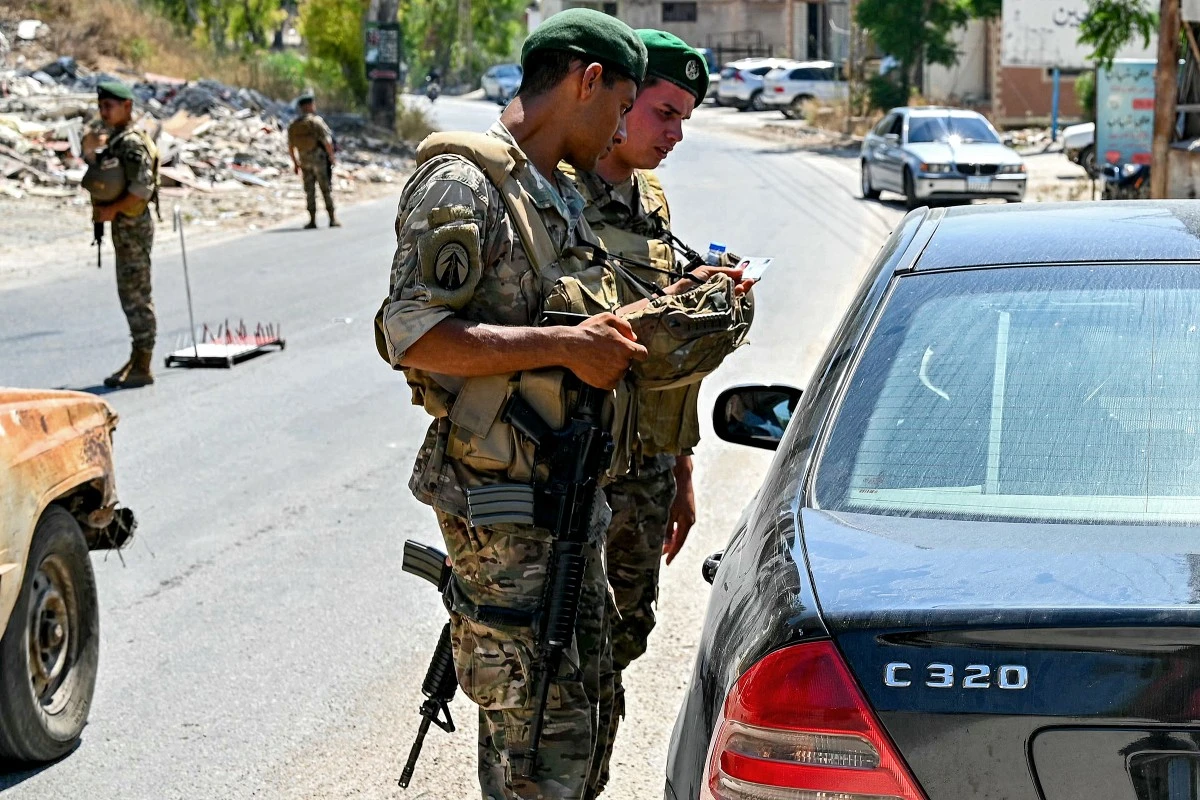
The Lebanese Army deployed extensively across Beirut’s southern suburbs on Saturday morning, patrolling streets following protests by Hezbollah supporters that saw dozens of motorcyclists descend on the capital, gathering along a major thoroughfare and chanting slogans in support of the group.
The demonstrations followed two incidents that have heightened tensions between Hezbollah and the Lebanese authorities.
The first involved the seizure of about 800 kg of C4 and TNT explosives at a checkpoint in Dahr Al-Baydar, which connects the Bekaa Valley to Beirut, more than a week ago. Two Hezbollah members were arrested in connection with the shipment, while the group acknowledged ownership of the explosives and demanded their return.
The second incident occurred on Friday, when security forces raided an apartment in Beirut’s southern suburbs and confiscated unfit pharmaceutical products. Hezbollah members reportedly surrounded the security personnel conducting the operation, although the officers continued their work.
The demonstrations revived memories of 2008, when Hezbollah gunmen wearing black shirts took to Beirut’s streets in response to government efforts to dismantle the group’s private telecommunications network, which was found to be connected to the state network. The ensuing clashes left several civilians dead and wounded.
The developments have raised questions about whether Hezbollah is attempting to reassert its control over Beirut, as it did 18 years ago, and whether it still possesses the ability to do so.
They also come amid the Lebanese government’s decisions last August to establish a state monopoly on weapons and declare Hezbollah’s military wing illegitimate, raising further questions about whether the country’s changing political and security landscape will prevent any attempt by the group to reassert its influence.
Lebanon’s top public prosecutor, Judge Ahmad Rami Al-Hajj, issued urgent judicial orders to the Lebanese Army’s Intelligence Directorate, the Gendarmerie Command and the Judicial Police, instructing them to immediately identify armed individuals who obstructed the security operation targeting a warehouse containing counterfeit medicines.
The orders called for the identification and prosecution of those who surrounded security personnel and interfered with the judicial operation, with a view to taking deterrent legal action against them.
Al-Hajj also instructed the head of the Central Criminal Investigations Department to expand the investigation into non-compliant pharmaceutical products and conduct on-site inspections of warehouses belonging to the companies and distributors implicated in the case.
In a statement, Hezbollah sought to distance itself from the pharmaceutical scandal and denied circulating reports that its officials were being pursued in connection with the case, particularly Hussein Al-Abdallah, head of the group’s Liaison and Coordination Committee, and his assistant, Ali Ayyoub.
The group dismissed the reports as “rumors.”
A Lebanese official source told Arab News that President Joseph Aoun had instructed army intelligence to expand its investigation into the explosives seized in Dahr Al-Baydar and determine their intended use.
Justice Minister Adel Nassar told Arab News that the Cabinet had adopted its decision to establish a state monopoly on weapons through a majority vote.
“The responsibility of the state today is to prevent threats to its security, to stop Lebanon from being dragged into other people’s wars, and to avoid providing pretexts for wars at Lebanon’s expense and at the expense of the people of the south and Beirut’s southern suburbs,” he said.
“Storing such a large quantity of explosives in the southern suburbs requires the state to intervene to protect Lebanese society from a group that is placing an entire area the size of Beirut’s southern suburbs at risk.”
Nassar insisted that the authorities would not back down.
“There will be no leniency, and no one is above the law. What is required is to continue the investigations and pursue them to the very end without hesitation,” he said.
Former MP Fares Souaid, who heads the opposition Saydet Al-Jabal Gathering, dismissed the prospect of Hezbollah’s street demonstrations fundamentally altering the political balance.
“Hezbollah’s displays will not turn the situation upside down. Its movements are merely intended to rally its supporters, but they will achieve nothing,” he told Arab News.
“This brazen behavior is an attempt to compensate for weakness. The situation in the region has changed. Syria is now without Bashar Assad, and Iran is no longer capable of changing the balance in its favor and regaining its grip on Lebanon.”
Souaid added that although the Lebanese Army was avoiding a confrontation with Hezbollah for its own reasons, it was no longer an ally of the group.
Beirut MP Waddah Sadek described the motorcycle procession through the capital on Friday night and into Saturday morning as a rehearsal for a return to the “black shirts” scenes of 2008 and the overthrow of former Prime Minister Saad Hariri’s government in 2011.
“Protecting Beirut and its residents is the responsibility of the Lebanese Army and security forces,” Sadek said.
“Any leniency will push the country toward a dangerous deterioration that Hezbollah, and Iran behind it, want at this stage.”
Beirut MP Ibrahim Mneimneh, meanwhile, criticized the authorities’ response to what he described as Hezbollah’s increasingly brazen challenges to the state.
“While Hezbollah has grown bolder in defying the state, the state’s response has been disappointing,” he said.
“Hezbollah is trying to reestablish itself through old rhetoric and practices that we had hoped were behind us.
“This is the result of the stalled implementation of the government’s decision to bring Hezbollah’s weapons under state control, as well as the loss of momentum behind efforts to make Beirut a weapons-free city.”
Ali Al-Amin, editor-in-chief of the Janoubia news website, said residents of Beirut’s southern suburbs had observed a series of Hezbollah activities intended to demonstrate that the group remained a force to be reckoned with.
“Hezbollah is trying to send a message that it is still present and that the state should not go too far,” he told Arab News.
“These are warning messages. According to discussions circulating in the southern suburbs, the party is attempting to impose its presence more forcefully and expand its influence.
“Meanwhile, the Lebanese Army’s movements have been timid, almost as though it is yielding to Hezbollah’s threats, even though the army leadership is implementing the instructions of the political authorities.”
Al-Amin argued that delays in implementing government decisions, excessive sensitivity in handling the Hezbollah issue, weak enforcement of the law and a lack of political backing for security forces had allowed the group to continue challenging state authority.
“The delay in implementing government decisions, the excessive caution in dealing with this issue, the lax enforcement of the law on the ground, and the failure to provide the necessary political cover for security forces to carry out their duties have all allowed Hezbollah to overstep its bounds and retain its disproportionate power,” he said.