- Analysis shows stark temperature differences between concrete laden and green spaces in Arab cities
- Experts say effective urban planning and policy must consider heat resilience at every scale to mitigate Urban Heat Island effects
DUBAI: Intensifying summer heat and accelerating climate change is a problem faced by every city in the world. Perhaps nowhere is it as destructive to everyday life than in the Arab world, where even before any notable global warming, summer temperatures can reach unbearable levels.
It is a problem that urban planners and architects from around the region have argued can be mitigated by reducing the “Urban Heat Island effect,” or UHI, in our concrete-laden cities by adding green spaces.
UHI is a microclimatic phenomenon where urbanized and industrial areas experience significantly higher land surface and atmospheric temperatures than neighboring rural, vegetated or coastal areas because surfaces such as concrete, asphalt, glass and dark roofing materials absorb and store high amounts of solar radiation during the day and re-emit that heat back into the environment.
In contrast, natural landscapes with vegetation, trees and bodies of water cool the surrounding air through shading and evapotranspiration.
“Urban heat is a global problem, but in the Middle East it compounds an already challenging climate, so every planning decision becomes an opportunity either to mitigate the problem or make it worse,” Baharash Bagherian, founder and CEO of URB, a Dubai-based developer, told Arab News.
“Two streets can record similar temperatures but feel completely different depending on shade, radiant heat, vegetation and airflow,” he said.
By looking at publicly available Land Surface Temperature datasets spanning July 2020 through July 2025, this effect can be seen in practice.
High-density, heavily built urban cores across the region consistently suffer from severe Urban Heat Island effects.
In contrast, districts integrated with dense tree canopy, parks and open green corridors operate as powerful microclimatic heat sinks, slashing surface temperatures by as much as 4.45 degrees Celsius during peak summer months.
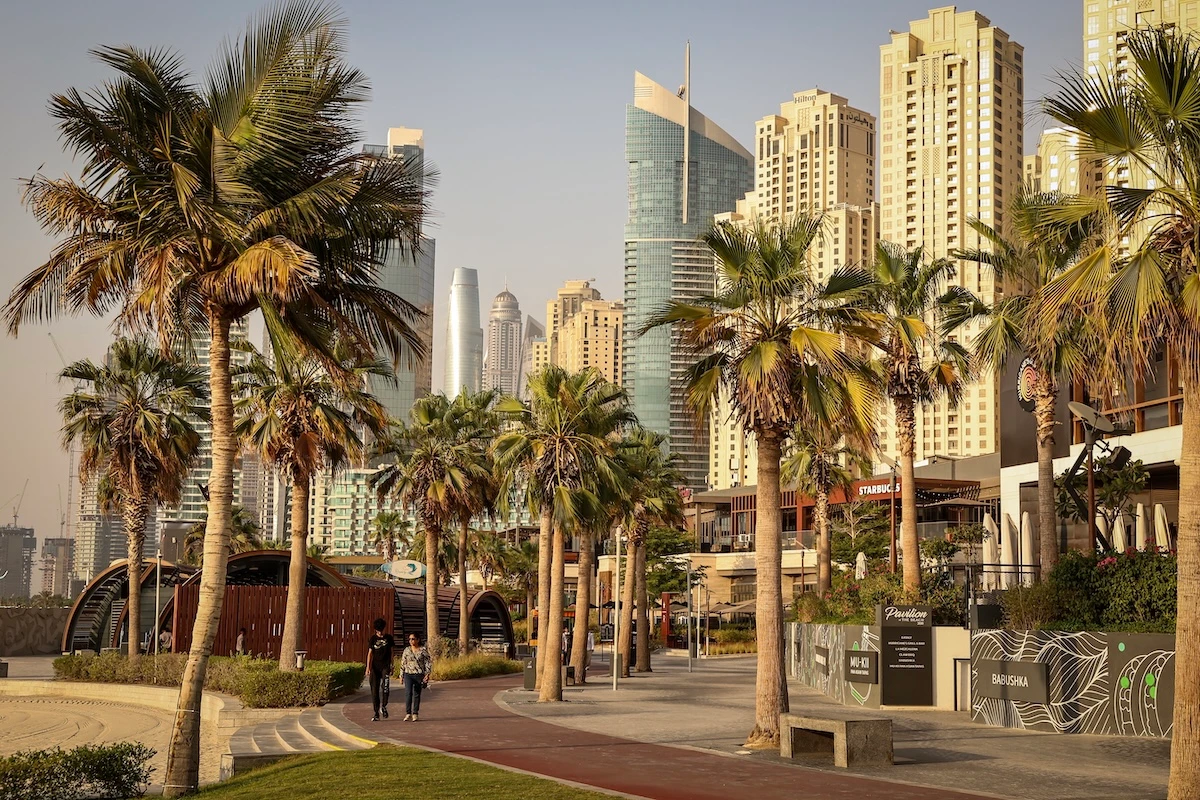
Few places demonstrate the thermal consequences of contemporary architecture more vividly than Dubai.
A five-year comparative analysis between Downtown Dubai — a high-density cluster of glass-and-steel skyscrapers, paved plazas and asphalt arteries — and Dubai Hills, a master-planned community woven with expansive parklands, tree corridors and a golf course, reveals an unyielding thermal penalty.
Over the 2020-2025 observation window, Downtown Dubai maintained an average surface temperature hotter than 2.40 degrees Celsius above Dubai Hills.
This gap was at its greatest in August, when Downtown Dubai’s ground surfaces registered an average of 4.45 degrees Celsius hotter than Dubai Hills.
URB is currently slated to put this into practice on a mass scale through the “Dubai Green Spine” project, which will transform 64 km along Sheikh Mohammed Bin Zayed Road (E311) into a transit-oriented, tree-laden boulevard.
“With more than one million trees, extensive landscape, permeable surfaces, interconnected green infrastructure and dedicated pedestrian and cycling routes, many of the elements that make the corridor more liveable also contribute to a cooler urban environment,” Bagherian said.
“The important idea is that landscape is not being added simply for beautification. It becomes part of the cooling infrastructure of the city.”
The cooling influence of green cover is even starker when contrasting dense industrial districts with protected public parklands in Abu Dhabi.
Thermal readings comparing Musaffah, an extensive industrial zone blanketed with asphalt, warehouses and heavy machinery, with Khalifa Park, a manicured green sanctuary on the capital’s coast, depict an extreme microclimatic divide:
Musaffah recorded higher land surface temperatures than Khalifa Park on 95.5 percent of all matching observation days.
On May 23, 2025, satellite sensors tracked a peak surface temperature of 51.82 degrees Celsius in Musaffah. Just kilometers away at Khalifa Park, the peak reached on the same heatwave weekend was 45.89 degrees Celsius — a difference of nearly 6 degrees Celsius.
“Two streets can record similar temperatures but feel completely different depending on shade, radiant heat, vegetation and airflow,” Bagherian said.
“For me, the ultimate test is simple; can someone comfortably walk 500 meters through that neighborhood in summer?”
The thermal dynamics of urban forms extend well beyond the Gulf. In Amman, Jordan, comparative readings between the historic, hilly neighborhood of Jabal Al-Weibdeh and the modern, high-rise corridor of Abdali Boulevard demonstrate how architectural mass and street geometry dictate local temperatures.
During peak summer (June and July), the dense concrete, asphalt and glass canyons of the boulevard drive daytime surface temperatures up to 38.21 degrees Celsius, creating a distinct heat island over the commercial core.
In contrast, Jabal Al-Weibdeh’s open topography, dispersed residential gardens and mature tree clusters help to temper summer heat buildup, even while capturing direct solar warmth during winter when the boulevard sits trapped in deep structural shade.
“Many cities in the region are investing heavily in greening, which is important, but greening alone is not enough. Heat resilience has to be addressed at every scale, from citywide green and mobility networks to street orientation, airflow, tree canopy, shade, hardscape exposure and material performance on individual plots,” Bagherian said.
“This is also where policy becomes critical. Urban heat does not recognize property boundaries. One development can create a shaded, comfortable environment while the neighboring plot creates vast exposed surfaces or blocks airflow.
“If every development is required to contribute to a wider heat-resilience strategy, the cumulative impact across an entire city can be enormous,” he said.