- Former Israeli prime minister hopes elections will end Netanyahu’s rule and says Saudi crown prince can help make peace possible
- Defends his 2008 Palestinian statehood offer, demands an Oct. 7 inquiry and condemns Israeli settler violence
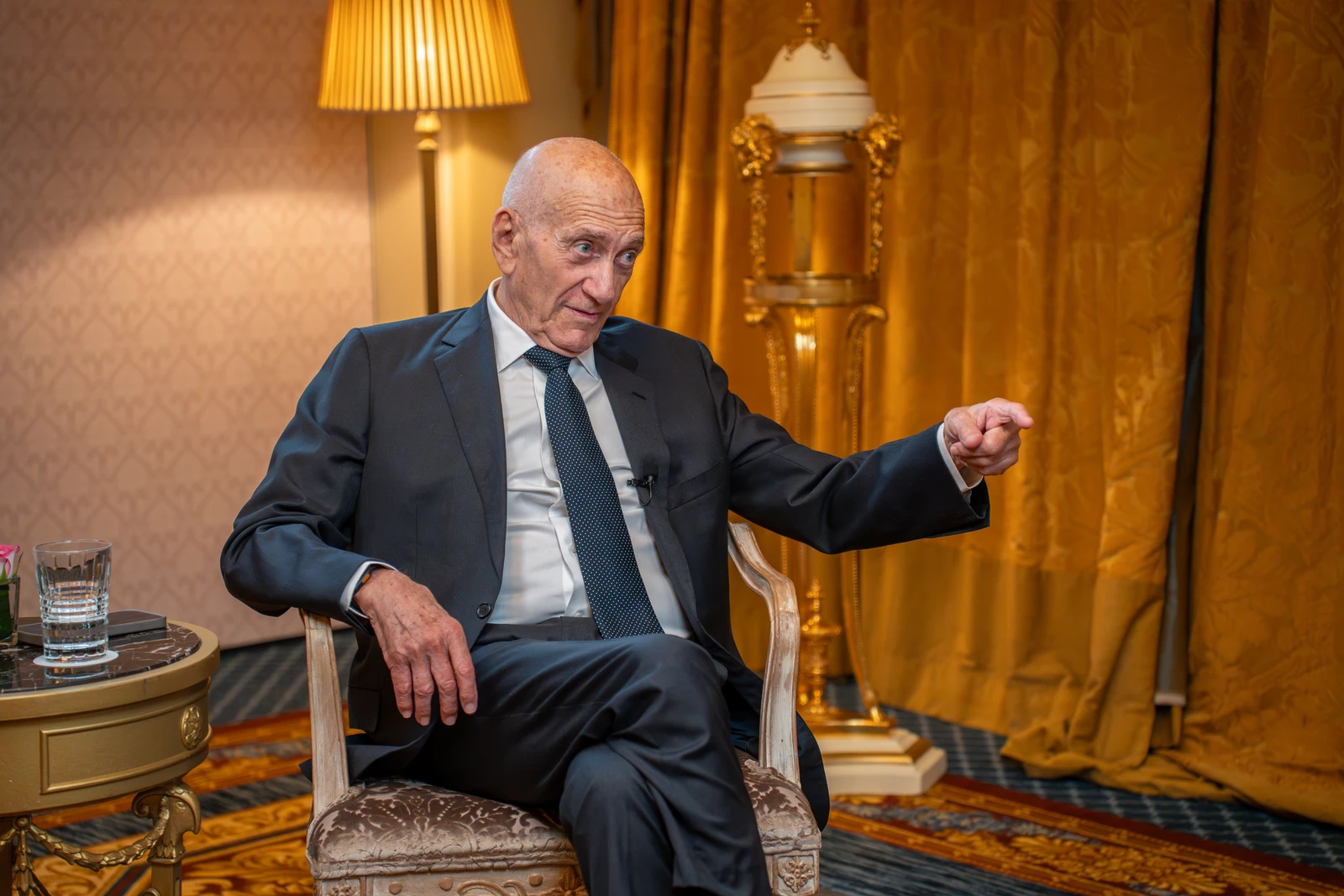
ATHENS: With Israelis preparing to vote in their first election since Oct. 7 and the ensuing wars in Gaza, Lebanon and with Iran, former Prime Minister Ehud Olmert says he remains one of the few Israeli voices willing to put a two-state solution on the table.
Olmert, who led Israel from 2006 to 2009, offered the Palestinians a state on almost all the land occupied in 1967 during his final year in office. The proposal was never signed, and months later he left office. Years afterward, he went to prison following a corruption conviction.
Now one of Benjamin Netanyahu’s fiercest critics, Olmert is making the coming election his campaign, hoping voters will end the era of the current prime minister and open the way for a renewed effort to secure peace.
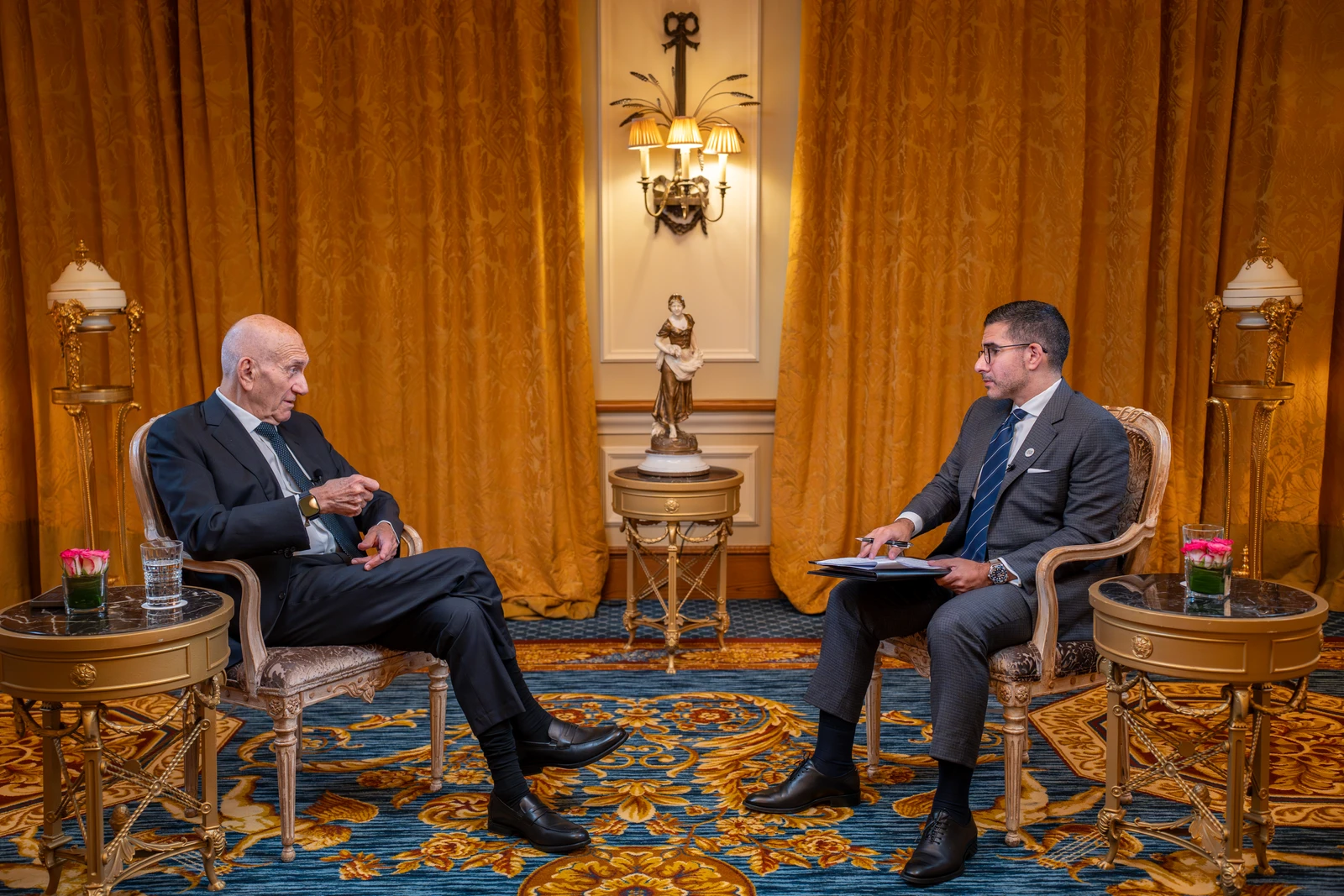
But the question, as Editor-in-Chief and host Faisal J. Abbas put it during an interview for the “Arab Views” podcast in Athens, is whether anybody in Israel is listening — and whether there is a serious partner for peace on the other side.
For more than two decades, the Arab world has had a peace plan, while Saudi Arabia has made clear that normalization with Israel must come in exchange for an irreversible path toward Palestinian statehood.
Olmert believes the outcome of the Israeli election could help determine whether that prospect remains achievable.
“I very much hope so,” he said when asked whether the vote would end the Netanyahu era. “For a long, very long time, the polls show that the bloc that supports Netanyahu doesn’t have more than 52 to 53 seats in the Knesset.”
A coalition needs 61 of the parliament’s 120 seats to form a government. Olmert has already chosen his preferred successor, former army chief Gadi Eisenkot.
“First of all, we have to get rid of the government of Netanyahu and the politics of Netanyahu and the voices and the rhetoric of Ben-Gvir and Smotrich and the like,” he said, referring to far-right politicians Itamar Ben-Gvir and Bezalel Smotrich.
“The group of thugs which are presently in charge of the Israeli national interests — they have to go.”
For Olmert, however, a change of government is only part of what is needed to revive the prospects for an agreement. He believes a regional leader could also make a difference.
“And it very much depends, to my judgment, on one single person who is not Israeli, who is not European, and he’s not American,” he said. “His Royal Highness MBS, Mohammed bin Salman. He can make a difference.”
Yet Olmert faces a deeply skeptical Israeli public. A Gallup poll released this month found that 65 percent of Israelis opposed a two-state solution, an almost complete reversal from 2012.
“First of all, it’s not surprising,” Olmert said. “I would expect that even more than 65 percent of the Israelis will be against the Palestinian state at this stage.”
He attributed that opposition largely to the Oct. 7 attack and its aftermath.
“The reason, largely, primarily, is the natural, even understandable reaction of the majority of the Israelis to the horrors of Oct. 7.”
Olmert said friends who had previously shared his political views and support for a two-state solution had since abandoned the idea, telling him they no longer believed the Palestinians could be relied upon to cooperate.
That change in public sentiment has coincided with renewed scrutiny of Netanyahu’s handling of Hamas in the years before the attack.
For years, Netanyahu’s critics have accused him of strengthening Hamas in Gaza to undermine the Palestinian Authority in Ramallah. Olmert went further, alleging that the prime minister had sought to buy Hamas’s cooperation through economic concessions and financial support.
“So he turned to Hamas, ignoring Mahmoud Abbas, hoping that he can buy Hamas by providing them with jobs in Israel and with financial support from Qatar,” Olmert said.
“And he helped bring in hundreds of millions of dollars in cash money. Cash money in suitcases.”
Olmert also blamed Netanyahu for the rise of Yahya Sinwar, the Hamas leader who planned the Oct. 7 attack. Sinwar was among more than 1,000 Palestinian prisoners released by Israel in 2011 in exchange for captured Israeli soldier Gilad Shalit.
“Netanyahu single-handedly made Sinwar, the archenemy of the State of Israel, into the leader of Hamas and gave him Gaza to exercise his murderous attitude towards Israel,” Olmert said.
Netanyahu is also alleged to have received warnings before the Oct. 7 attack, which he ignored..
A report in The Atlantic said Egypt’s then-intelligence chief, Abbas Kamel, had flown to Israel 11 days before the assault to warn the government. Asked about the report, Olmert suggested that such a visit would have carried considerable significance.
“Obviously, you know, when a plane of the Egyptian intelligence, military intelligence, lands in Israel for one hour and it goes back, this is not in order to bring flowers or to get a chocolate bag from someone in Israel,” he said.
Olmert also said he knew of a separate warning that had reached Netanyahu approximately five days before the attack.
“I think, to the best of my memory, five days before Oct. 7, from a highly authoritative, reliable, and powerful person to the prime minister, warning him that Hamas is about to start a comprehensive, murderous military operation on the entire front with Israel,” he said.
“And the prime minister didn’t respond, didn’t even share the warning with the military and the security high command.”
Netanyahu’s office rejects The Atlantic report and denies that the UAE warned Israel, while dismissing critics such as Olmert as political opponents.
Olmert also questioned Netanyahu’s alleged response on the morning of the attack. He said the prime minister had asked, “Why do they shoot?” — interpreting the reported remark as evidence of an understanding that Hamas would not attack in exchange for money and concessions.
“We give you money, we help you, and you don’t fight,” Olmert said.
Netanyahu’s office has rejected the allegations surrounding the warnings. Olmert argued that Israel would not get answers about the failures surrounding Oct. 7 without a formal state commission of inquiry.
He said appointing one should be the first decision of a new government, or of a new parliamentary majority able to muster 61 votes against Netanyahu.
“The first decision, it will be to appoint a commission of inquiry that will go into the background, the circumstances that led to Oct. 7,” he said.
On Gaza, Olmert reiterated his position that Israel had committed war crimes while rejecting the characterization of its military campaign as genocide.
He said the absence of a government policy of genocide was central to his distinction between the two terms.
“We have to recognize that there was not a policy of genocide of the Israeli government,” he said.
“War crimes, war crimes. But not every war crime is genocide.”
Asked to explain what he considered war crimes, Olmert cited the destruction of public facilities where civilians were present, if there was no imminent security need for the attacks.
“If, as we think, there were sometimes public facilities that were destroyed where hundreds of civilians were present, and that it was not an imminent security need, and still it took place and civilians were killed, this is a war crime,” he said.
Citing a death toll in Gaza of 75,000, Olmert said he believed more than half of those killed had not been involved in terrorist activity.
“And this is a number which is intolerable and unacceptable and unforgivable.”
He nevertheless described the International Criminal Court’s arrest warrant for Netanyahu as a mistake.
Olmert was even more forceful in his condemnation of Israeli settler violence in the occupied West Bank, describing attacks against Palestinians as part of a concerted effort to expel them from their land and prepare the territory for annexation.
He referred to what he called daily atrocities against Palestinians who were not involved in violence.
“This is a crime, a terrible crime, a pogrom in nature, the worst thing,” he said.
Abbas noted that Netanyahu had dismissed the violence at the UN as the work of a few juveniles and suggested that those who viewed it more seriously had been radicalized.
Asked whether he had been radicalized, Olmert replied: “A long time ago, for many other reasons as well.”
He said he had long been subjected to abuse from Netanyahu’s supporters.
“So I’ve been radicalized, and I’ve been cursed, and I was called a traitor by the poison machine of Netanyahu for a very long time.”
Olmert also pointed to Israelis from civil society who travel to Palestinian communities to provide support and help residents defend themselves against settler attacks.
The discussion then returned to the peace proposal Olmert made to Palestinian President Mahmoud Abbas in 2008. It envisaged a Palestinian state roughly along the 1967 lines, with land swaps and a shared Jerusalem.
The offer was never signed, and many in the Arab world believe Abbas did not take it seriously because Olmert was already on his way out of office.
Asked directly whether the proposal had been sincere, Olmert replied: “Absolutely.”
He cited the memoirs of Condoleezza Rice, the US secretary of state at the time, as evidence of his commitment to an agreement.
Olmert recalled explaining his plan during a dinner at his residence, saying that he repeatedly asked the waiters not to serve the food because he was engrossed in describing his proposal. Rice, he said, later remarked that she could hardly believe what she had heard.
But Palestinians have offered a different account of the negotiations, pointing to Olmert’s refusal to let Abbas take away the map of what territories would be exchanged to show his experts.
Olmert acknowledged withholding it, saying he feared Abbas would leave with the map and never return.
“My refusal was, at the time that we were in that meeting, based on my fear he will take the map and never come back,” he said.
“And it turned out that I was not so wrong.”
Olmert said he had asked Abbas to return the following day with experts, arguing that Ramallah was only a 45-minute drive from his residence in Jerusalem.
Instead, he recalled receiving a telephone call from Saeb Erekat, then chairman of the Palestinian negotiating committee, apologizing that Abbas had to travel to Amman and saying he would return with a map expert.
Olmert said he was still waiting for that meeting nearly 18 years later.
For him, the failure to reach an agreement does not remove the need for change on both sides. He argued that Palestinians seeking recognition of their own rights must also recognize Israel’s right to exist.
“The Palestinians want to have their own right recognized,” he said.
“They have to recognize explicitly, publicly, proudly, Israel’s right to exist rather than to always be in opposition.
“So the change has to take place in both places.”
Olmert’s own record remains part of the debate over his legacy. He resigned in 2008 rather than fight corruption charges from the prime minister’s office, was convicted and imprisoned, and wrote his memoirs in his cell. He continues to describe the case against him as a conspiracy.
He defended his decision to leave office, arguing that the standing of the government and the position of prime minister were more important than his own political survival.
“I chose to deal with it not from my position of prime minister because I thought that the status of the government and the status or the position of prime minister is more important than the personal status of the individual,” he said.
“And I paid a dear price for it.”
He contrasted his decision with Netanyahu’s approach, arguing that the current prime minister had placed his own political survival above the interests of the country.
“For him, his personal survivability was more important than the interest of the state,” Olmert said.
Olmert will not be on the ballot in the coming election. But he has cast himself as a voice for an Israel that he believes Netanyahu’s government has pushed aside, leaving the question of whether others will follow his lead.
Asked about the prospects for change, he ended on a note of cautious optimism.
“So there is a glimpse of hope here, rising up, and I believe that with the outcome of the coming elections, it will all change.”