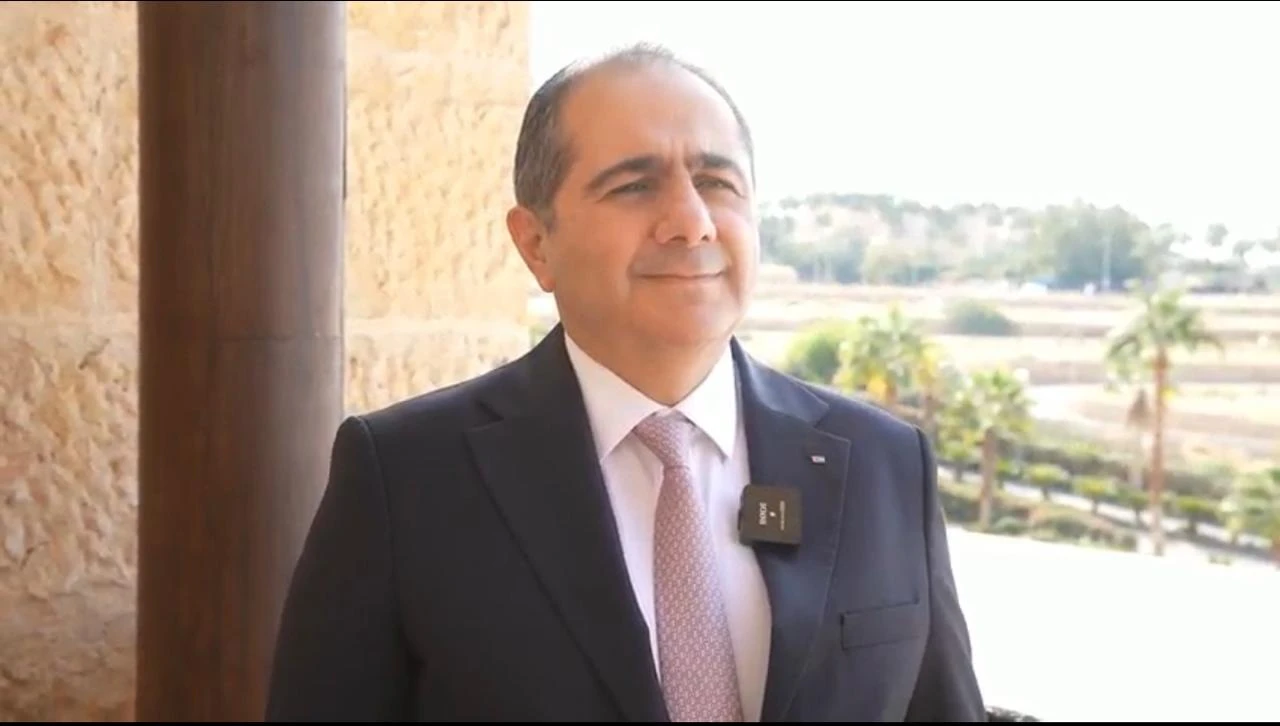
DEAD SEA: Jordan expects its new wave of artificial intelligence and data center projects to add about 3.6 billion Jordanian dinars ($5 billion) to the economy and help double employment in the tech sector, Minister of Digital Economy and Entrepreneurship Sami Smeirat told Arab News on the sidelines of the Jordan-EU Investment Conference.
Speaking shortly before a series of announcements that he said would focus on AI and advanced technology, with data centers at the core, Smeirat said: “Data centers are at the heart and forefront of these announcements.”
He said the package included a 400-megawatt data center in the Al-Risha area and a 200-megawatt AI campus, along with other data centers and upgrades to AI research capacity for universities.
“Collectively, these will definitely have an impact on growth in Jordan,” he said. “We are expecting a contribution of 3.6 billion Jordanian dinars to GDP, and in employment it will make a big difference.”
Jordan’s ICT sector currently employs 50,000 young people, according to Smeirat, with the government aiming for 100,000 by 2033.
The conference at the Dead Sea brought European officials, investors and development finance institutions together with Jordanian policymakers, with the aim of turning the partnership between Jordan and the European Union into concrete projects.
Smeirat said the country’s case to investors rested on its people as much as its infrastructure. Jordan, he said, “has been known for its unique talents, its advanced digital infrastructure and its entrepreneurs.”
He pointed to Jordan’s outsized role in the region’s startup scene, saying: “Twenty-seven percent of the Arab world’s entrepreneurs came out of Jordan, and those entrepreneurs created companies that reached Series A, B and C financing, while we represent 3 percent of the Arab world.”
He described that track record as momentum built over 25 years that the government now wanted to sustain. “We need to keep this momentum,” he said, adding that the new announcements were part of those efforts.
Smeirat acknowledged that successive governments had done well in building the sector, but said the next step was to connect its parts more effectively.
“We think we need to connect the talents better with the digital infrastructure and the innovation environment that we have,” he said.
That is the aim of Jordan Forward, an initiative that came out of the National Council for Future Technology, which is overseen by Crown Prince Al-Hussein bin Abdullah II.
According to Smeirat, the initiative is designed to strengthen the whole tech ecosystem and amplify its impact by linking academia with research, and turning that research into viable ideas, entrepreneurs and companies.
The target is ambitious. “Ultimately, the target is to have 400 homegrown companies within the coming 10 years,” he said.
Reaching that number will require a much larger pool of early-stage ventures. Smeirat said the government would probably need to work with a funnel of about 4,000 to produce the 400 companies it is aiming for.
Beyond Jordan’s borders, the minister said regional cooperation on digital infrastructure is stronger than ever, naming Saudi Arabia, the UAE, the wider Gulf Cooperation Council and Syria.
“The cooperation and collaboration with our Arab neighbors and friendly countries, Saudi Arabia, the UAE, the whole GCC, and Syria as well, is at its best,” he said. “We are currently working with our colleagues from Syria to create a digital corridor that will create diverse connectivity between East and West.”
Smeirat said he met with his Saudi counterpart often, and that cooperation with Bahrain, Kuwait and Oman was also strong.
Taken together, the minister’s comments outline a strategy with three parts. The first is to build large-scale computing capacity at home through data centers and AI campuses. The second is to turn Jordan’s reputation for producing entrepreneurs into a pipeline of homegrown companies. The third is to use regional partnerships to place the kingdom at the center of new digital routes.
The data center projects are expected to drive the headline numbers, from the projected GDP contribution to the jobs target. But Smeirat’s emphasis on talent and startups suggests the government sees long-term value in the companies those projects help create, not only in the infrastructure itself.
For a country that accounts for 3 percent of the Arab world’s population but more than a quarter of its entrepreneurs, Jordan is betting that combining that talent with AI infrastructure and regional connectivity can turn the tech sector into one of its main growth engines.
Arab News PK