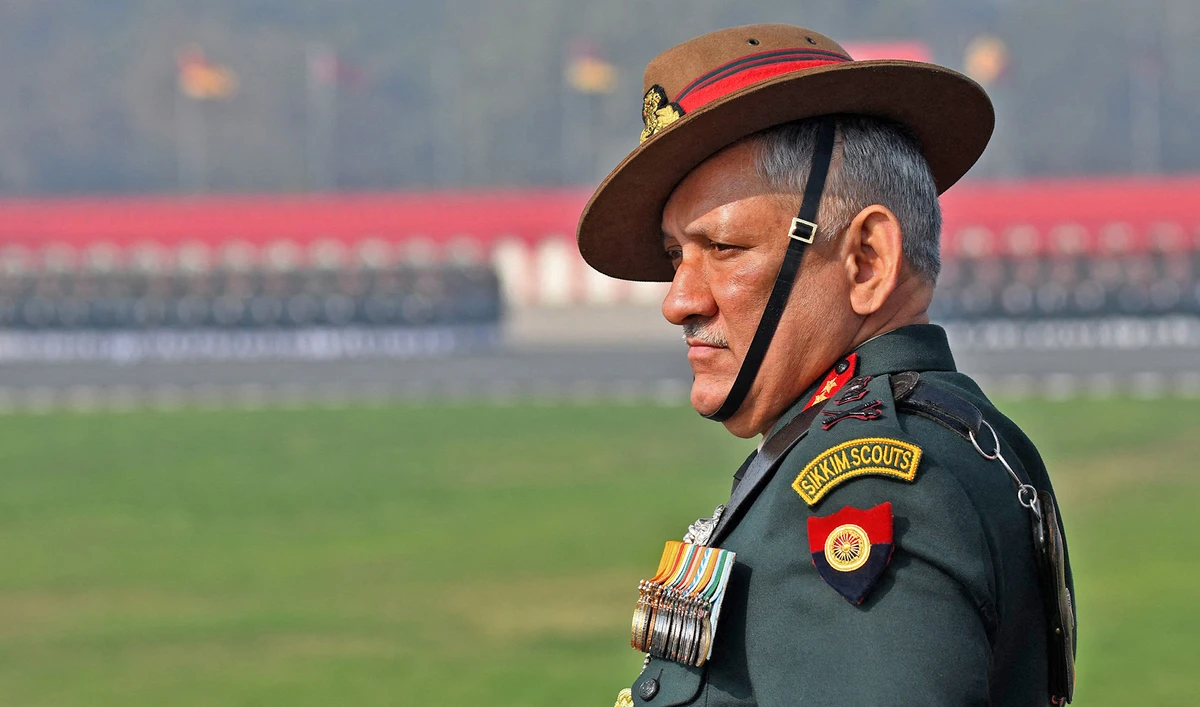
- Rawat, 63, was the first Chief of Defence Staff of India and was appointed in December 2019
- Wife and 11 others also killed in crash in Tamil Nadu, only surviving group captain reported to have 90% burns
NEW DELHI/ISLAMABAD: Indian defence chief General Bipin Rawat, his wife and 11 others have died in a military helicopter crash in the southern Indian state of Tamil Nadu, the Indian Air Force said on Wednesday.
Rawat was traveling from an Indian Air Force base in Sulur to the Defence Services Staff College in Wellington to deliver a lecture. Hill station Coonoor where the helicopter crashed shortly after take off is along the flight path.
The only survivor of the crash, Group Captain Varun Singh, is undergoing treatment at a military hospital in Wellington. Media reported that he had suffered 90% burn injuries in the crash.
“With deep regret, it has now been ascertained that Gen Bipin Rawat, Mrs Madhulika Rawat and 11 other persons on board have died in the unfortunate accident,” Indian Air Force said in a tweet.
The air force said an inquiry had been launched into the accident.
The Pakistan army’s media wing tweeted to express condolences over the crash on behalf of top military leaders.
"General Nadeem Raza, CJCSC (Chairman Joint Chiefs of Staff Committee) & General Qamar Javed Bajwa, COAS (Chief of Army Staff) express condolences on tragic death of #CDS General #BipinRawat, his wife and loss of precious lives in a helicopter crash in India,” the Pakistan army said in a tweet.
Rawat, 63, was the first Chief of Defence Staff (CDS) of India and was appointed in December 2019. Prior to that, he served as the 57th and last chairman of the Chiefs of Staff Committee as well as 26th Chief of Army Staff of the Indian Army.
“Gen Bipin Rawat was an outstanding soldier,” Indian Prime Minister Narendra Modi said on Twitter as he posted a picture of him and Rawat shaking hands. “A true patriot, he greatly contributed to modernising our armed forces and security apparatus. His insights and perspectives on strategic matters were exceptional. His passing away has saddened me deeply.”
“India will never forget his exceptional service,” Modi added.
Defence minister Rajnath Singh called Rawat’s death an “irreparable loss”: “As the first Chief of Defence Staff he had prepared plans for jointness of our Armed Forces.”
In a career spanning over 40 years, Rawat played a leadership role in India's restive northeast and also led United Nations peacekeeping missions abroad.
He also commanded forces in Kashmir and on the border with China. Recently, he was on the forefront of dealing with tensions in the Himalayan region of Ladakh where India and China have been in a protracted standoff. The two countries, which fought a border war in 1962, have over-lapping claims to large areas of territory along the frontier.