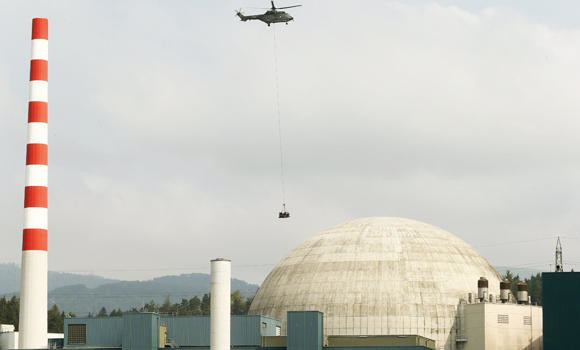
GENEVA: Greenpeace said Thursday it had launched legal action to demand that Switzerland shut down Beznau, the world’s oldest commercial nuclear plant, for security reasons.
The plant, located in the northern Swiss canton of Aargau, near the German border, has been running for 46 years.
“The Beznau nuclear plant would not resist a powerful earthquake,” the environmental protection group said in a statement.
The organization said it, along with the Swiss Energy Foundation and the Tri-national Nuclear Protection Association, had filed the suit on Wednesday demanding “the definitive closure of the installation.”
Following the 2011 Fukushima nuclear disaster in Japan, Swiss authorities launched probes to determine how all of the country’s four nuclear power plants would withstand an earthquake.
In July 2012, they determined that all were fit to withstand a severe earthquake, and could keep running since they posed no threat to the population or the environment.
But Greenpeace and the other plaintiffs in the case said the experts’ calculations were based on erroneous technical norms.
The organizations said they had asked in a letter that the Federal Inspectorate for Nuclear Safety (IFSN) “correct its July 2012 decision and order the closure of the Beznau plant.”

Greenpeace wants Swiss to shut aging nuclear plant
Kremlin says Putin is mediating in Iran to normalize situation
- Putin had then been briefed by Pezeshkian in a separate call on what the Kremlin called Tehran’s “sustained efforts” to normalize the situation inside Iran
MOSCOW: President Vladimir Putin is mediating in the Iran situation to quickly de-escalate tensions, the Kremlin said on Friday, after the Russian leader spoke with Israeli Prime Minister Benjamin Netanyahu and Iranian President Masoud Pezeshkian.
Moscow has condemned US threats of new military strikes after Iran acted against protests that broke out late last month.
Putin in his call with Netanyahu expressed Russia’s willingness to “continue its mediation efforts and to promote constructive dialogue with the participation of all interested states,” the Kremlin said, adding he had set out his ideas for boosting stability in the Middle East.
No further details were given on Putin’s mediation attempt.
Putin had then been briefed by Pezeshkian in a separate call on what the Kremlin called Tehran’s “sustained efforts” to normalize the situation inside Iran.
“It was noted that Russia and Iran unanimously and consistently support de-escalating
the tensions — both surrounding Iran and in the region as a whole — as soon as possible
and resolving any emerging issues through exclusively political and diplomatic means,” the Kremlin said.
Putin and Pezeshkian had confirmed their commitment to their countries’ strategic partnership and to implementing joint economic projects, the Kremlin added.
Separately, the Shanghai Cooperation Organization, which includes Russia, China, India, and Iran, among others, said it opposed external interference in Iran and blamed Western sanctions for creating conditions for unrest.
“Unilateral sanctions have had a significant negative impact on the economic stability of the state, led to a deterioration in people’s living conditions, and objectively limited the ability of the Government of the Islamic Republic of Iran to implement measures to ensure the country’s socio-economic development,” the SCO said in a statement.
Protests erupted on Dec. 28 over soaring inflation in Iran, whose economy has been crippled by sanctions.
Asked what support Russia could provide to Iran, Kremlin spokesman Dmitry Peskov said: “Russia is already providing assistance not only to Iran but also to the entire region, and to the cause of regional stability and peace. This is partly thanks to the president’s efforts to help de-escalate tensions.”
The US Treasury on Thursday announced new sanctions targeting Iranian officials, including Ali Larijani, secretary of Iran’s Supreme Council for National Security.