Back from Iran, Pakistani students say they heard gunshots while confined to campus

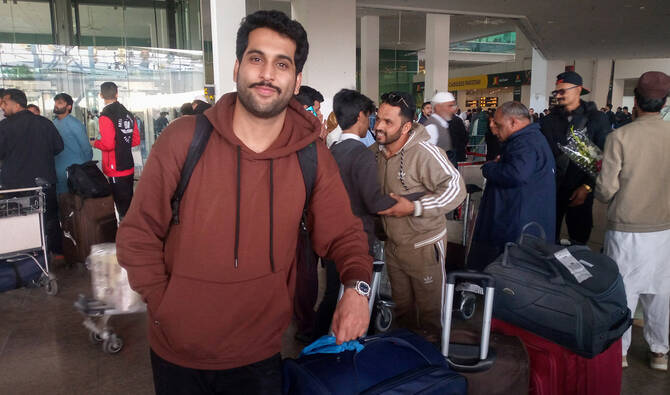
A Pakistani medical student Arslan Haider waits at the airport after arriving from Tehran on a commercial flight amid the ongoing nationwide protests in Iran, in Islamabad. (REUTERS)
Short Url
Updated 15 January 2026
Follow

Back from Iran, Pakistani students say they heard gunshots while confined to campus

  • Students say they were confined to dormitories and unable to leave campuses amid unrest
  • Pakistani students stayed in touch with families through the embassy amid Internet blackout

ISLAMABAD: Pakistani students returning from Iran on Thursday said they heard gunshots and stories of rioting and violence while being confined to campus and not allowed out of their dormitories in the evening.

Iran’s leadership is trying to quell the worst domestic unrest since its 1979 revolution, with a rights group putting the death toll over 2,600.

As the protests swell, Tehran is seeking to deter US President Donald Trump’s repeated threats to intervene on behalf of anti-government protesters.

“During ‌nighttime, we would ‌sit inside and we would hear gunshots,” Shahanshah ‌Abbas, ⁠a fourth-year ‌student at Isfahan University of Medical Sciences, said at the Islamabad airport.

“The situation down there is that riots have been happening everywhere. People are dying. Force is being used.”

Abbas said students at the university were not allowed to leave campus and told to stay in their dormitories after 4 p.m.

“There was nothing happening on campus,” Abbas said, but in his interactions with Iranians, he ⁠heard stories of violence and chaos.

“The surrounding areas, like banks, mosques, they were damaged, set on fire ... ‌so things were really bad.”

Trump has repeatedly ‍threatened to intervene in support of protesters ‍in Iran but adopted a wait-and-see posture on Thursday after protests appeared ‍to have abated. Information flows have been hampered by an Internet blackout for a week.

“We were not allowed to go out of the university,” said Arslan Haider, a student in his final year. “The riots would mostly start later in the day.”

Haider said he was unable to contact his family due to the blackout but “now that they opened international calls, the students are ⁠getting back because their parents were concerned.”

A Pakistani diplomat in Tehran said the embassy was getting calls from many of the 3,500 students in Iran to send messages to their families back home.

“Since they don’t have Internet connections to make WhatsApp and other social network calls, what they do is they contact the embassy from local phone numbers and tell us to inform their families.”

Rimsha Akbar, who was in the middle of her final year exams at Isfahan, said international students were kept safe.

“Iranians would tell us if we are talking on Snapchat or if we were riding in a cab ... ‌that shelling had happened, tear gas had happened, and that a lot of people were killed.”


Pakistan has ruled out military operation in northwestern Tirah Valley

Updated 4 sec ago
Follow

Pakistan has ruled out military operation in northwestern Tirah Valley

  • Residents in northwestern Tirah Valley fled their homes this month fearing a military operation against militants
  • Defense minister says army conducting intelligence-based operations in area, residents’ migration “routine” practice

Islamabad: Defense Minister Khawaja Asif on Tuesday clarified that the military was not conducting a military operation in the northwestern Tirah Valley, saying that the ongoing residents’ migration from the area was a routine practice that has been going on for several years. 

The defense minister’s clarification came as residents of Tirah Valley in Pakistan’s northwestern Khyber Pakhtunkhwa (KP) province bordering Afghanistan fled their homes this month, fearing a planned military operation by the army against militants, particularly the Tehreek-e-Taliban Pakistan (TTP) group. 

Pakistan’s information ministry on Sunday issued a clarification that the armed forces were not involved in the “depopulation” of the valley. It pointed to a notification from the provincial Khyber Pakhtunkhwa Relief, Rehabilitation and Resettlement Department in December which demanded the release of funds, reportedly Rs4 billion [$14.24 million], for the voluntary movement of people from Tirah Valley. 

Speaking to reporters at a news conference alongside Information Minister Attaullah Tarar and Special Assistant to the PM for Information and KP Affairs Ikhtiar Wali Khan, Asif said the last military operation in the area was conducted several years ago. He said the military had decided that intelligence-based operations (IBOs) were more effective than military operations as they resulted in lower civilian casualties. 

“So over a long period of time, the army gave up [military] operation in favor of IBOs,” Asif said. “For many years this practice has been continuing. Hence, there is no question of an operation there.”

The defense minister described the migration of residents from Tirah Valley as a “routine” practice due to the harsh cold. 

He criticized the provincial government, led by the Pakistan Tehreek-e-Insaf (PTI) party for not serving the people of the area, accusing it of not building any schools, hospitals, or police stations in Tirah Valley.

Asif said around 400-500 TTP members lived in the valley with their families, alleging that hemp was being harvested there on over 12,000 acres of land. He said that while hemp is also used for medicinal and construction purposes, its dividends were going to militants and politicians. 

“All of this hemp is harvested there and the dividends from it either go to the people associated with politics or the TTP,” the minister said.

“We have initiated the process to stop this so that the people benefit from this harvest and so that schools and hospitals are constructed there.”

The minister said that a district-level jirga or tribal council met representatives of the KP government on Dec. 11, 24 and 31 to decide matters related to the residents’ migration in the area. 

Holding up the KP Relief, Rehabilitation and Resettlement Department notification, Asif said:

“In the presence of this notification, in the presence of this tribal council and in the presence of all of these things, where do you see the army?“

The minister accused the provincial government of deflecting its “failures” in the province to the armed forces or to a military operation that did not exist. 

The migration has exposed tensions between the provincial government and the military establishment over the use of force in the region.

KP Law Minister Aftab Alam Afridi said earlier this month that the provincial government will not allow a military operation to take place in the area, arguing that past military campaigns had failed to deliver lasting stability.