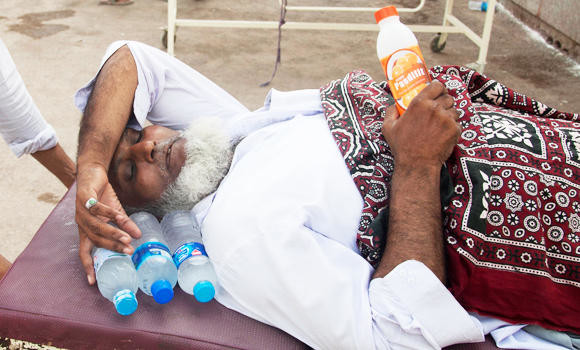
Pakistan heat wave eases after more than 1,150 die

Updated 26 June 2015
Follow

Pakistan heat wave eases after more than 1,150 die

KARACHI: Sea breezes brought cooler temperatures on Friday to ease a heat wave that killed more than 1,150 people over a week around Pakistan’s teeming port city of Karachi.
Meanwhile, Pakistani welfare volunteers held a mass funeral for 50 victims of Karachi’s worst heatwave in decades, whose bodies had gone unclaimed.
The extreme heat of up to 44 degrees Celsius, the hottest since 1981, coincided with power failures and triggered sharp criticism of the government’s response in the city of 20 million people.
The crisis, following a heat wave in India last month that killed about 2,500 people, illustrates how ill-prepared many developing nations are for the extreme weather conditions that scientists say will accompany global climate change in coming decades.
“These type of events are taking place across the world ... we need to prepare ourselves and develop our strategy,” said Qamar uz Zaman Chaudhry, the Islamabad-based special adviser for Asia to the UN-World Meteorological Organization.


Cyclone Gezani destroys 18,000 homes and causes at least 36 deaths in Madagascar

Updated 4 sec ago
Follow

Cyclone Gezani destroys 18,000 homes and causes at least 36 deaths in Madagascar

ANTANANARIVO, Madagascar: Cyclone Gezani killed at least 36 people, injured more than 370 and destroyed almost 18,000 homes across Madagascar, authorities said Thursday.
Madagascar’s president has declared a national disaster and made a plea for international leaders to help the largely poor Indian Ocean island.
The tropical cyclone made landfall late Tuesday and caused widespread destruction in the main port city of Toamasina on the east coast before tearing across the country.
The National Office for Risk and Disaster Management said Thursday the death toll had risen to at least 36 while six people were missing. It said 374 people were injured and more than 250,000 people were affected by the storm.
Authorities said 32 of the deaths occurred in the Toamasina area, the country’s main port and an economic hub. President Michael Randrianirina said 75 percent of the city was damaged or destroyed.
Many of Madagascar’s 31 million people live in houses that give inadequate shelter from strong storms and authorities said many of the deaths were caused by building collapses.
The disaster agency said 17,980 houses were destroyed and more than 37,000 others were damaged by Gezani, which brought winds in excess of 195 kph (121 mph).
Drone video released by the disaster agency showed the extent of the damage in Toamasina, home to more than 300,000 people. Almost every building sustained major damage by having their roofs or other parts of the structures ripped off. Many buildings were flattened completely, while trees were stripped bare or uprooted and left lying in roads across the city.
Residents trudged through floodwater that reached to their knees as they began to piece their lives back together.
“We can clearly see what Toamasina needs right now: above all, food, basic necessities, and building materials to quickly rebuild everything that has been destroyed in Toamasina and its surroundings,” Randrianirina said after he visited the city that took the brunt of the cyclone. He called on all of Madagascar’s people to help with the recovery effort.
Madagascar, off Africa’s east coast, is especially vulnerable to destructive storms that blow in off the Indian Ocean. It has been hit by more than a dozen cyclones or strong tropical storms since 2020.
A cyclone hit the northwest part of the island just last month, killing at least 14 people.