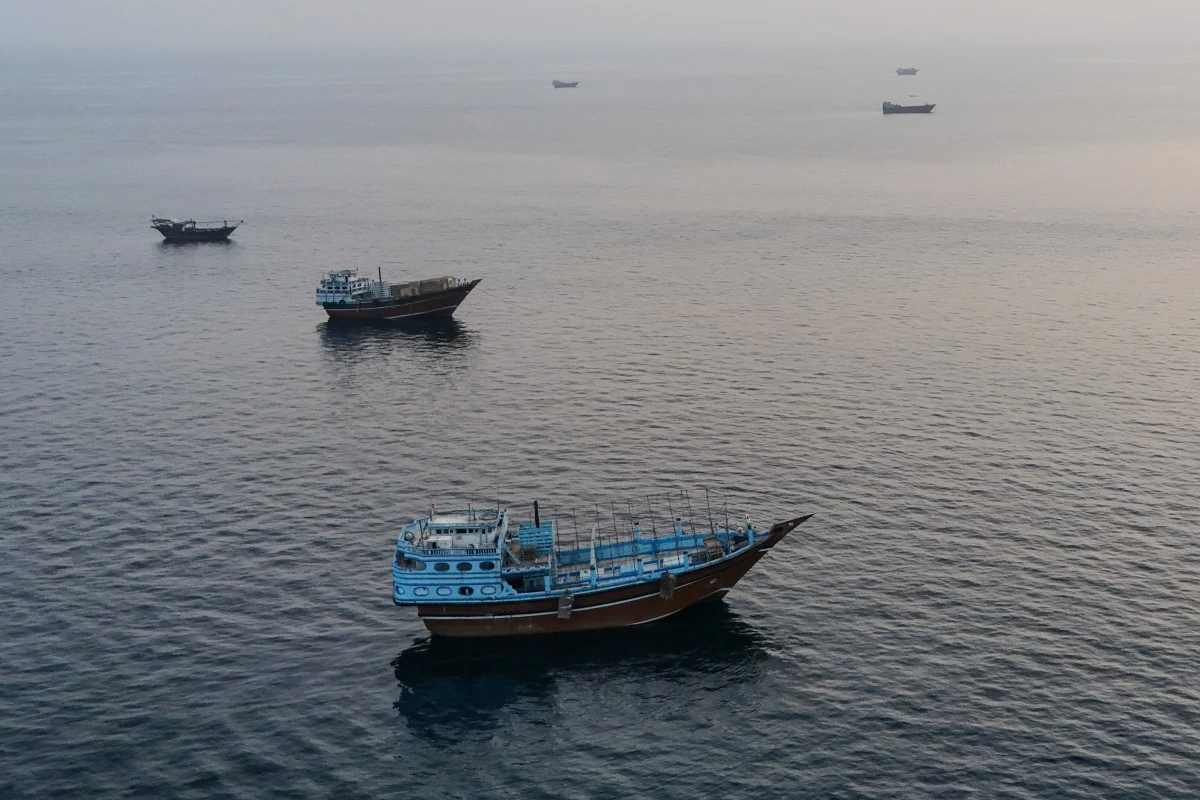
- Sailor from Gujarat is 15th Indian killed in attacks on ships around Strait of Hormuz
- Indian-flagged MSV Al-Jusufi was struck by an ‘unidentified aerial object’ off Oman
NEW DELHI: India condemned on Tuesday the killing of a national aboard a vessel attacked near the Strait of Hormuz, which brought to 15 the number of Indians killed in attacks on merchant ships amid escalating tensions between the US and Iran.
The Indian-flagged MSV Al-Jusufi cargo ship was hit near Limah in Omani waters overnight. It was manned by 14 Indian nationals.
Shipping Minister Sarbananda Sonowal said on X that it was struck by “an unidentified aerial object while navigating near the coast” of Oman.
“While 13 crew members safely evacuated and were rescued by the Omani Coast Guard, I am deeply saddened to report that one of our seafarers, Gandhar Nahim Ajij from Gujarat, tragically succumbed to his injuries.”
The Ministry of External Affairs called for an “immediate de-escalation” and the conclusion of ongoing peace talks between the US and Iran to return stability to the region.
“We condemn the attack on a commercial vessel MSV Al-Jusufi,” it said in a statement.
“The targeting of commercial shipping and civilian infrastructure in the region must end, and free and unimpeded navigation and commerce through the international waterways in the region, in keeping with international law, must be restored at the earliest.”
The sailor became the 15th Indian seaman killed in the area since the beginning of US and Iranian strikes in the strait in March, according to data from the Ministry of External Affairs.
Last week, the ministry’s spokesperson, Randhir Jaiswal, told reporters in New Delhi that 14 seafarers were among Indians killed in the war.
While in the previous attacks — some of which were claimed by Iranian or US forces — most of the targeted ships were tankers, MSV Al-Jusufi is a dhow, according to Manoj Yadav, secretary-general of the Forward Seamen’s Union of India, a labor union representing sailors working aboard commercial vessels.
Dhows are traditional wooden sailing boats historically used across the Arabian Gulf, Red Sea, and Indian Ocean for trade, fishing, and transportation.
“I have spoken with a few seafarers who work on the same dhow. It’s not a commercial vessel, it’s not a merchant vessel, it’s a dhow,” Yadav said.
“The person who was killed on board had lost his father 20 years back. He was also working on a dhow, and in that dhow he died.”
India’s maritime regulator in July called on ship owners, managers and recruitment agencies to stop sending Indian nationals to work on vessels going through the Strait of Hormuz, following attacks on at least 10 civilian ships staffed by Indian seafarers.
But the advisory was not binding. According to the FSUI, more than 4,000 Indian sailors remain aboard vessels in the region.