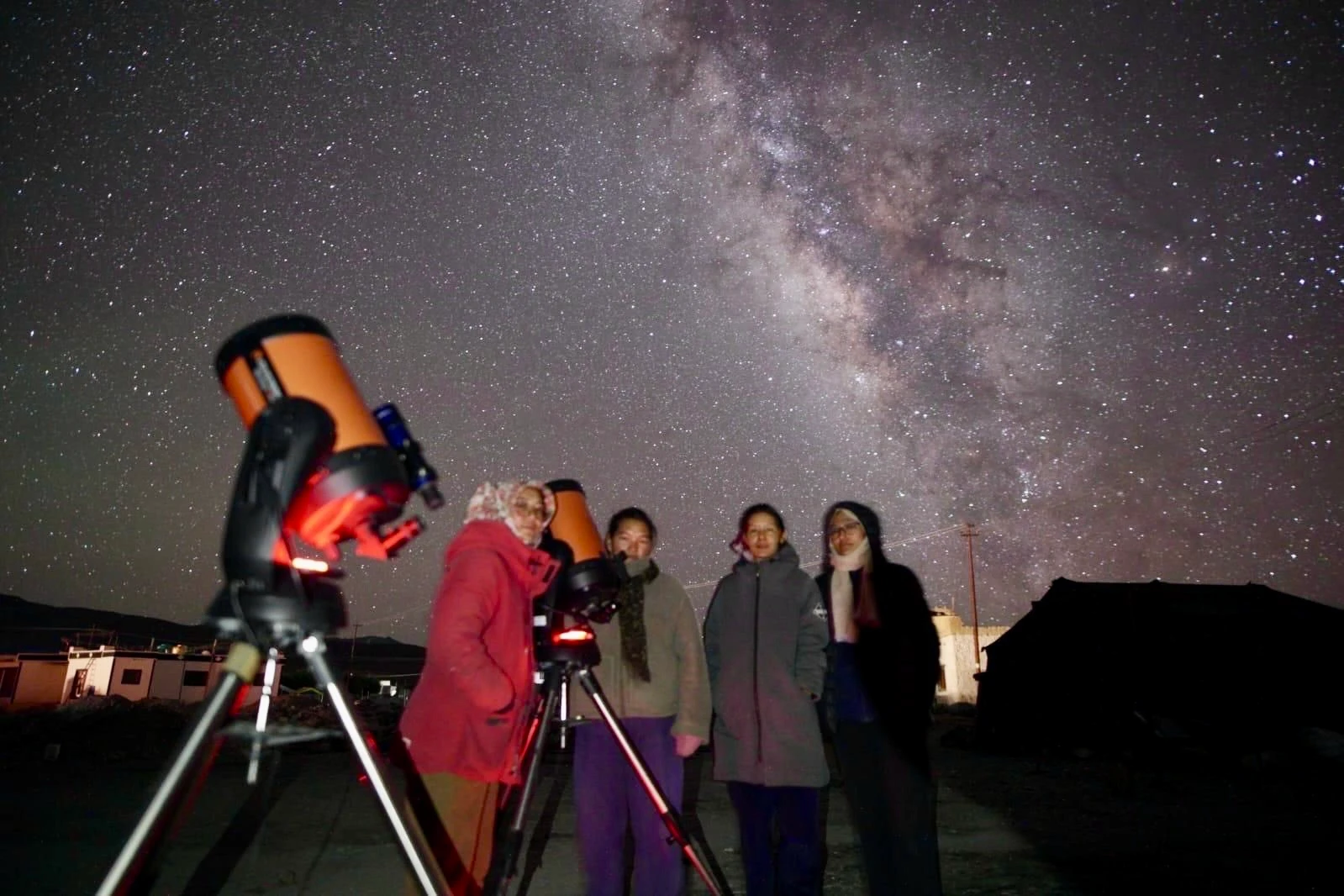
- All in their late 20s, the guides were trained by Indian Institute of Astrophysics
- Hanle, in the Himalayan region of Ladakh, was declared Dark Sky Reserve in 2022
NEW DELHI: It is nearing 10 p.m., and Padma Chamchot is busy helping tourists peer through her telescope. For the next few hours, they will brave the Himalayan cold, gazing at the stars without flinching as she guides them through different constellations.
It all started in 2022, when she passed her 10th standard exam and saw an advertisement by the Ladakh Union Territory administration and the Indian Institute of Astrophysics for candidates to become “astro ambassadors.” She was among 24 students chosen for training.
“In the training, we were taught how to operate (a) telescope, how to monitor stars through telescopes. We were also told about the solar wind and other stars,” she told Arab News.
“It’s not that we learnt about stars only through training. We learned about them through our relatives and others. Night is very dark in our area because there is no light and we gaze at the stars from the beginning.”
What they knew since childhood was complemented with technical skills, including how to photograph the Milky Way on phones for tourists, and how to identify stars, planets and constellations and navigate the night sky.
Chamchot is a native of Hanle, in India’s Himalayan region of Ladakh. It is located at 4,500 meters above sea level and is known for its clear, dark skies. It is also home to the Indian Astronomical Observatory, operated by the Indian Institute of Astrophysics, and is one of India’s leading centers for astronomical research. In 2022, the village found a place on India’s astrotourism map, when it was declared the country’s first Dark Sky Reserve to protect its skies from artificial light.
The recognition marked a new beginning for its locals — a predominantly pastoral Buddhist community of around 3,000 people.
“After taking training, I started working as an astro ambassador and every night, we would go to the hills with our telescope. In a peak tourist season, we get at least 20-30 tourists (a day),” Chamchot said.
“Life has changed after joining this profession. My earnings help my family. The income that I generate helps the household. I, as a woman, feel more free, independent and at liberty to do whatever I want to do.”
She is not alone. Out of 24 astro ambassadors who received training, 18 are girls — all in their 20s.
Tsering Dolkar, another member of the group, has been able to uplift her family with the job. She earns about $400 a month in the peak season.
“I earn well,” she said. “This helps me and my family. My father does not work, and the earnings help the family live a comfortable life.
She admits that she was not interested in astronomy before. But her training at the Indian Institute of Astrophysics made her want to continue learning.
“The knowledge about stars not only changed me but also gave me a meaning in life,” she said.
“I feel empowered being an astro ambassador. I want to study more.”