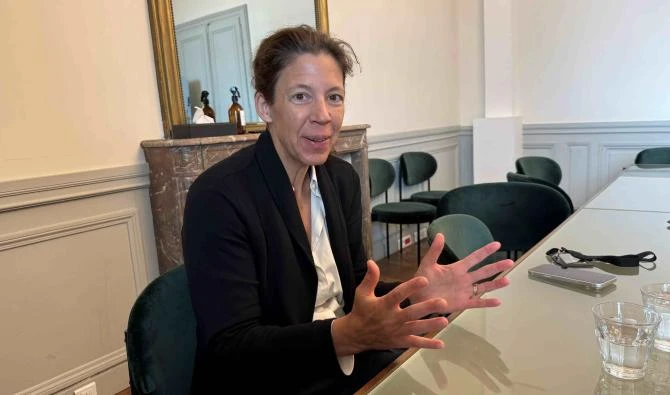
PARIS: Helene Huby may still be aged under 50, but she leads one of Europe’s most ambitious space companies, with 650 employees, contracts worth billions and a project that goes far beyond mere technological prowess.
Her ambition is to build the space transportation systems of tomorrow, but also to help shape a space sector that serves as a forum for cooperation among nations — a vision in which the Arab world, and Saudi Arabia in particular, plays a role she intends to expand.
Huby has an almost disarming way of recounting a journey that, seen from the outside, is anything but ordinary.
When asked how she ended up in the space world, her answer can be is a simple one: “By chance.”
After her husband accepted a position in Bremen, Germany, she began looking for a new job. A position opened up at Airbus; she took it, and it was there, she says, that she discovered her calling.
“That’s it,” she sums up with a simplicity that stands in stark contrast to the path that would follow.
She worked “incredibly hard.” She caught the attention of the chief technical officer at Airbus Defence and Space, who offered her the role of leading the group’s innovation efforts.
The Exploration Company
It was a considerable gamble because when Huby entered the industry, she knew practically nothing about space. She seized the opportunity and, by her own admission, “delivered” rather well. Her rise was then meteoric.
She moved on to ArianeGroup, where she led a small rocket project, among other things, before returning to Airbus. There, she became vice president in charge of the European Service Module — the European component of the Orion capsule that orbited the Moon.
Europe produced half of this capsule, and while working on it, an idea began to take hold: “Why not build the entire capsule?”
In 2021, Huby left Airbus and founded The Exploration Company. Five years later, she says, two capsule prototypes have flown, but neither has completed its entire mission. Only the most recent one accomplished the bulk of what was required of it.
The next goal is far more ambitious: it involves flying the final capsule to a space station. The schedule calls for a first flight in November 2028, but delays are common in this industry, and the date could change.
What stands out about Huby is that she does not start by talking about growth or valuation. She talks about impact. “What drives me is impact,” she explains, and the idea of having, at the end of a full life, created “as much positive impact as possible.”
She says her project took shape as she observed gaps and tried to fill them. Europe did not have a space capsule: she decided to create one.
But she identified another gap — one that lies in the way humanity is preparing to build its future in space, which is not only a new technological frontier, but also part of our collective future.
Yet, she notes, this space is currently being shaped in an increasingly “confrontational” manner, particularly through the rivalry between the US and China.
In contrast, her solution involves building spacecraft in collaboration with multiple countries, bringing different nations together to work as a team and using technology to foster concrete partnerships.
This ambition goes beyond technology, and she is striving to realize it through The Exploration Company, which specializes in what she calls “the space transportation vertical.”
On one hand, rockets enable travel from Earth into space. On the other, capsules provide transportation between space, space stations and back to Earth.
The company aims to gradually master this entire chain: Building the vehicles, but also operating them. According to Huby, this integrated approach is similar to how an airline might both build and operate its own aircraft.
The financial challenge is on par with the ambition: it takes about half a billion euros to develop a cargo capsule, about four billion for a capsule designed for crewed flight and several more billion to develop a very large launch vehicle.
She is not promising the impossible. Huby knows that timelines can slip, that prototypes can fail and that the technology still has to prove itself. But her current obsession is surprisingly simple: “To make the product work.”
That same clarity comes through when she talks about sustainability. She refuses to portray spaceflight as inherently clean: “A rocket pollutes,” she acknowledges bluntly.
The challenge, therefore, is to minimize its environmental impact as much as possible by reusing capsules and rockets, using biomethane for future launch vehicles and paying close attention to the production chain.
But here again, Huby refuses to let go of her caution. The priority, she insists, is that the vehicles work. Only then will it be possible to go even further in reducing their environmental footprint.
Thomas Pesquet
The capsule was designed so that the non-reusable portion disintegrates in the atmosphere upon separation, rather than becoming additional space debris.
This approach is indicative of her way of thinking: she does not claim to solve all the world’s problems, but believes that every stakeholder must take their share of responsibility.
This conviction also explains her involvement alongside French President Emmanuel Macron in the space summit held in Paris on Sept. 9 and 10.
Along with astronaut Thomas Pesquet, who shares her passion for human spaceflight and Europe’s ambitions in space, she was selected as a special envoy for the summit.
More than 120 delegations are expected, and the stakes go far beyond technical issues. The goal is to reflect on how humanity will live and cooperate in this space that is gradually becoming a new frontier.
It is with this same mindset that she is looking with great interest toward the Arab world. The Exploration Company is already established in the UAE and is developing collaborations with various partners there.
Discussions are also underway with Saudi Arabia, says Huby, who believes that the Arab world will become one of the major leaders in space over the next 10 years.
She sees countries there that are ambitious, have a deep understanding of technology, and, above all, the ability to ensure their decisions are sustainable over the long term.
She specifically cites Saudi Arabia, which has set local production targets in the military sector and pursued them until they were achieved.
However, there is a desire within the region to distinguish itself from a certain approach — one for which Western companies are sometimes criticized when they enter the region. The region does not want to come looking for money; it wants, first and foremost, to contribute something.
The Exploration Company, she explains, invested in the region even before receiving any local investment. The company has created jobs there, developed technologies and contributed to the ecosystem.
If the region’s governments subsequently wish to provide financial support to the company, they are obviously welcome to do so. But the message is clear: the relationship must begin with a contribution — of creation and the development of skills.
Finally, there is another side to Huby — the one that emerges between technical answers — and when asked about her status as a woman in a still very male-dominated world, she simply replies that there are “a few.”
And above all, there is the one who dismisses the nickname “the French Elon Musk” and replies: “We’ll talk about that when our products have taken flight.”
Helene Huby: The rocket scientist and entrepreneur aiming to boost Arab countries’ presence in space