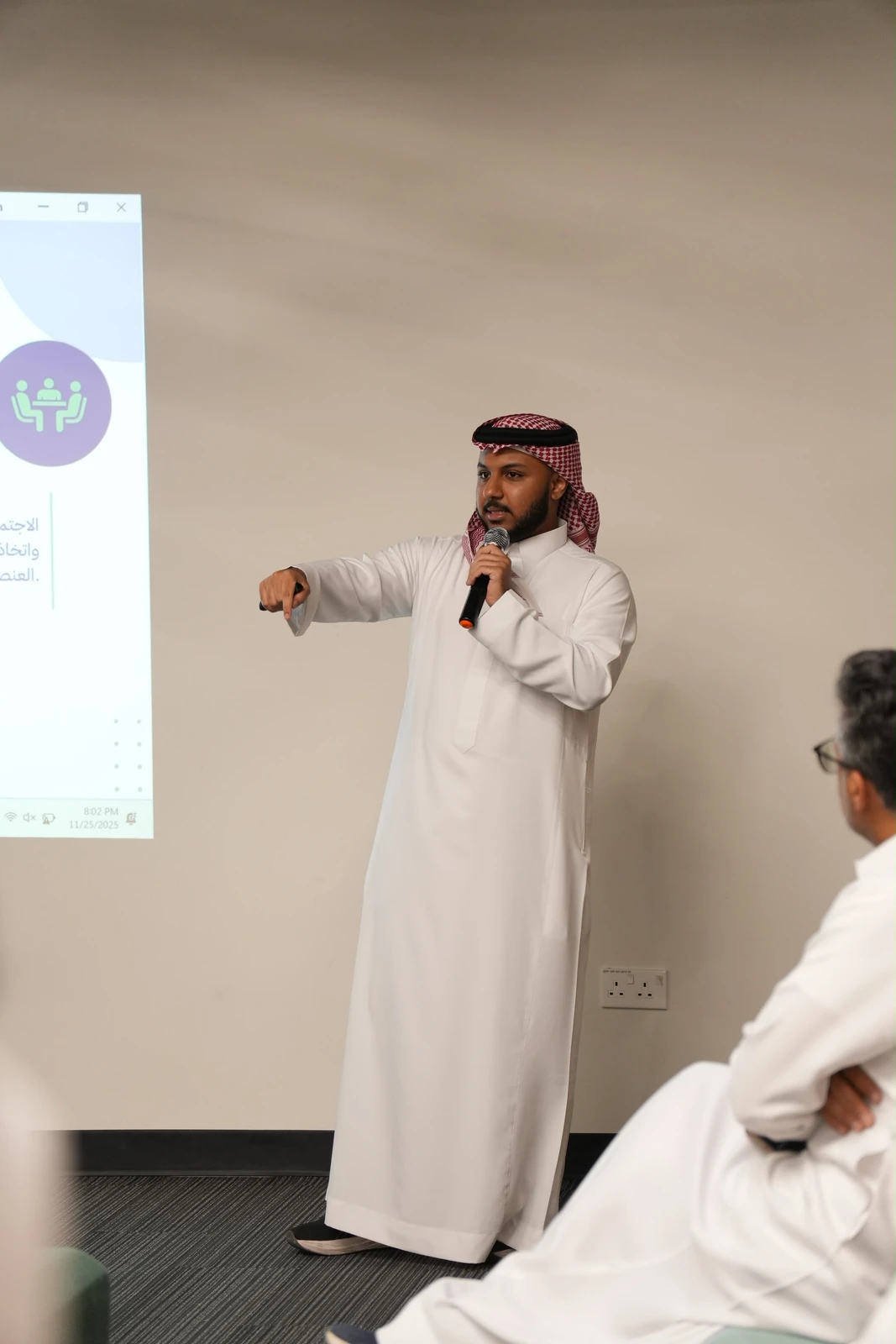

- Shaghaf Academy focuses on ‘communication performance’ to help professionals translate existing English knowledge effectively
- The training addresses challenges such as multicultural communication and workplace politics
While English is widely used as a second language in Saudi Arabia, communicating professionally in your non-native tongue is not as simple as learning grammar and vocabulary — you need to be able to recall what you know when speaking under pressure.
To address this, Mohammad Al-Mansaf founded Shaghaf (Passion) Academy, a Saudi training and consulting institution focused on what he describes as “communication performance” — the ability to translate existing language knowledge into effective professional communication.
“As we get closer to achieving the goals of Vision 2030, we can see that the Saudi workforce is relying increasingly on English because we are bringing in talent from different continents, backgrounds and nationalities,” Al-Mansaf told Arab News. “From that, we can start seeing new workplace challenges.”
Al-Mansaf highlights three recurring challenges: navigating multicultural and cross-functional communication, understanding an organization’s unspoken politics, and effectively conveying professional knowledge. Through his training, he encourages individuals to refine their soft skills, develop tools to recognize and navigate these nuances, and practice applying the language skills they already possess.
He believes communication performance is not just about knowing English — it is about being able to use it effectively in real professional situations. Al-Mansaf began training people in 2018, helping young people to improve their English through free online classes. In 2021, he shifted towards business English before moving into what he describes as professional communication performance training.
The redirection, he said, came from patterns he observed among professionals in Saudi Arabia. The need varies across generations, he has observed. Older people are seeking English they did not use extensively earlier in their careers, while younger Saudis might be comfortable using English socially, but struggle with the specialized language and pressure of professional environments.
What really caught his attention were the professionals who appear to have the language skills but seem unable to demonstrate them during presentations, interviews or conversations with senior colleagues.
“The main difference is that traditional institutions teach grammar and knowledge. We transform that knowledge into a real skill and something where you can actually see the impact in the workplace,” he explained.
His approach centers on one-to-one training for professionals who already know English but struggle to use it confidently and fluently in meetings and other workplace situations. Rather than conventional courses, lectures, or theoretical assignments, the training uses daily exercises built around participants’ working environments.
Al-Mansaf describes the underlying problem as a gap between knowledge and performance: a professional may understand English, yet hesitate, lose words or struggle to organize ideas when required to speak. The training therefore focuses on identifying the behaviors that emerge under pressure.
One common pattern is the “breakdown loop,” caused by working memory overload, where the mental demands surrounding communication begin to consume cognitive resources needed to communicate effectively
“Imagine you are thinking about how you appear, translating in your head, trying to speak, trying to protect your image, observing the other person’s expressions and trying to predict the next step — all at once. Eventually, performance breaks down. You lose access to your language,” said Al-Mansaf.
“People often analyze that incorrectly. They think, ‘I have this problem because my English is weak.’ But that may not actually be the core problem. That is what we call performance collapse in behavioral communication.”
But, he added: “You cannot break the cycle simply by learning more or gaining more knowledge. You already have the knowledge. What you need to focus on is changing the behavior and reorganizing how you think and respond under pressure and evaluation in the workplace.”
Another recurring challenge, he said, was the frustration adult professionals experience with the pace of improvement. His approach treats confidence not as something they must acquire before speaking, but something that develops by being repeatedly placed in situations where they have to communicate despite discomfort or mistakes.
“If you improve your performance, you will speak more. If you speak more, you will make more mistakes. And if you make more mistakes, you will learn and improve. That is basically the formula,” said Al-Mansaf.
Shaghaf Academy trains professionals through realistic workplace scenarios and role plays, encouraging people to start with their first idea rather than waiting until a whole answer feels perfect. Learners are asked to observe a behavior, adjust it, and test themselves again under gradually increasing pressure.
Al-Mansaf believes workplace communication is not just of interest to individuals. Through his work with private and semi-government organizations, he has observed that, due to the lack of communication reform between employees, “organizations are only using perhaps 50 per cent of the real capacity of their employees.”
He has seen meetings where only a small proportion of employees participate, despite others possessing expertise that could contribute.
‘‘Imagine going into a meeting with 10 people where everyone is silent and only one person speaks. Do you think that meeting can be as effective as one where everyone is speaking and sharing their ideas and thoughts? It’s impossible,” said Al-Mansaf.
‘‘People would have really strong and valuable ideas, but they write them down and then lose them. They don’t speak.’’
He said this communication performance gap meant that companies might not spot talent, development needs or role limitations: “It affects negotiation and bargaining. It affects the image of the organization and the level of trust in it, internally and externally.’’
Performance communication gap is therefore ‘‘a mystery risk inside many companies: everyone has it, but no one talks about it,” argues Al-Mansaf. And, as access to information changes through artificial intelligence, he feels education will increasingly need to consider how students communicate and apply knowledge.
“Especially in the first year, I think we should have at least one subject specialized in performance communication,” he said. “Especially with the AI transformation, our role is becoming less about providing knowledge and more about changing behavior.”
Shaghaf, which began primarily with Saudi learners, now works with professionals from Kuwait, Qatar, Jordan, Oman, the UAE, Bahrain and Egypt, which Al-Mansaf feels proves that challenge exists across the region.
Trainees continue to report improvements in their behavior and communication performance at work, with some saying their managers now recognize and trust their capabilities. Colleagues have noticed they are calmer and more confident and, in some cases, improved communication performance has led to greater responsibility and leadership opportunities.
Looking ahead, he expects professional communication to become increasingly important where expertise must be articulated, not just possessed.“Success in an institution is having the ability to speak out loud — to have the freedom, confidence and calmness to say what you know, show what you know and demonstrate your expertise,” he said.
‘‘I hope that our methodology, consultations, private training and coaching in English communication performance can eventually be reflected in companies and institutions across the Gulf and potentially beyond.’’