- “I gained people’s respect and acceptance because I learned to respect and accept myself first”
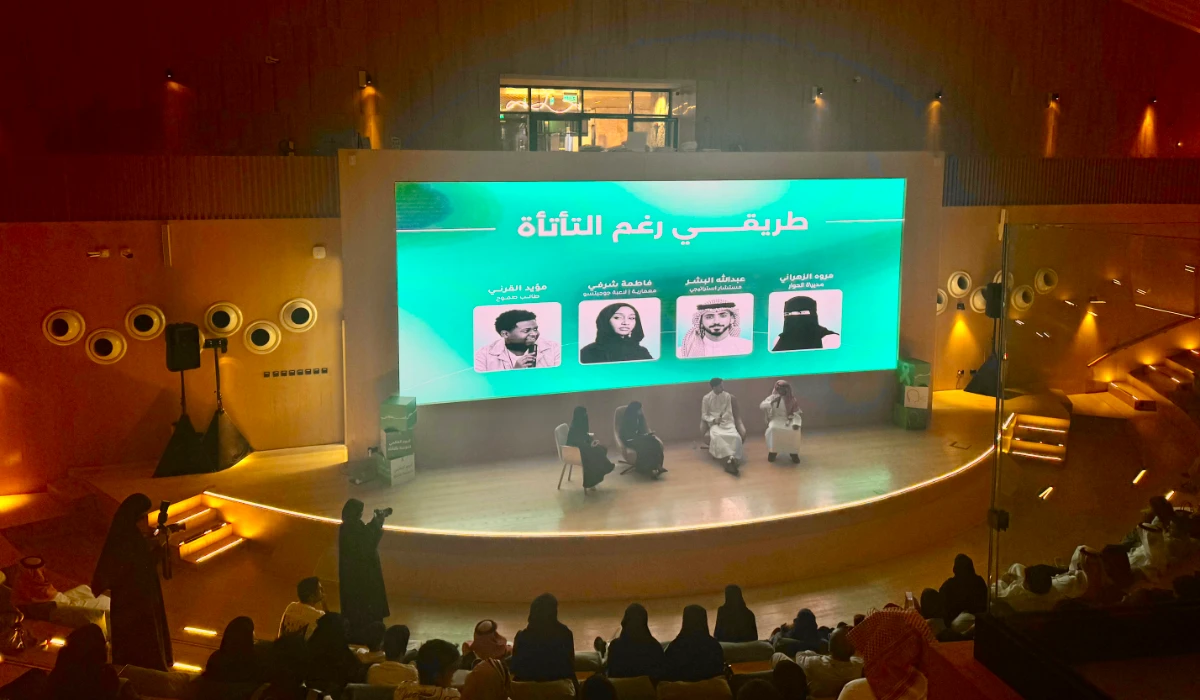
RIYADH: When 14-year-old Moayed Al-Qarni stepped up to the microphone at a Riyadh event marking International Stuttering Awareness Day, he had a simple message to share: “My words are important, and they deserve to be repeated.”
His statement resonated with many in the audience, which included people who stutter, their families and speech specialists who had gathered to discuss a condition that affects millions worldwide but is often misunderstood.
The event featured personal stories, panel discussions and an open-mic session, creating a space where participants could speak openly about experiences that are frequently hidden behind embarrassment or anxiety.
For 25-year-old architect and jiu-jitsu athlete Fatima Sharfi, one of the most important lessons has been refusing to let her speech define her.
“When you reduce my opportunities to stutter, you reduce my opportunities to express myself,” she told Arab News.
Sharfi said she grew up in a supportive environment and never viewed herself as different because of her stutter.
“I never felt different or that I was someone who needed help. I was fortunate to have a very supportive environment,” she said. That changed during her final years of school, when she became aware that some teachers treated her differently.
“That was the first time I really became aware of the difference,” she said.
Rather than allowing those experiences to undermine her confidence, Sharfi said they reinforced the importance of self-acceptance.
“I always believed that a person is a reflection of how they see themselves. The way I wanted people to see me had to begin with how I saw myself.
“I gained people’s respect and acceptance because I learned to respect and accept myself first.”
Sharfi believes that navigating a stutter ultimately strengthened her confidence.
“When I pushed myself to speak despite my stutter, I gained tremendous self-confidence, not only in speaking but in every aspect of my life,” she said.
“I stopped being afraid of failure or trying new things.”
For Al-Qarni, the experience of stuttering changes depending on the situation.
“Actually, in familiar places like school and home, my stuttering is quite minimal. With strangers, I stutter more,” he said.
Despite the challenges, he is determined not to let speech define his future.
“I stutter, and I like to attend these events and participate in them. My dream is to be a famous, successful doctor, and stuttering isn’t an obstacle to my big dreams,” he said.
For others, understanding from family members has been transformative.
Renad Al-Jurayyad said she began stuttering after a distressing experience at school when she was in second grade.
“At the time, my parents weren’t really aware of what I was going through,” she said.
While professional support helped, she said the biggest change came when those around her learned how to listen.
“When my family became more aware, they started listening to me. They stopped interrupting me. The people around me became more understanding.”
Al-Jurayyad described social relationships as one of the most difficult aspects of living with a stutter, but also one of the areas in which she has experienced the most growth.
“The thing that exhausted me the most was relationships with people,” she said.
“Now, I’ve reached a point of emotional consciousness where I know how to choose the environment that suits me and makes me comfortable.”
Looking back, she believes those challenges helped build resilience.
“Maybe if I had grown up without stuttering, I wouldn’t have developed this psychological resilience.”
The event was organized by Mutalathem, a Saudi initiative established by Saad Al-Munajem in 2021 to support people who stutter through community activities, peer support groups and youth programs.
“When I started in 2021, my only goal was to establish support groups. Nothing more,” Al-Munajem said.
What began as a small initiative has since expanded beyond Saudi Arabia, with online support groups attracting participants from across the Arab world.
One of the project’s most significant milestones, he said, was the creation of camps for children and teenagers who stutter.
“We were offering something evidence-based, helping children understand that communication doesn’t necessarily mean speaking fluently,” he said.
For Al-Munajem, changing perceptions of communication is at the heart of the initiative’s work.
“I realized it was more than just support groups; you’re actually helping children. You’re helping the next generation not go through the same struggles that we did.”
The discussions also highlighted how varied stuttering conditions can be. Some people report speaking more fluently while singing, reciting rhythmically or speaking alone, while bilingual speakers may experience different levels of fluency depending on the language they use.
There is no single experience of stuttering, participants highlighted. Triggers, coping strategies and progress differ from person to person, making support and understanding particularly important.
For many attendees, the most powerful message of the day was not about speech itself, but about being heard.
“I want to be an example to others,” Al-Munajem said. “Look, I stutter, and I’m doing things — it hasn’t stopped me, so don’t let it stop you either.”
Among those inspired by that message is Al-Jurayyad, who credits the Mutalathem founder with helping her find her own voice.
“Saad was one of the biggest motivations for me to speak up more and put myself out there,” she said.