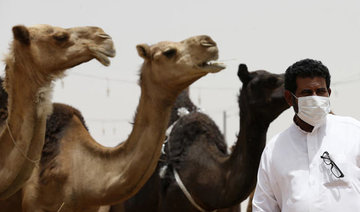
MADINAH: The Ministry of Health has reiterated that the ban on slaughtering camels during Haj would remain in place, with no exceptions, because of the danger posed by Middle East Respiratory Syndrome (MERS) coronavirus.
Faisal Al-Zahrani, spokesman of the ministry, said the ban covers the entire Kingdom during Eid Al-Adha. It also includes the Burmese community in Makkah, whose members traditionally sacrifice camels. They would now have to use lambs, he was quoted as saying by a local publication.
He said the Grand Mufti Sheikh Abdul Aziz Al-Asheikh had issued an edict instituting the ban to protect pilgrims. The fatwa states that people can use cows or sheep.
Abdulrahman Abdulkarim, an official at the Reconciliation Council at the Mount of Ohod in Madinah, said the Burmese community collects money to buy camels every year, with people sharing the meat of the animal.
He said that he has not received any official confirmation of the ban. However, several camel merchants have stopped buying camels and purchased sheep and cows because of the MERS virus, he said.
Camels have been identified as carriers of the MERS virus, which has infected 1,225 people in the kingdom since June 2012 when tit was first discovered by scientists.
Of the total, 521 victims have died, 633 have recovered and 71 are still under treatment, including 16 new cases in the past four days.
The Ministry of Agriculture earlier said that 3.3 percent, or 7,700 out of the 233,000 camels in the Kingdom, are infected with MERS virus.


Camel slaughter during Haj banned

Camel slaughter during Haj banned

Saudi, UN officials discuss trade and AI in Austria
- Talks on ways to boost economic transformation in global system
- Commerce Minister Majid Al-Qasabi highlights rules-based trade
RIYADH: Saudi Arabia and UN officials held discussions in Vienna, Austria, on Dec. 18 and 19, on international trade rules and artificial intelligence.
Participants at the meeting included representatives of the Kingdom’s National Competitiveness Center and the UN Commission on International Trade Law, or UNCITRAL, the Saudi Press Agency reported.
The workshop was a part of the NCC’s efforts to contribute to the development of legislative and regulatory frameworks for trade, keeping pace with global digital transformations, and enhancing the competitiveness of the national economy.
The Kingdom’s delegation was led by Commerce Minister Majid Al-Qasabi, who is the chairman of the NCC. Also present were Iman bint Habas Al-Mutairi, CEO of the NCC, 39 government officials, and Anna Jobin-Bret, secretary of UNCITRAL.
In his opening speech, Al-Qasabi spoke about the connection between technology and consumer behavior and its impact on the future of global trade.
The workshop included seven specialized sessions, which addressed AI in international trade, focusing on how it can improve the efficiency of supply chains, logistics operations, and e-commerce.
In a session, “Digital Platforms for Cross-Border Trade,” panelists addressed the legal and regulatory frameworks for using digital platforms.
Other sessions reviewed UNCITRAL’s perspective on the UN@80 initiative. Jobin-Bret spoke about the commission’s efforts and role in the world body’s reform process.
The workshop concluded with a session addressing preparations for joining the new Convention on Commercial Registers, emphasizing the importance of UNCITRAL’s efforts to ensure reliable digital trade.


