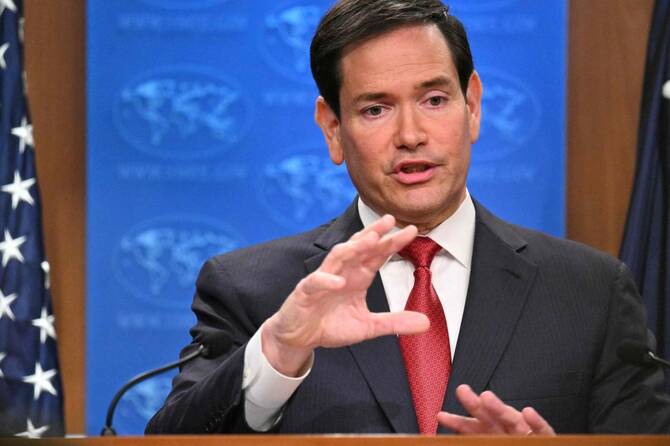
WASHINGTON: Secretary of State Marco Rubio weighed in on Russia-Ukraine and Israel-Hamas peace efforts and defended the Trump administration’s increasing military pressure on Venezuela during a rare, end-of-year news conference Friday.
In a freewheeling, more than hourlong meeting with reporters, Rubio also defended President Donald Trump’s radical overhaul in foreign assistance and detailed the administration’s work to reach a humanitarian ceasefire in Sudan in time for the new year.
Rubio’s appearance in the State Department briefing room comes as key meetings on Gaza and Russia-Ukraine are set to be held in Miami on Friday and Saturday after a tumultuous year in US foreign policy. Rubio has assumed the additional role of national security adviser and emerged as a staunch defender of Trump’s “America First” priorities on issues ranging from visa restrictions to a shakeup of the State Department bureaucracy.
“When I was a senator, I represented the state of Florida,” he said. Now, “my job is to implement the president’s foreign policy — provide advice, provide counsel, provide ideas, provide for opportunities and ways in which his foreign policy can be implemented.”
The news conference is taking place just hours before Trump’s special envoy Steve Witkoff meets with senior officials from Egypt, Turkiye and Qatar to discuss the next phase of the Republican president’s Gaza ceasefire plan, progress on which has moved slowly since it was announced in October.
Witkoff and other US officials, including Trump son-in-law and informal adviser Jared Kushner, have been pushing to get the Gaza plan implemented by setting up a “Board of Peace” that will oversee the territory after two years of war and create an international stabilization force that would police the area.
On Saturday, Witkoff, Kushner and Rubio, who will be at his home in Florida for the holidays, are to meet with Russian President Vladimir Putin’s adviser Kirill Dmitriev in Miami to go over the latest iteration of a US-proposed plan to end the Russia-Ukraine war.
“There’s no peace deal unless Ukraine agrees to it. But there’s also no peace deal unless Russia agrees to it,” Rubio said. ″So our job is not to force anything on anyone. It is to try to figure out if we can nudge both sides to a common place.”
The US proposal has been through numerous versions with Trump seesawing back and forth between offering support and encouragement for Ukraine and then seemingly sympathizing with Putin’s hard-line stances by pushing Ukrainian President Volodymyr Zelensky to agree to territorial concessions. Kyiv has rejected that concession in return for security guarantees intended to protect Ukraine from future Russian incursions.
On Venezuela, Rubio has been a leading proponent of military operations against suspected drug-running vessels that have been targeted by the Pentagon in the Caribbean Sea and the eastern Pacific Ocean since early September. The Trump administration’s actions have ramped up pressure on leftist Venezuelan President Nicolás Maduro, who has been charged with narco-terrorism in the US
In an interview with NBC News on Friday, Trump would not rule out a war with Venezuela. But Rubio and Defense Secretary Pete Hegseth have publicly maintained that the current operations are directed at “narco-terrorists” trying to smuggle deadly drugs into the United States. Maduro has insisted the real purpose of the US military operations is to force him from office.
Rubio sidestepped a direct question about whether the US wants “regime change in 2026” in the South American country.
“We have a regime that’s illegitimate, that cooperates with Iran, that cooperates with Hezbollah, that cooperates with narco-trafficking and narco-terrorist organizations,” Rubio said, “including not just protecting their shipments and allowing them to operate with impunity, but also allows some of them to control territory.”
Rubio’s news conference comes just two days after the Trump administration announced a massive $11 billion package of arms sales to Taiwan, a move that infuriated Beijing, which has vowed to retake the island by force if necessary.
Trump has veered between conciliatory and aggressive messages to China since returning to the Oval Office in January, hitting Chinese imports with major tariffs but at the same time offering to ease commercial pressure on Beijing in conversations with China’s President Xi Jinping. The Trump administration, though, has consistently decried China’s increasingly aggressive posture toward Taiwan and its smaller neighbors in disputes over the South China Sea.
Since taking over the State Department, Rubio has moved swiftly to implement Trump’s “America First” agenda, helping dismantle the US Agency for International Development and reducing the size of the diplomatic corps through a significant reorganization. Previous administrations have distributed billions of dollars in foreign assistance over the past five decades through USAID.
Critics have said the decision to eliminate USAID and slash foreign aid spending has cost lives overseas, although Rubio and others have denied this, pointing to ongoing disaster relief operations in the Philippines, the Caribbean and elsewhere, along with new global health compacts being signed with countries that previously had programs run by USAID.
“We have a limited amount of money that can be dedicated to foreign aid and humanitarian assistance,” Rubio said. “And that has to be applied in a way that furthers our national interest.”


![]()

Rubio fields questions on Russia-Ukraine, Gaza and Venezuela at wide-ranging news conference
Short Url
https://arab.news/g4g7w
Rubio fields questions on Russia-Ukraine, Gaza and Venezuela at wide-ranging news conference
- “There’s no peace deal unless Ukraine agrees to it. But there’s also no peace deal unless Russia agrees to it,” Rubio said
- “We have a limited amount of money that can be dedicated to foreign aid and humanitarian assistance“


Latest updates


Recommended


© 2026 SAUDI RESEARCH & PUBLISHING COMPANY, All Rights Reserved And subject to Terms of Use Agreement.