

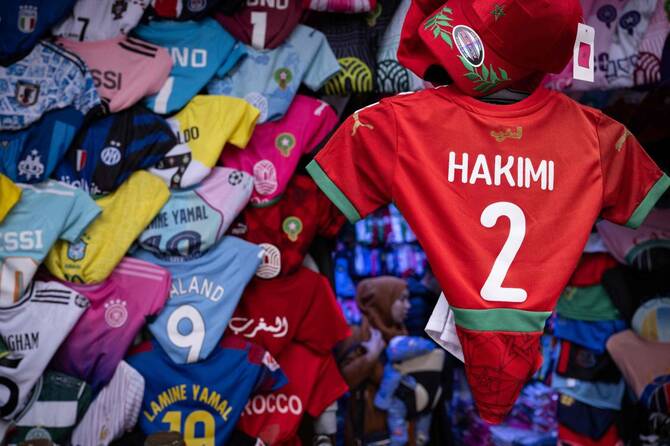

RABAT: The Africa Cup of Nations begins in Morocco this weekend, with the hosts desperate to get their hands on the trophy but sweating on the fitness of star man Achraf Hakimi for a tournament crammed awkwardly into football’s packed calendar.
The Morocco captain’s race to overcome injury and the club future of Egyptian icon Mohamed Salah will dominate headlines around this edition of the AFCON, which runs until January 18.
Yet again, a Cup of Nations is not taking place at the time initially intended, after recent editions were moved due to clashes with the West African rainy season, the pandemic, conflicts or an Ebola outbreak.
The introduction of FIFA’s expanded Club World Cup last June and July forced the Confederation of African Football (CAF) to push back its flagship tournament.
They could not wait until next June because of the World Cup, and they can no longer stage the Cup of Nations in January and February because of the new UEFA Champions League format.
The solution is to start in December and continue into the New Year, at a time when many European leagues — where so many African stars play — are taking a break.
The exception, of course, is the Premier League which operates a packed schedule throughout the Christmas period.
As a result, a player like Manchester United’s Bryan Mbeumo could miss six Premier League matches, should Cameroon reach the final.
That helps explain why FIFA made a late call to allow clubs to retain players until December 15 before they could join their national teams, rather than a week earlier.
World football’s governing body said they had come to that decision out of the “spirit of solidarity demonstrated by CAF to reduce the impact on various parties,” but it has hampered preparations for participating sides.
Morocco must be seen as favorites as they prepare to open the competition against island minnows Comoros on Sunday at the new 69,000-seat Prince Moulay Abdellah Stadium in Rabat.
World Cup semifinalists in 2022, they are Africa’s best team in the FIFA rankings in 11th place and have enjoyed a world-record run of 18 consecutive victories heading into the tournament.
- Hakimi against the clock -
But the pressure is on a country that has only ever won one Cup of Nations, in 1976, when it was an eight-team competition held in Ethiopia.
The fitness of Hakimi, the reigning African player of the year, could be decisive.
The Paris Saint-Germain right-back has not played since coming off in tears with an ankle injury against Bayern Munich in the Champions League on November 4.
Morocco will be showcasing some world-class stadiums as it hosts the Cup of Nations for the first time since 1988.
The Prince Moulay Abdellah Stadium, which will also be the venue for the final, is one of four being used in Rabat.
A huge 75,000-seat stadium in Tangier will host a semifinal, while games will also be played in Casablanca, Marrakech, Agadir and Fez as the country builds toward the 2030 World Cup which it will co-host with Spain and Portugal.
Morocco are aiming to follow the example of Ivory Coast, who won the last AFCON as hosts in 2024.
It is also notable that North African teams have won four of the last five editions held in the region, including Algeria’s triumph in Egypt in 2019 and the Egyptians’ success at home in 2006.
It remains to be seen whether the doubts surrounding Salah’s Liverpool future impact Egypt’s chances of winning a record-extending eighth title.
- Ivory Coast defend title -
With the World Cup also approaching, Salah may now see performing for his country as the priority — he has never won an AFCON, having played in final defeats in 2017 and 2022.
Elsewhere Senegal, winners in 2022 and with a squad featuring Sadio Mane and Iliman Ndiaye, are serious contenders.
Nigeria will hope to make amends for missing out on the World Cup. Runners-up last time, the Super Eagles will be led by Ademola Lookman and Victor Osimhen, the latter “the greatest striker in the world” according to coach Eric Chelle.
Algeria have not won an AFCON game since lifting the title in 2019. They are skippered by Riyad Mahrez but the player to watch may be Mohamed Amoura, a regular scorer in the Bundesliga for Wolfsburg.
Ghana and Cape Verde are both going to the World Cup but neither will be present in Morocco.


