Lebanon PM publishes long-awaited banking law draft

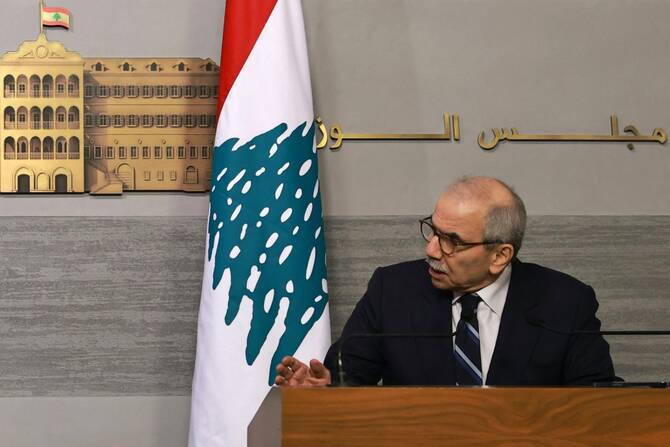
Lebanese Prime Minister Nawaf Salam published on Friday a long-awaited banking draft bill, which distributes losses from the 2019 economic crisis between banks and the state. (AFP)
Short Url
Updated 19 December 2025
Follow

Lebanon PM publishes long-awaited banking law draft

  • The law stipulates that each of the state, the central bank, commercial banks and depositors will share the losses accrued as a result of the financial crisis.
  • Depositors with a limit of $100,000, over the course of four years

BEIRUT: Lebanese Prime Minister Nawaf Salam published on Friday a long-awaited banking draft bill, which distributes losses from the 2019 economic crisis between banks and the state.
The draft law is a key demand from the international community, which has conditioned economic aid to Lebanon on financial reforms.
In a televised speech, Salam said “this draft law constitutes a roadmap to getting out of the crisis” that still grips Lebanon.
The draft will be discussed by the Lebanese cabinet on Monday before being sent to parliament, where it could be blocked.
The law stipulates that each of the state, the central bank, commercial banks and depositors will share the losses accrued as a result of the financial crisis.
Depositors, who lost access to their funds after the crisis, will be able to retrieve their money, with a limit of $100,000, over the course of four years.
Salam said that 85 percent of depositors had less than $100,000 in their accounts.
The wealthiest depositors will see the remainder of their money compensated by asset-backed securities.
“I know that many of you are listening today with hearts full of anger, anger at a state that abandoned you,” Salam said.
“This bill may not be perfect... but it is a realistic and fair step toward restoring rights, halting the collapse.”

- ‘Banks are angry’ -

The International Monetary Fund, which closely monitored the drafting of the bill, had previously insisted on the need to “restore the viability of the banking sector consistent with international standards” and protect small depositors.
The Associations of Banks in Lebanon criticized the draft law on Monday, saying in a statement that it contains “serious shortcomings” and harms commercial banks.
“Banks are angry because the law opens the door to them sharing any part of the losses,” said Sami Zougheib, researcher at The Policy Initiative, a Beirut-based think tank.
He told AFP that banks would have preferred that the state bear full responsibility.
The text provides for the recapitalization of failing banks, while the government’s debt to the Central Bank will be converted into bonds.
Salam said that the bill aims to “revive the banking sector” which had collapsed, giving free rein to a parallel economy based on cash transactions, which facilitate money laundering and illicit trade.
According to government estimates, the losses resulting from the financial crisis amounted to about $70 billion, a figure that is expected to have increased over the six years that the crisis was left unaddressed.
Since assuming power, Salam and President Joseph Aoun have pledged to implement the necessary reforms and legislation.
In April, Lebanon’s parliament adopted a bank restructuring law, as the previous legislation was believed to have allowed a flight of capital at the outbreak of the 2019 crisis.
The new bill stipulates that politically exposed persons and major shareholders who transferred significant capital outside the country from 2019 onwards — while ordinary depositors were deprived of their savings — must return them within three months or face fines.
The draft law could still be blocked by parliament even if the cabinet approves it.
“Many lawmakers are directly exposed as large depositors or bank shareholders, politically allied with bank owners, and unwilling to pass a law that either angers banks or angers depositors,” Zougheib said.
Politicians and banking officials have repeatedly obstructed the reforms required by the international community for Lebanon to receive financial support.


Bahrain arrests four for spying for Iran’s IRGC as Gulf attacks intensify

Updated 12 March 2026
Follow

Bahrain arrests four for spying for Iran’s IRGC as Gulf attacks intensify

  • Investigators said the suspects were found to have sent pictures and coordinates of vital locations in Bahrain to the IRGC via encrypted software

MANAMA: Bahrain has detained four citizens suspected of spying for Iran’s Islamic Revolutionary Guard Corps (IRGC), as Tehran’s retaliatory strikes on Gulf states show no signs of letting up.

Bahrain’s General Directorate of Criminal Investigation and Forensic Science identified the four detainees as Murtadha Hussain Awal, 25; Ahmed Isa Al Haiki, 34; Sarah Abdulnabi Marhoon, 36; and Elias Salman Mirza, 22. A fifth suspect, Ali Mohammed Hassan Al Shaikh, 25, remains at large abroad.

Investigators said Murtadha Hussain and his cohorts, acting on IRGC instructions, used high-resolution equipment to photograph and record coordinates of vital locations in Bahrain, transmitting the data to the IRGC via encrypted software.

The arrests come as Iran escalates attacks across the Gulf. Bahrain’s Interior Ministry issued an advisory urging residents in Hidd, Arad, Qalali and Samaheej to stay indoors and seal windows against smoke from fires sparked by Iranian strikes. Fuel tanks at a facility in Muharraq Governorate, northeast of Manama, were among the targets. Oman’s Port of Salalah also battled blazes at fuel storage tanks following separate Iranian drone strikes.

Elsewhere in the region, two Iranian drones struck near Dubai International Airport, wounding four people, though flights continued uninterrupted. A fire broke out at a luxury apartment tower in Dubai Creek Harbour after another drone hit — extinguished by Thursday morning.

Iran also targeted commercial ships and struck what officials described as the world’s busiest international airport on Wednesday, as US and Israeli strikes continued to pound Tehran.

A war now 12 days old — and costly

The conflict began on February 28, when US and Israeli forces launched coordinated strikes on Iran. Tehran has since retaliated by targeting Gulf states, US and Israeli assets, and critical energy infrastructure.

Iran has declared a blockade on energy shipments through the Strait of Hormuz, a vital chokepoint for global oil and gas flows, sending commodity prices surging and rattling international markets.

The Pentagon told Congress this week that the first week of war cost the United States $11.3 billion — including $5 billion in munitions in the conflict’s opening weekend alone.

The UN Security Council on Wednesday voted to approve a resolution demanding a halt to Iran’s attacks on its Gulf neighbors. Bahrain’s UN Ambassador Jamal Alrowaiei welcomed the move.

“The international community is resolute in rejecting these Iranian attacks against sovereign countries that are threatening the stability of the peoples, especially in a region of strategic importance to global economy, energy security and global trade,” he said.

Despite the resolution, there were no immediate signs the conflict was easing.

(With AP)