

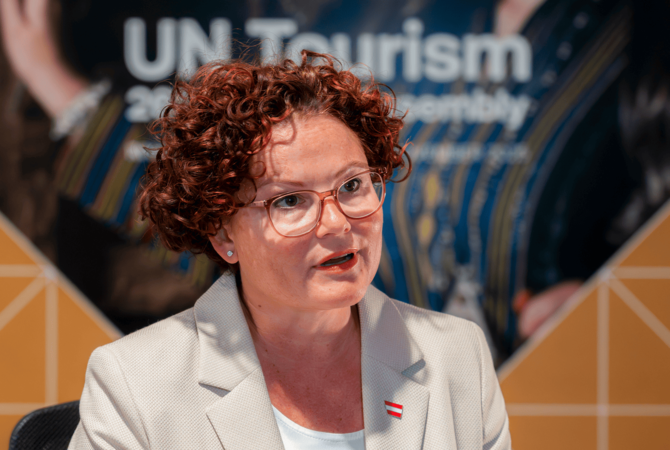

RIYADH: A tourism hub was officially launched at King Saud University on Monday in cooperation with the Austrian IMC Krems University of Applied Sciences, in the presence of the Austrian State Secretary General for Energy, Startups, and Tourism, Elisabeth Zehetner.
IMC Krems, located in the UNESCO World Heritage Site, is a leading institution renowned for its focus on tourism and hospitality, which has already welcomed its first batch of Saudi students under the two universities’ joint education collaboration who will spend the program’s duration enriching their knowledge about the ins and outs of the tourism industry.
Speaking to Arab News on the sidelines of the 26th UN Tourism General Assembly in Riyadh, Zehetner said: “For us, it’s very important to collaborate with Saudi Arabia. I think, for both countries, it’s a very important market. So we are very happy to have a lot of tourists from Saudi Arabia coming to Austria, enjoying our nature, our lakes, our seas, our landscape, and our mountains. On the other hand, we see that we have common challenges concerning education.”
She expressed that this concern was the driver for launching the collaboration initiative, which was inked in May last year.
“I think we can learn a lot from our cultures, but we can have a new level of education in order to really offer a good experience to all our clients,” Zehetner said.
In other areas of collaboration, “concerning the work in the UN Tourism Organization, we are both chairing the statistical part of this UN Assembly. And it’s so important for us to have good data that we can (use for) evidence-based decisions and also comparable data all over the world; knowing how many people travel, where they travel, also, in order to face problems like overtourism,” she said. “We are working, especially with Saudi Arabia, very closely in order to foster and strengthen the whole UN organization.”
As the Kingdom’s tourism sector steadily grows at an unprecedented pace, this presents opportunities and offers lessons in sustainable growth for Austria and its neighboring countries.
“We are learning a lot from Saudi Arabia because we see how quickly you establish new theme parks, for example. It’s really astonishing what you do and also what you are doing at the Red Sea and AlUla. It is very important for us to see how you are doing this, and we really see that you also focus on sustainability in all this growth. I think this is very important also to ensure future tourism, even in 50 years, here in Saudi Arabia,” the state secretary said.
She added that education and diversification are key factors in building a resilient, sustainable tourism economy in today’s global landscape.
“Diversification is very important so that you really have people coming from all over the world so that you are not dependent on a special country concerning the touristic flows,” Zehetner said, noting that it’s also important to focus on the population’s acceptance of touristic practices and create an economy for domestic tourism.
“I think the most important thing from the beginning is to look closely at the balance so that the local population is also convinced that this kind of tourism is helping the prosperity in the local regions … Concerning sustainability, I think we should not only think about the quantity of tourists that come to us. We should also think about the quality, because this will help to establish a long lasting, sustainable system,” she said.
Every year, Austria surveys 10,000 people from its population of 9 million to assess whether locals are able to maintain their quality of life and avoid protests such as the one in Spain that took place earlier in 2025.
“I think the most important is that we show that tourism is a part of the economic development, and for local prosperity,” Zehetner said.
When it comes to global tourism trends, a popular topic at the General Assembly this year was the rise of digitization and artificial intelligence use within the industry. Many travelers are using AI agents such as ChatGPT to plan their itineraries, book their travels, and discover new destinations.
As one of the most transformative tools, Austria is utilizing AI to stay ahead of the curve. The state secretary explained that the country is experimenting with utilizing the technology in hotels, be it for automated concierge and reception desks and managing guests’ food allergies, or conducting virtual tours in order to free up the human workforce for direct contact with clients, therefore elevating the customer’s experience.
Zehetner said: “It’s very important for all of our countries that our enterprises, working in the tourism industry, are fit for these new challenges.
“They must be able to be found by AI, but we also have to see that the trend of artificial intelligence will help with our shortage of labor force. We have, in a lot of countries, a shortage of labor force in the tourism industry.
She added: “Digitalization (can be) an instrument in order to get more services directly (for) the guests. This means also that we have to transform tourism education, because it’s also now about digitalization, but it’s also about how to get the best service for the guests.
“So especially in Austria, it’s very important to show to the people who come to our country the hearts that we have. When something comes from the heart, you have also to have the people who inspire our tourists by our Austrian culture.”


