- KAUST researchers received a total of 20 recognitions across various research categories, making it the top-ranked university in Saudi Arabia for this accolade
- Other Saudi institutions included on the list are Taif University, PNU, KAPSARC, King Saud University, and KFUPM
RIYADH: Researchers from six Saudi institutions have been included in the 2026 Clarivate Highly Cited Researchers list, with King Abdullah University of Science and Technology dominating the national rankings by accounting for 70 percent of the Saudi-based researchers recognized.
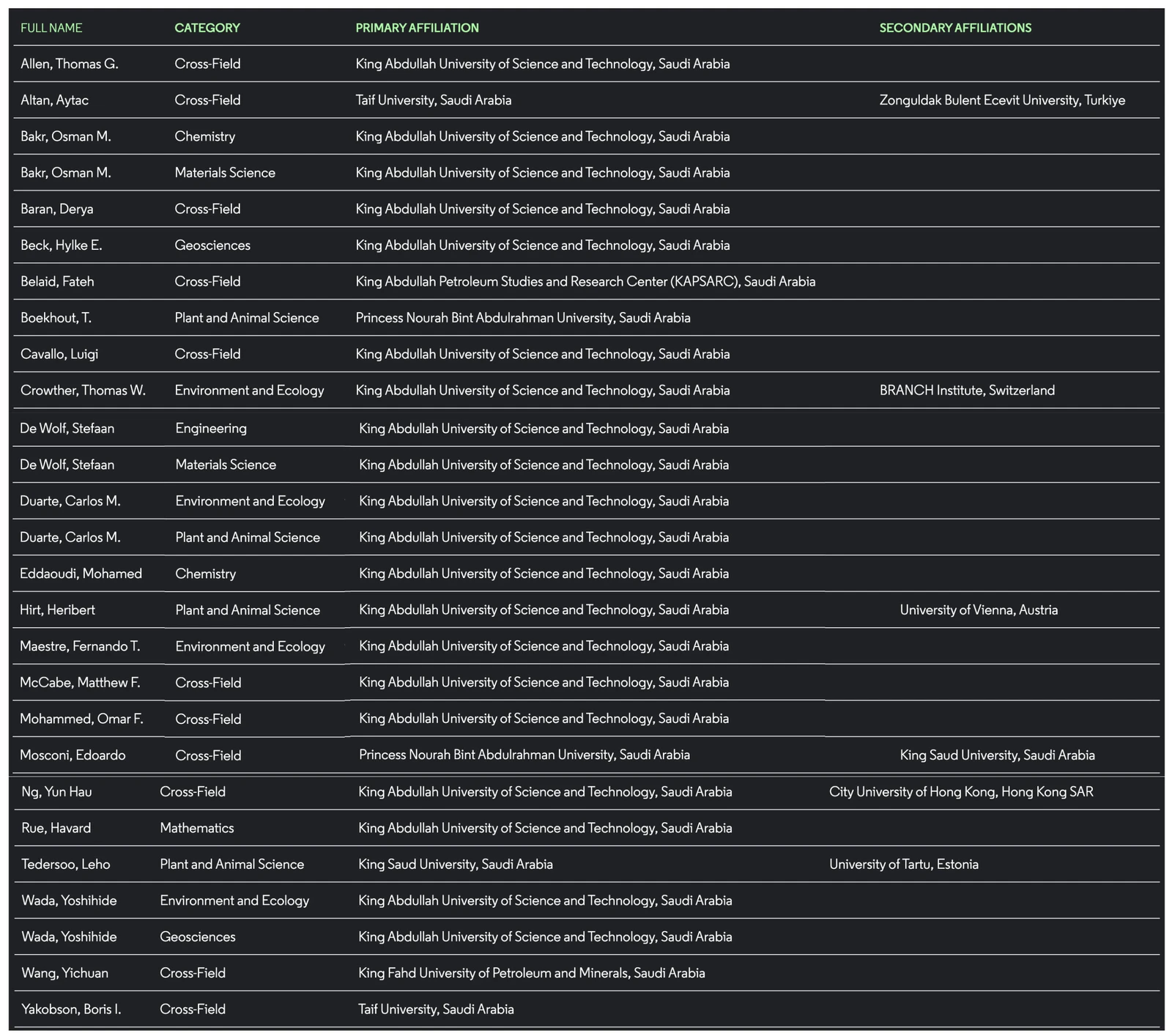
Sixteen KAUST researchers received a combined 20 recognitions across research categories, making it the leading institution in Saudi Arabia and the top-ranked university in the Arab world by number of researchers recognized on this year's list.
Other Saudi institutions represented on the list were Taif University with two recognitions in the Cross-Field category; Princess Nourah bint Abdulrahman University with two recognitions in Plant and Animal Science and Cross-Field; King Abdullah Petroleum Studies and Research Center with one recognition in Cross-Field; King Saud University with one recognition in Plant and Animal Science; and King Fahd University of Petroleum and Minerals with one recognition in Cross-Field.
The annual Clarivate Highly Cited Researchers list recognizes scientists and social scientists whose publications have demonstrated exceptional influence, with multiple papers ranking among the world's top 1 percent most-cited research papers in their respective fields and publication years.
According to Clarivate, the 2026 list comprises 7,090 Highly Cited Researcher awards worldwide, recognizing researchers whose work has helped shape the global research landscape across disciplines, institutions and countries. Researchers selected for the list have authored multiple Highly Cited Papers in the Web of Science Core Collection over the past 11 years.
KAUST President Sir Edward Byrne described the recognition as a significant milestone for the university.
"For a university established less than two decades ago, having 16 researchers named among the world's most highly cited, with 20 recognitions across research categories, is a remarkable achievement," Byrne said in a press release posted on the KAUST website.
"It reflects the strength of the research community we have built at KAUST and our sustained commitment to scientific excellence.
"More importantly, it demonstrates that the work of our researchers is contributing to the advancement of knowledge and influencing scientific discovery around the world," Byrne said.
The university said the recognition highlights the global influence of its research, with scientists worldwide citing work produced at KAUST and building upon it to drive further discoveries.
The 16 KAUST researchers were recognized across eight Clarivate categories: Chemistry, Cross-Field, Environment and Ecology, Engineering, Geosciences, Mathematics, Materials Science, and Plant and Animal Science.
Four KAUST researchers earned recognition in two categories each, helping raise the university's total to 20 recognitions.
Among them were Prof. Osman Bakr, whose research focuses on hybrid nanomaterials for applications including solar cells, batteries and photonic devices; Prof. Carlos Duarte, who studies the impact of global change on marine ecosystems and nature-based solutions to climate change and biodiversity loss; Prof. Stefaan De Wolf, whose work centers on high-performance photovoltaic technologies and solar-cell efficiency; and Prof. Yoshihide Wada, whose research examines links between the biosphere, socio-economic systems and global resource constraints.
KAUST said its highly cited researchers and their colleagues are advancing scientific knowledge, helping inform policy decisions and shaping research directions in Saudi Arabia and internationally.
Clarivate said that while citation performance forms the foundation of its methodology, the final selection also incorporates additional quantitative indicators, qualitative analysis and expert judgment to ensure a robust assessment process.