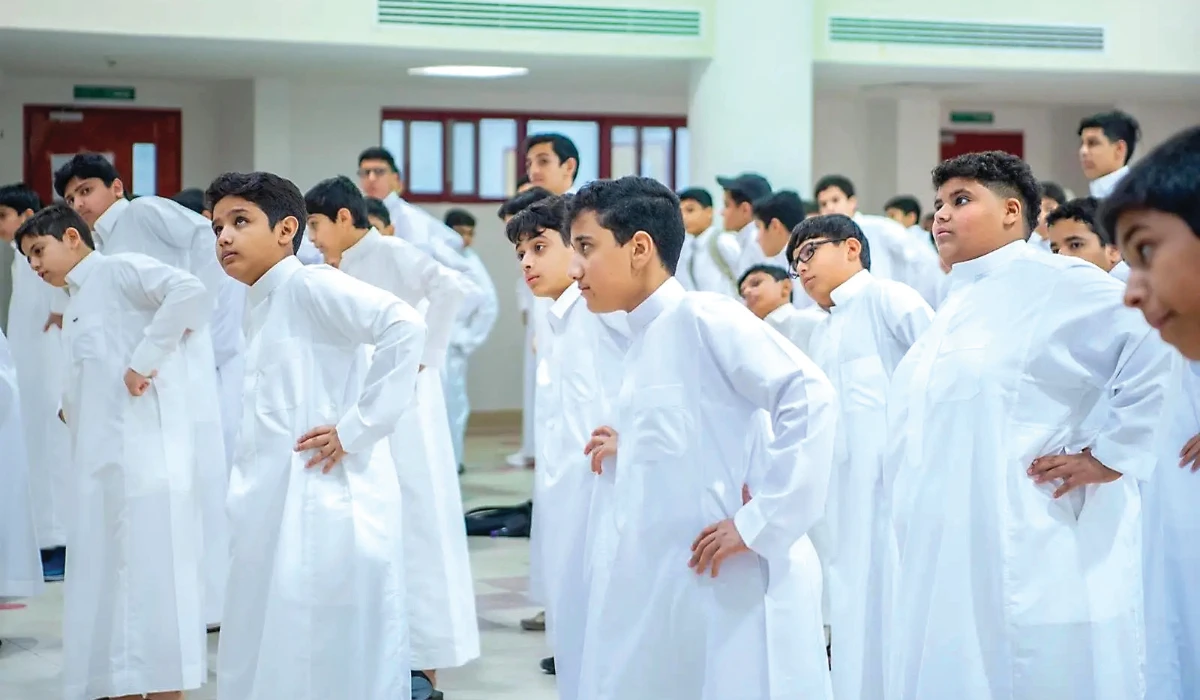
- Children are exposed to war-related concepts from a young age, often influenced by conversations at home and media
- Educators emphasize the importance of emotional safety when discussing distressing events with children
RIYADH: When Sara Shahid’s first grade pupils heard alarming sounds during the school day, as Saudi air defense interceptions took place, some immediately recognized what they thought they were hearing.
“Is that real, teacher? Is that real bombing? Are those missiles?” they asked.
For Shahid, a mother of two, what stood out was that some of her young pupils were already familiar with the language of conflict.
“Some of them already knew these terms,” she told Arab News. “Some of them probably knew something about it from home, their mums and dads, parents talk.”
The school had regularly practised emergency drills, so teachers immediately instructed pupils to take cover beneath their desks and stay away from doors and windows.
“We had been drilling, actually, so the kids were also prepared and ready,” Shahid recalled.
While some pupils remained calm, others became frightened and began crying. Teachers tried to distract them from the sounds, saying tables and chairs were being moved on another floor.
“We had to reassure them. We had to tell them that they were safe and they were going to be fine, and their parents were going to be here soon,” Shahid said.
Parents were contacted, and within approximately an hour, all pupils had been collected.
With schooling now taking place online, children may still be wondering why they are no longer attending classes in person, raising a question for parents and educators: How much should children know about the frightening events unfolding around them?
“I think it’s not the best idea to involve kids in such matters, as they are sensitive and can easily develop anxiety and fear,” Shahid said.
“It might be a good idea with certain age groups for awareness,” she added. However, she believes such conversations are unnecessary for children aged six and under unless circumstances require them.
For family and systemic psychotherapist Hadil Aoloum, the priority is establishing a child’s sense of emotional safety before deciding how much information to share.
“All children want to know, especially younger children, is: ‘Am I going to be safe? Am I safe?’” she told Arab News.
While parental judgement is essential in determining what children can understand at different ages, Aoloum advised against either overwhelming them with details or avoiding their questions altogether.
“Tell them the truth, but tell them the truth in a child-appropriate and developmentally appropriate way. What you might tell a 15-year-old will be very different from what you might tell a five-year-old.”
Her first recommendation is to let children guide the conversation.
“You might ask a child, ‘What are you worried about?’ You want to understand what is happening in their internal world.
“Children might hear a bit from the news, hear a little bit from parents’ conversations, hear a bit from what their friends say, and they might piece that all together, including their own imagination, to make a narrative that might be really, really frightening, and possibly inaccurate.”
Aoloum compared children’s search for reassurance to passengers experiencing turbulence on an airplanes
“When there’s turbulence, one of the first things I do is look at the cabin crew. I look at their facial expressions, I look at the concern on their face, and that helps me assess: Am I safe, or should I worry?
“And then what happens if there’s severe turbulence? The seatbelt sign comes on. That’s a precautionary measure. It’s temporary.”
Similarly, children observe the reactions of adults around them to determine how worried they should be.
“Children don’t need parents who are never frightened. They need parents who can acknowledge fear without feeling overwhelmed by it, who can demonstrate how to respond to uncertainty.”
Aoloum stressed that parents should model emotional regulation rather than conceal their fears.
“You can demonstrate fear, absolutely, because that gives children permission to experience fear and communicate that,” she said.
“We’re not saying to parents don’t show fear, but just don’t be overwhelmed by it, and really model emotional regulation.”
The same approach, she said, can help children recognise the protective measures operating around them rather than associate every unfamiliar sound or change in routine with immediate danger.
For children hearing loud sounds associated with Saudi air defence interceptions, parents can explain that personnel and defence systems are responding to threats, while emphasising the importance of following official safety instructions.
Temporary online schooling and precautionary evacuations can similarly be explained as measures taken to keep people safe.
“When work or school says, ‘You need to work from home today,’ that’s a measure, that’s a sense of safety. Okay, someone’s looking after me,” Aoloum said.
“Instead of me being hypervigilant to danger, there’s someone out there who is helping me keep safe.”
Maintaining familiar routines can reinforce that reassurance, particularly when uncertainty disrupts children’s everyday lives.
“What we want to do is keep a lot of predictability,” she said.
“That’s what we tell parents when there’s a war zone or a natural disaster: keep the routine there. It might not be predictable when we hear the other interception or attack.
“But you know what? We know when we’re going to have lunch, we know what time we’re going to go to school, we know what time we’re going to go to bed.”
For Aoloum, reassuring children is ultimately a responsibility shared between families and institutions.
“We’re all systems, whether we’re a family system, whether we’re a school system, or whether we’re a government. We are all part of the system,” she said.
Reassurance also goes beyond telling children not to be afraid. It means helping them understand, at an age-appropriate level, that frightening events can be discussed, emotions can be managed, and the responsibility for responding to danger does not rest solely on their shoulders; adults and authorities are looking after us as we follow safety procedures.