- ‘The work after harvesting is crucial. If you rush it or miss it, you’ll have lower yields or poorer quality the following year’
JEDDAH: Across Saudi Arabia’s date-growing regions, the annual harvest season is more than an agricultural cycle. For many farming families, it is a continuation of traditions, skills and knowledge passed down through generations.
As dates begin to ripen, farmers closely monitor the fruit before harvesting, sorting and preparing it for sale or processing. While modern technology has transformed many aspects of the industry, growers say the expertise behind producing high-quality dates remains rooted in experience handed down within families.
“Dates are part of our identity as Saudis, especially here in Madinah,” said Fahad Al-Raddadi, CEO of Naqwat Alnanaa Farms Co.
“My family has been farming for five generations.”
Al-Raddadi recalls spending summer weekends on the family farm alongside his grandfather and father, harvesting dates, cleaning palm trees, trimming fronds and preparing the farm for the following season.
“The work after harvesting is crucial. If you rush it or miss it, you’ll have lower yields or poorer quality the following year.”
Dates are part of our identity as Saudis, especially here in Madinah. My family has been farming for five generations. Fahad Al-Raddadi, CEO of Naqwat Alnanaa Farms Co.
Date farming is a year-round responsibility. Once the harvest ends, farmers prepare palms for the next season through irrigation, pruning and the application of organic fertilizers.
The flowering period is one of the most critical stages of the growing cycle. Farmers must open flowering clusters at the right time, while monitoring weather conditions and irrigation levels that can directly affect production.
Pollination follows, along with a process known as “sarbana,” a traditional thinning practice in which farmers remove some of the smaller, less-developed fruit from each cluster so the remaining dates can grow larger and achieve better quality.
“If you want premium dates, you remove smaller fruits early so the rest grow bigger and better quality,” Al-Raddadi said. “If you want higher volume, you leave them crowded.”
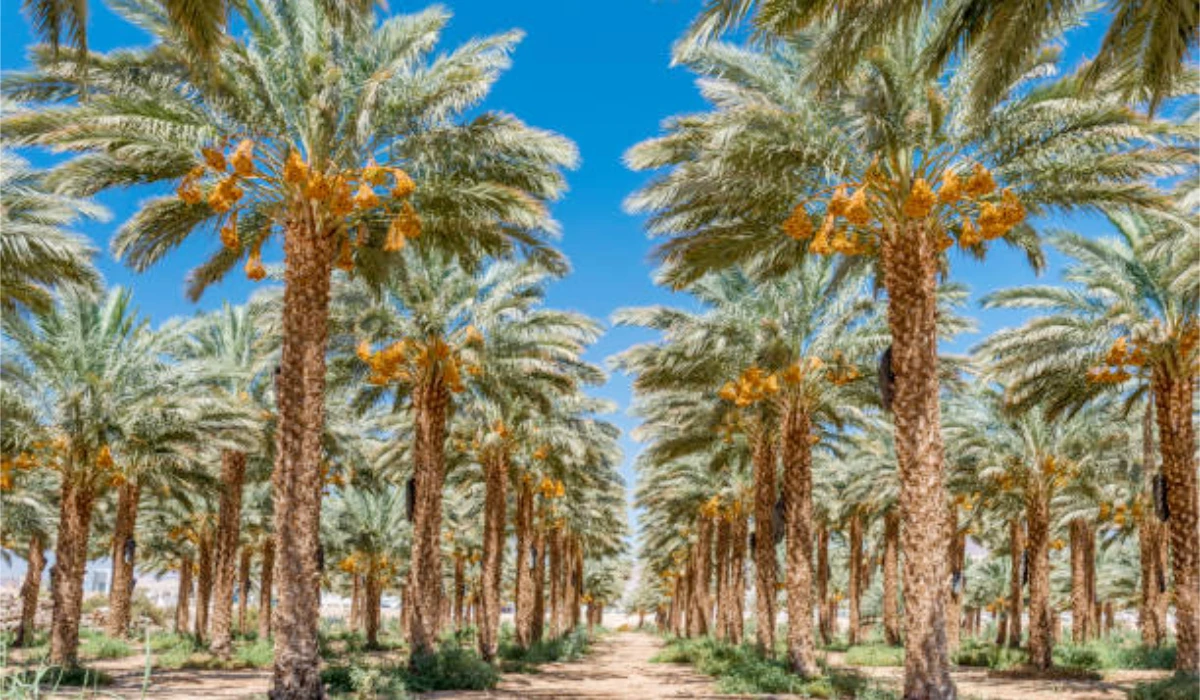
The harvest itself varies depending on the variety. Some dates are harvested as entire clusters, while others are picked individually. Certain varieties are collected only when fully ripe, while others are harvested earlier and allowed to mature later.
For growers, understanding these differences is part of an expertise developed over years, and often decades, of working with palm trees.
Marwan Al-Marwani, founder and CEO of Ajwatech, grew up immersed in that tradition.
“I grew up in an agricultural environment, so date harvesting is something I have been accustomed to since childhood. We inherited this profession from our fathers and grandfathers, and we continue to preserve it because it is part of our heritage,” he said.
As the first signs of ripening appear, farmers watch the fruit closely before harvesting fresh, soft dates known as rutab. Once date clusters reach full maturity, the process of “saram,” or harvesting, begins.
After collection, dates are sorted by quality before being packaged and prepared for sale or processing.
Although mechanization has simplified parts of the process, both Al-Marwani and Al-Raddadi say traditional methods remain important.
“Each palm tree has its own shape, size, and character, so each requires a different technique,” Al-Marwani said.
Al-Raddadi prefers manual harvesting because it allows him to assess fruit quality immediately, separating premium dates from lower grades and those destined for animal feed.
But for many farmers, the harvest is about more than production.
Saudi families traditionally exchange date varieties as gifts, serve them alongside Saudi coffee and offer them to visitors as a symbol of hospitality. Different harvests often become a source of conversation among relatives and friends.
Al-Raddadi said those traditions remain central to his family gatherings.
He remembers climbing palm trees and passing harvested branches to his father, who would then hand them to his grandfather for sorting.
“That’s the quality control, but I believe it’s really about the connection,” he said.
Harvesting also remains physically demanding, especially during the summer months. Farmers climb tall palms using ropes and techniques refined over generations.
For those raised on farms, however, the challenge becomes routine.
“Climbing isn’t really a challenge for us,” Al-Raddadi said. “Palm farmers grow up doing it from childhood; it comes naturally.”
Summer heat presents another challenge, although he noted that date farms often feel noticeably cooler than surrounding urban areas because of the shade and airflow created by the palms.
Storage and timing can be equally important. Dates must be harvested within a relatively narrow window; harvesting too late can result in spoilage. Once picked, the fruit requires suitable storage, including refrigeration, which can become scarce during peak season.
Recent investments in agricultural infrastructure have helped address those challenges.
According to Al-Raddadi, dedicated facilities now provide shaded and refrigerated spaces where farmers can market their harvests and participate in auctions. Centralized date markets in regions including Madinah and Al-Ahsa have also strengthened links between growers and buyers.
Date festivals held across the Kingdom have created additional marketing opportunities.
“These platforms and events have fundamentally changed the business. Technology has also transformed how dates are marketed. Social media has enabled farmers and producers to reach wider audiences, while developments in irrigation, sorting, packaging and storage have improved production and distribution,” Al-Raddadi said.
Innovation is also shaping how younger consumers engage with the product.
“At Ajwatech Co., we have also introduced innovations in dates and given them a different character,” Al-Marwani said. “We have kept pace with the times and transformed them into finished products that are highly sought after by the younger generation, such as Ajwa ice cream and other creative products.”
Despite modernization, farmers remain concerned about preserving traditional varieties and agricultural knowledge.
“Dates are woven into who we are as Saudis. We eat them morning, afternoon, and evening with Saudi coffee; dates are essential. It’s embedded in our culture, our hospitality, our identity,” Al-Marwani said.
He also warned that wide traditional varieties are at risk of disappearing as consumer preferences narrow.
“Getting younger generations into date farming is challenging. Most people know dates exist, but families typically stick to their preferred varieties, maybe 10 types. There are 400 types of dates, many of them disappearing.
“The Ministry of Culture’s Slow Food Ark of Taste initiative is helping preserve the rarest varieties before they go extinct. I’ve been fortunate to work with them, documenting heritage varieties and raising awareness about where our dates come from and why they matter. That’s how we keep this knowledge and these trees alive for the next generation.”
For Saudi date farmers, each harvest is about more than gathering fruit. It is also a way of preserving cultural traditions, agricultural expertise and a connection to the land that has endured for generations.