- Lahore records hazardous air quality at 443, while Karachi ranks fifth globally
- Motorway police restrict traffic in Punjab, advise against unnecessary travel
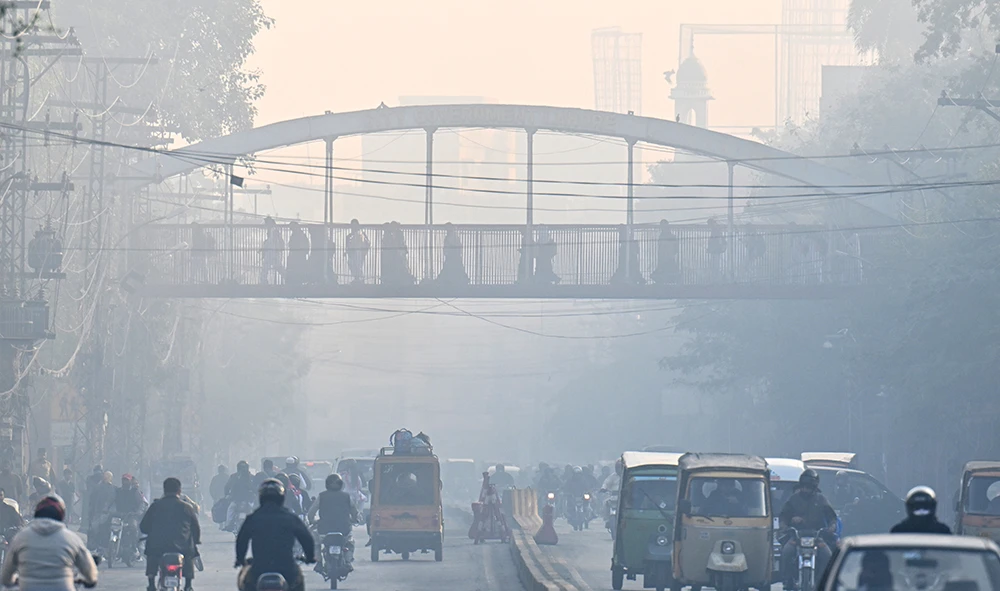
ISLAMABAD: Pakistan’s eastern city of Lahore ranked as the world’s most polluted major city on Sunday morning, with air quality reaching hazardous levels, while dense fog forced authorities to close sections of a major motorway in the country’s most populous Punjab province.
Air pollution typically worsens during winter in Pakistan as cooler temperatures and stagnant atmospheric conditions trap emissions from vehicles, factories, brick kilns and agricultural fires close to the ground. Poor visibility also disrupts road travel, particularly across the agricultural plains of Punjab.
Motorway police announced the closure of a section of the M4 motorway between Faisalabad and Pindi Bhattian early Sunday due to dense fog, while restricting heavy traffic between Abdul Hakeem and Faisalabad.
“The motorways are being closed to protect people’s lives and property,” Syed Imran Ahmed, a spokesperson for the motorway police’s central region, said in a statement. “Avoid unnecessary travel in fog.”
He advised motorists to travel during daylight hours, preferably between 10 a.m. and 6 p.m., reduce their speed and maintain a safe distance from other vehicles.
Lahore recorded an air quality index (AQI) of 443 between 9 a.m. and 10 a.m. on Sunday, according to Swiss air quality monitoring firm IQAir, well above the threshold of 300 considered hazardous to human health.
Pakistan’s southern port city of Karachi ranked fifth among the world’s most polluted major cities with an AQI of 175, classified as unhealthy. Cairo, Delhi and Baghdad occupied the second, third and fourth spots, respectively.
Punjab authorities have introduced a range of measures to combat winter smog in recent years, targeting industrial and vehicular emissions and subsidizing agricultural machinery to discourage farmers from burning crop residue.
Exposure to fine particulate matter, a major component of air pollution, can increase the risk of respiratory and cardiovascular diseases as the tiny airborne particles penetrate deep into the lungs and enter the bloodstream.