- Three countries report progress toward operationalizing Makkah pact’s secretariat in Saudi Arabia
- They reaffirm commitment to joint technological development, military training, defense industries
ISLAMABAD: Pakistan and Türkiye pledged to intensify efforts to help Saudi Arabia defend itself against attacks by Yemen’s Iran-aligned Houthis during trilateral talks in Islamabad on Friday, Pakistan’s Deputy Prime Minister Ishaq Dar said after a meeting on the implementation of the Makkah defense pact.
Saudi Arabia, Pakistan and Türkiye signed the agreement in Makkah on Aug. 7 amid heightened regional tensions over the US-Israeli war against Iran. The pact commits them to treating an armed attack on any one of the three countries as an attack on all.
The region has also seen renewed hostilities between Saudi Arabia and Yemen’s Houthis, with the group targeting civilian and energy infrastructure in the Kingdom. The two conflicts have threatened global trade and energy supplies, disrupting shipping through the Strait of Hormuz and the Bab Al-Mandab Strait, two of the world’s most important maritime chokepoints.
“The three sides reiterated their strong condemnation of the persistent and heinous attacks by the Houthi militia targeting civilians and civilian infrastructure in the Kingdom of Saudi Arabia and reaffirmed their collective resolve to continue and intensify efforts to support the Kingdom in safeguarding its security, sovereignty and territorial integrity in accordance with the collective defense provisions of the Makkah Agreement for Joint Defense,” Dar, who also serves as his country’s foreign minister, said in televised remarks.
A joint statement issued after the meeting said the three countries had reviewed progress toward the “practical implementation of collective defense commitments, in line with their national legislation.”
Neither Dar nor the communique specified any new military measures to counter Houthi attacks.
Turkish Foreign Minister Hakan Fidan said on Nov. 21 that his country was providing defensive support to Saudi Arabia but had made no decision on deploying troops inside Yemen. Pakistan already sent a military contingent, including fighter jets and support aircraft, to Saudi Arabia in April under a bilateral defense agreement signed in September 2025, according to a statement issued by the Saudi defense ministry at the time.
All three countries have repeatedly described the agreement as a defensive arrangement that is not directed against any country.
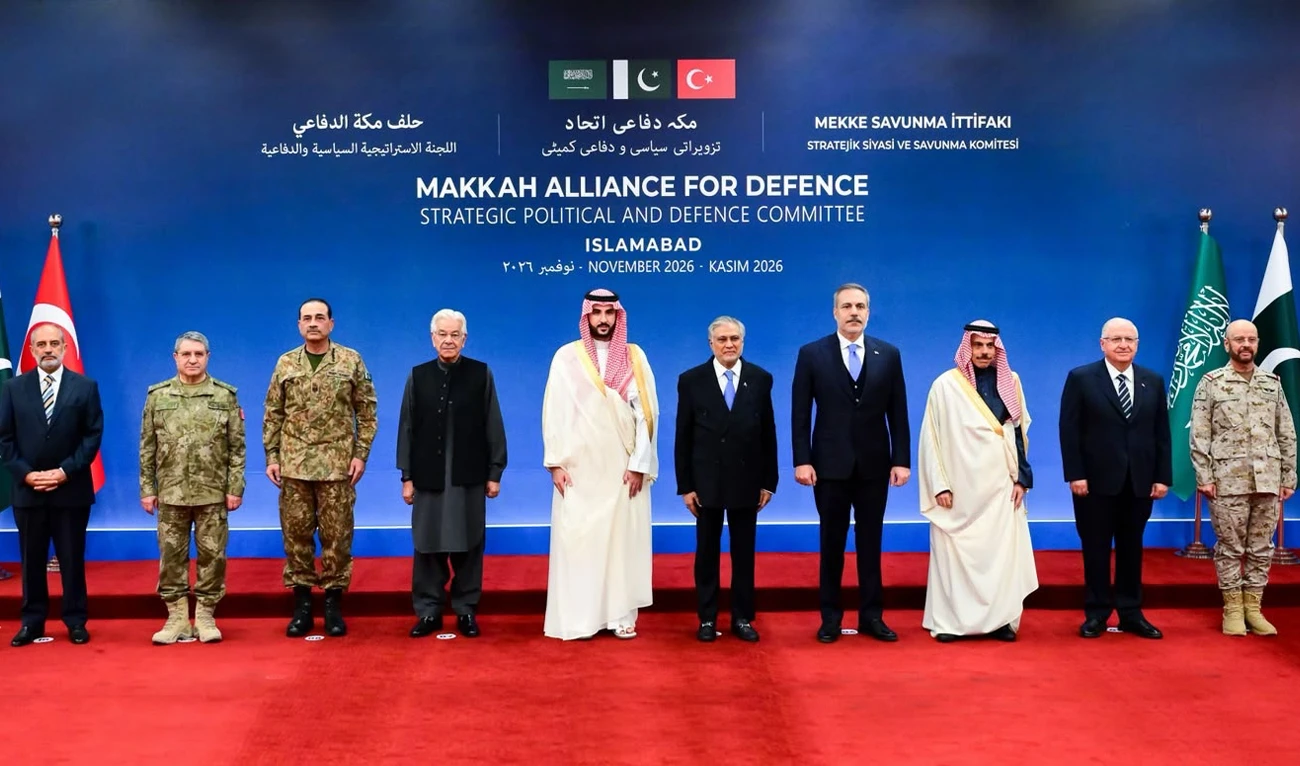
Friday’s meeting brought together the foreign and defense ministers and military chiefs of the three member states for the second meeting of the alliance’s Strategic, Political and Defense Committee (SPDC).
Dar, Defense Minister Khawaja Muhammad Asif and Chief of Defense Forces Field Marshal Asim Munir represented Pakistan. The Saudi delegation comprised Defense Minister Prince Khalid bin Salman, Foreign Minister Prince Faisal bin Farhan and Chief of General Staff Gen. Fayyad bin Hamed Al-Ruwaili.
Türkiye was represented by Foreign Minister Hakan Fidan, Defense Minister Yaşar Güler and Chief of General Staff Gen. Selçuk Bayraktaroğlu.
Dar said the three countries had reviewed the implementation of decisions taken at previous meetings and “expressed satisfaction at the pace of progress toward the establishment and operationalization of the Alliance Secretariat in the Kingdom of Saudi Arabia.”
At their first committee meeting in Istanbul on Aug. 31, the three countries agreed to establish a permanent secretariat in Riyadh and pursue joint development and production of defense technology.
At emergency talks in Riyadh on Oct. 5, the committee condemned attacks targeting Saudi cities and civilian facilities and confirmed retired Pakistani Lt. Gen. Nauman Mahmood as the alliance’s first secretary-general for a three-year term.
“The parties reaffirmed their commitment to strengthening cooperation in defense industries, joint technological development, training and capacity building with a view to enhancing the collective capabilities and cohesion of their armed forces in order to address mutual security concerns and contribute to peace and security in the region,” Dar said.
The deputy prime minister said the three countries had also reviewed the evolving regional security situation and agreed to maintain consultations on issues of mutual interest.
“The SPDC agreed to continue consultations aimed at enhancing cooperation and coordination on matters of mutual interest, supporting efforts toward de-escalation of regional tensions and encouraging the peaceful resolution of disputes through dialogue and diplomacy,” he said.
Dar also held bilateral talks with his Turkish counterpart Hakan Fidan on the sidelines of the meeting, with the two ministers agreeing to expand economic cooperation and maintain close coordination under the Makkah defense pact to promote dialogue and de-escalation, Pakistan’s Foreign Office said.
The two ministers expressed satisfaction with growing bilateral cooperation in trade, investment, defense and energy and agreed to translate their political ties into tangible economic gains.
Pakistan has been working with Middle Eastern countries, including Qatar, to bring the United States and Iran back to the negotiating table following an interim agreement Islamabad brokered in June.
Friday’s talks were held amid tight security in the Pakistani capital, with authorities imposing temporary traffic restrictions and directing government offices in Islamabad’s Red Zone to work remotely.