- Pakistan proposes preferential trade arrangement separate from existing free trade agreement with China
- Minister Ahsan Iqbal also seeks progress on major transport, energy and industrial cooperation projects
ISLAMABAD: Pakistan has sought duty-free access to the Chinese market for all its goods to narrow a $19.6 billion bilateral trade deficit, according to an official statement on Friday, as Planning Minister Ahsan Iqbal held talks with a senior Chinese official in Beijing.
China is one of Pakistan’s largest trading partners and a major source of investment through the China-Pakistan Economic Corridor (CPEC), a flagship project of Beijing’s Belt and Road Initiative. However, bilateral trade remains heavily skewed in China’s favor, with Pakistan’s imports reaching $22.34 billion in the 2025-26 fiscal year against exports of $2.71 billion.
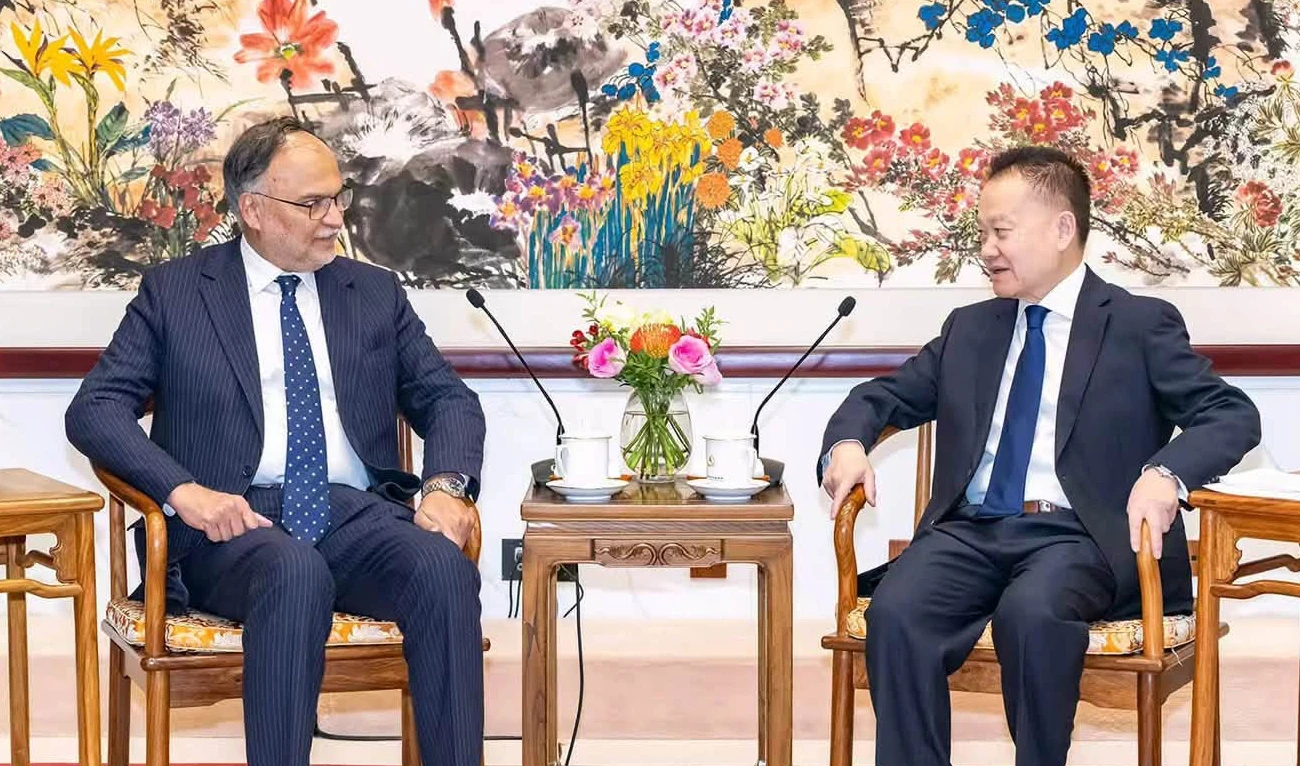
“Pakistan proposed a non-reciprocal arrangement, separate from the existing bilateral free trade agreement and modelled on the zero-tariff access China has extended to African countries,” Pakistan’s planning ministry said in a statement following Iqbal’s meeting on Thursday with Zhou Haibing, vice chairman of China’s National Development and Reform Commission.
Iqbal proposed bilateral technical talks to determine product coverage, rules of origin and a timetable for implementing the proposed arrangement.
The planning minister is visiting China, where he also witnessed the launch of a space mission carrying Pakistan’s first astronaut, marking a milestone in scientific and technological cooperation between the two countries.
Thursday’s meeting also focused on the next phase of CPEC, which is increasingly geared toward industrial cooperation, agricultural modernization and technology after years of investment in Pakistan’s transport and energy infrastructure.
Iqbal sought early completion of a financing agreement for a 102-kilometer section of the Karakoram Highway, part of a wider Rs576 billion ($2.06 billion) realignment project, and discussed Chinese participation in upgrading Pakistan’s main railway line.
He also sought Beijing’s support in restoring regular shipping services to the southwestern port of Gwadar and proposed a joint study on establishing strategic petroleum storage facilities there.
The minister called for progress on major hydropower projects and proposed assessing the feasibility of converting selected power plants from imported coal to locally produced coal to reduce Pakistan’s dependence on imported fuel.
The two sides also discussed industrial cooperation, including the development of model special economic zones and mineral processing facilities.
“Mr Zhou Haibing described the corridor as a pillar of China–Pakistan economic cooperation and pointed to its tangible gains,” the statement said.
The Chinese official expressed readiness to work with Pakistan on the next phase of CPEC and called for closer alignment with Islamabad’s development priorities.
The talks also covered cooperation in artificial intelligence, agricultural modernization and a proposed jointly financed program to provide 10,000 doctoral scholarships over a decade.