- Chinese Communist Party official holds talks with Pakistan’s civilian, military leadership
- Ishaq Dar calls for political engagement as two countries mark 75 years of diplomatic ties
ISLAMABAD: Pakistan and China on Monday discussed expanding strategic partnership through closer political and institutional cooperation, as a visiting Chinese Communist Party official held talks with the country’s civilian and military leadership on bilateral ties and regional security.
The discussions come as the two countries mark 75 years of diplomatic relations, with Beijing remaining a key economic and defense partner for Islamabad through major infrastructure investments, military cooperation and diplomatic support.
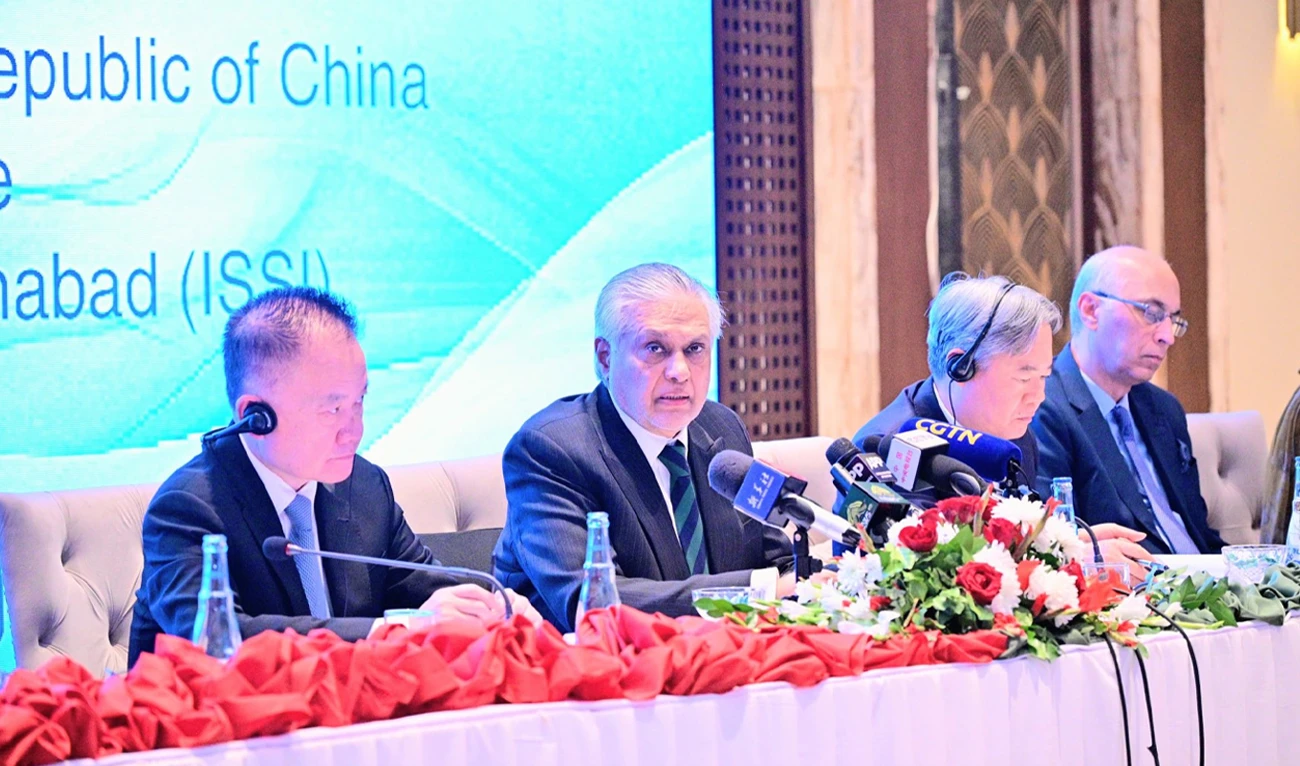
Deputy Prime Minister and Foreign Minister Ishaq Dar called for stronger political engagement and closer institutional ties at a symposium in Islamabad attended by Liu Haixing, head of the International Department of the Communist Party of China’s Central Committee.
“Our engagement underscores an important dimension of the Pakistan-China relationship: that its strength rests not only on intergovernmental cooperation but also on sustained political understanding, institutional linkages and exchanges between our political parties,” Dar said.
China is Pakistan’s largest trading partner and a major investor in its infrastructure and energy sectors through the multibillion-dollar China-Pakistan Economic Corridor (CPEC), a flagship project of Beijing’s Belt and Road Initiative.
The two countries also maintain close defense and security ties, while Beijing has provided financial assistance to Pakistan as Islamabad works to stabilize its economy.
Dar said the relationship was supported by broad political consensus in Pakistan and called for sustained exchanges between political parties and institutions to strengthen cooperation beyond traditional diplomatic channels.
“Our All-Weather Strategic Cooperative Partnership reflects the recognition across our political spectrum that the Pakistan-China partnership is a vital strategic asset for the country,” he said.
He referred to an agreement signed in May between China’s ruling Communist Party and Pakistan’s governing Pakistan Muslim League-Nawaz party to promote more structured political exchanges.
Pakistan had also proposed five political corridors covering political dialogue, governance cooperation, youth engagement, people-to-people exchanges and regional cooperation, Dar said.
The proposals build on existing mechanisms for dialogue between Chinese and Pakistani political parties, including consultations linked to the second phase of CPEC, which aims to expand cooperation into industrial development and other sectors.
Dar also called for closer collaboration on institutional strengthening, public services, development planning and anti-corruption measures, citing China’s governance experience as a potential model for Pakistan.
“China’s experience offers invaluable best practices. It shows how far-sighted leadership sets long-term national priorities, mobilizes collective effort and turns priorities into tangible benefits for the betterment of the people,” he said.
The symposium brought together representatives of Pakistan’s major political parties, including the Pakistan Peoples Party and Pakistan Muslim League-Nawaz, alongside government officials and policy experts.
In a separate meeting at the army’s General Headquarters in Rawalpindi, Liu and Pakistan’s army chief, Field Marshal Asim Munir, discussed regional and international security developments and bilateral relations, according to a military statement.
Both sides “expressed their shared resolve to further strengthen the all-weather strategic cooperative partnership between Pakistan and China,” the military said.
Munir emphasized the importance of sustained high-level engagement, stronger institutional links and expanded cooperation, while Liu praised Pakistan’s contributions to regional peace and stability.
The meetings highlighted efforts by Islamabad and Beijing to broaden their partnership through political and institutional engagement alongside their established economic and security cooperation.