

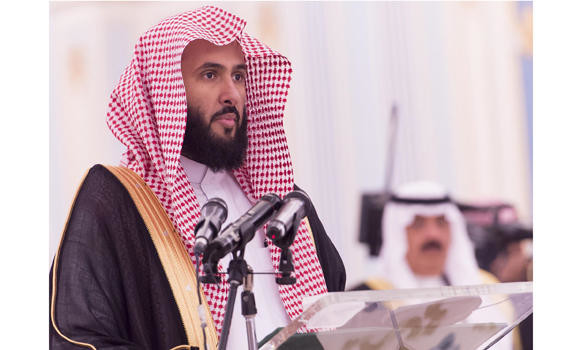
Our judiciary is transparent, independent: Justice minister

Updated 06 January 2016
Follow

Our judiciary is transparent, independent: Justice minister

JEDDAH: Justice Minister Walid Al-Samaani on Tuesday reiterated that trials in the Saudi courts, including terror-related cases, have to follow rigorous procedures in terms of providing evidence.
He explained that at the first stage of litigation, three judges preside over the Criminal Court. When the case is sent to Appeals Court, five judges look into it. After this, the case goes to the Higher Court, where it is studied by another set of five judges. At this stage, the final verdict is issued.
Before a final verdict is delivered, it goes through no less than 13 judges, making the judgment absolutely indisputable.
“The trials are completely transparent and in line with Islamic law,” said Al-Samaani.
Lawyer Ahmed Al-Jamaan Al-Malki, a member of the Arab Lawyers Union, said the Saudi judiciary is based on Islamic law derived from the Holy Qur’an, Sunnah, consensus (Ijma’), and analogy (Qiyas).
Saudi Arabia is the only country in the world that relies fully on Islamic laws for verdicts of all kinds, which are enshrined in the country’s Basic Law of Governance.
He said the judiciary is independent. Even evidence submitted by the king must conform to Islamic law, he said. Some cases are overseen by one judge whereas criminal cases involving execution, amputation or stoning involve three judges. There are five judges sitting at the Appeals Court and five at the Supreme Court.
Abdullah Al-Falaj, a legal consultant, said that Saudi law provided that the judiciary be an independent authority.
“There shall be no power over judges in their judicial function other than the power of the Shariah. These are guarantees for the independence of the judicial authorities and systems, so that everyone is equal before the law without discrimination by one person against another,” Al-Falaj said.
He said that the law provided that an accused person shall have the right to seek the assistance of a lawyer or a representative to defend him or her during the investigation and trial.
Al-Falaj said the Kingdom had ratified a number of international conventions and treaties on human rights, such as the Arab Charter on Human Rights, Convention on the Rights of the Child, International Convention on the Elimination of All Forms of Racial Discrimination and the Convention on the Prevention and Punishment of the Crime of Genocide.

RELATED STORY: Saudi judicial system gives accused full rights to defend


Saudi hospitality boom sparks innovation beyond the plate

Chefs at Julien prepare meals to pair with Diageo drinks. (AN photo by Basmah Albasrawi)
Updated 11 January 2026
Follow

Saudi hospitality boom sparks innovation beyond the plate

  • At the Four Seasons Riyadh, Diageo hosted a private tasting at Tonic Bar followed by a 10-course dinner at Julien
  • Dinner at Julien paired dishes with drinks made using Tanqueray 0.0, Captain Morgan 0.0, and Guinness 0.0

RIYADH: As restaurants and hotels in Saudi Arabia refine their culinary identities, beverages are increasingly being treated as crafted experiences in their own right, shaped by technique and intention.

At the Four Seasons Riyadh, Diageo hosted a private tasting at Tonic Bar followed by a 10-course dinner at Julien, offering a snapshot of how this evolution is beginning to take shape, as international players and local venues test new approaches to pairing and presentation. 

Speaking to Arab News, Nick Rees, marketing director of Diageo MENA, pointed to the rapid growth of the nonalcoholic segment globally and in the region: “There’s a far faster growing percentage of it (the industry) is non-alcohol … There (are) trends globally … A lot of it will be pointed to wellness, mindful drinking.”

Rees said that Saudi Arabia’s fast-developing culinary and hospitality scene calls for beverages that match the level of excellence seen in kitchens across the Kingdom.

“It’s kind of the lack of choices and that’s where we want to be able to provide people the option, and people here absolutely have the same kind of talent and desire as their counterparts behind the kitchen,” he said.

“That’s where our role is to give people the kind of core ingredients for them to be able to work with … we have many more brands that we would love to introduce to the Kingdom.”

The dinner at Julien paired dishes with drinks made using Tanqueray 0.0, Captain Morgan 0.0, and Guinness 0.0, offering a glimpse into the range of styles Diageo is bringing to the market.

Flavor profiles ranged from light and refreshing combinations with cucumber and capers brine to richer, malt-forward blends, each designed to complement the accompanying dishes, from ravioli to black cod. 

Rees emphasized that pairing food with thoughtfully crafted beverages is becoming an essential part of the hospitality experience. 

“In the Kingdom, we’re looking at giving people the experience that currently is not available to them because I know for sure that the kind of quality and expertise and craftsmanship that can go into creating some of these drinks is absolutely as exciting as the work that the chefs would do with their food,” he said.

Anthony Abou Haider, head of Gulf at Diageo, said the company sees long-term potential in Saudi Arabia’s hospitality sector. 

“It’s such an opportunity to be a part of this transformation journey,” he told Arab News. “We’re not looking for a short-term gain, we’re looking at a very long-term gain here because whatever we do now is building for the future.”