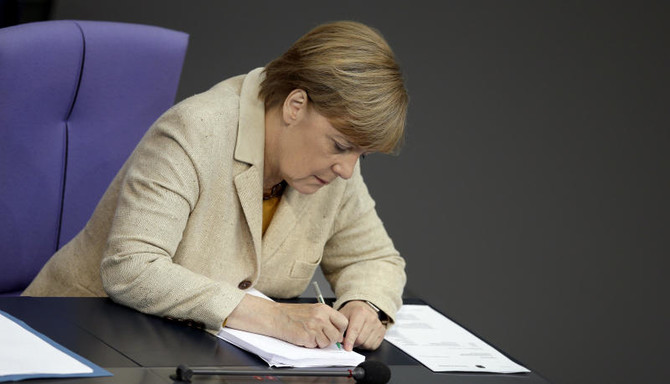
BERLIN: German Chancellor Angela Merkel Monday defended her open-door policy to refugees in the face of falling poll ratings, saying it was “part of the basic humanity of our country.”
It was not her job to “spread worry” but “to work on finding solutions to the problems,” Merkel told mass-market daily Bild in a lengthy interview.
She voiced understanding for citizens’ fears given the record influx, expected to reach 800,000 to one million this year.
But she stressed that “for me it is part of the basic humanity of our country that one deals with a refugee in a friendly way, as with every other human being.”
Asked whether she could imagine sheltering a refugee at her home, however, she said: “Although I have great respect for the people who do that, I could not imagine that for me now.”
To manage the migrant wave, Germany would have to quickly repatriate rejected asylum-seekers fleeing poverty not war, said the chancellor.
“Newly arrived people without hopes of being allowed to stay will be sent back directly,” she said.
Despite mounting criticism within her conservative party, Merkel said she was “firmly convinced” that the Christian Democrats were behind her, adding that polls “are not my gauge.”
The chancellor also reiterated it was impossible to immediately end the influx of asylum-seekers.
“If someone wants to say ‘let’s stop it now’, then they have to be able to stop it, but it’s not that simple,” she told Bild.
The greatest migration crisis since World War II could only be solved together with Germany’s European and international partners, she said, pointing at the war in Syria.
“The diplomacy of the entire West — but also of the Arab states, Russia and regional powers — has so far been unsuccessful in Syria,” she said.
Merkel added that “the whole of Europe must work to secure the EU’s external borders, while distributing the refugees fairly between the member states.”
She stressed that no new taxes would be raised in Germany to pay for handling the migrant influx.
“We can be pleased that we have managed the economy well for years and that our current economic situation is good,” said Merkel.
She also sought to ally fears that the majority Muslim refugees presented a threat to German society.
Germany would continue to be defined by “the constitution, the social market economy, the freedoms of religion and expression,” she said.
“To the people who come here, we make clear from day one that we have laws and rules that govern communal life which they must follow.
“Only in this way can Germany be a safe haven to them.”

Merkel defends refugee policy as expression of ‘humanity’
China overturns death sentence for Canadian in drug case
TORONTO: China has overturned the death sentence of Canadian Robert Lloyd Schellenberg, a Canadian official told AFP Friday, in a possible sign of a diplomatic thaw as Prime Minister Mark Carney seeks to boost trade ties with Beijing.
Schellenberg’s lawyer Zhang Dongshuo, reached by AFP over the phone in Beijing on Saturday, confirmed the decision was announced Friday by China’s highest court.
Schellenberg was detained on drug charges in 2014 before China-Canada ties nosedived following the 2018 arrest in Vancouver of Huawei chief financial officer Meng Wanzhou.
That arrest infuriated Beijing, which detained two Canadians — Michael Spavor and Michael Kovrig — on espionage charges that Ottawa condemned as retaliatory.
Then, in January 2019, a court in northeast China retried Schellenberg, who was 36 at the time, sentencing him to death while declaring that his 15?year prison term for drug trafficking had been too lenient.
The court said he had been a central player in a scheme to ship narcotics to Australia, in a one-day retrial that Amnesty International called “a flagrant violation of international law.”
Schellenberg has denied wrongdoing.
The Canadian official requested anonymity in confirming the decision by China’s highest court to overturn Schellenberg’s death sentence.
Schellenberg, who has been held in northeastern Dalian since 2014, will be retried by the Liaoning High People’s Court, his lawyer Zhang said. The timing for the retrial has not yet been set.
Zhang said he met with Schellenberg in Dalian on Friday, and said the Canadian appeared relatively relaxed.
Carney, who took office last year, visited China in January as part of his global effort to broaden Canada’s export markets to reduce trade reliance on the United States.
“Global Affairs Canada (GAC) is aware of a decision issued by the Supreme People’s Court of the People’s Republic of China in Mr. Robert Schellenberg’s case,” foreign ministry spokesperson Thida Ith said in a statement sent to AFP.
Ith said the ministry “will continue to provide consular services to Mr. Schellenberg and to his family,” adding: “Canada has advocated for clemency in this case, as it does for all Canadians who are sentenced to the death penalty.”
New partners
Key sectors of the Canadian economy have been hammered by US President Donald Trump’s tariffs, and Carney has said Canada can no longer count on the United States as a reliable trading partner.
Carney says that despite ongoing tensions, including allegations of Chinese interference in Canadian elections, Ottawa needs a functioning relationship with Beijing to safeguard its economic future.
When in Beijing last month, Carney met Chinese President Xi Jinping and heralded an improved era in relations — saying the two countries had struck a “new strategic partnership” and a preliminary trade deal.
Global Affairs Canada did not comment on whether diplomacy during Carney’s visit related to Schellenberg’s case impacted the Chinese court decision.
“Due to privacy considerations, no further information can be provided,” Ith said.
Schellenberg’s lawyer Zhang said Carney’s visit raised his hopes that the Chinese court would announce a relatively positive outcome for his client.
Meng, who had initially been charged with scheming to evade US sanctions on Iran, was freed in September 2021.
Spavor and Kovrig were released the same month.