
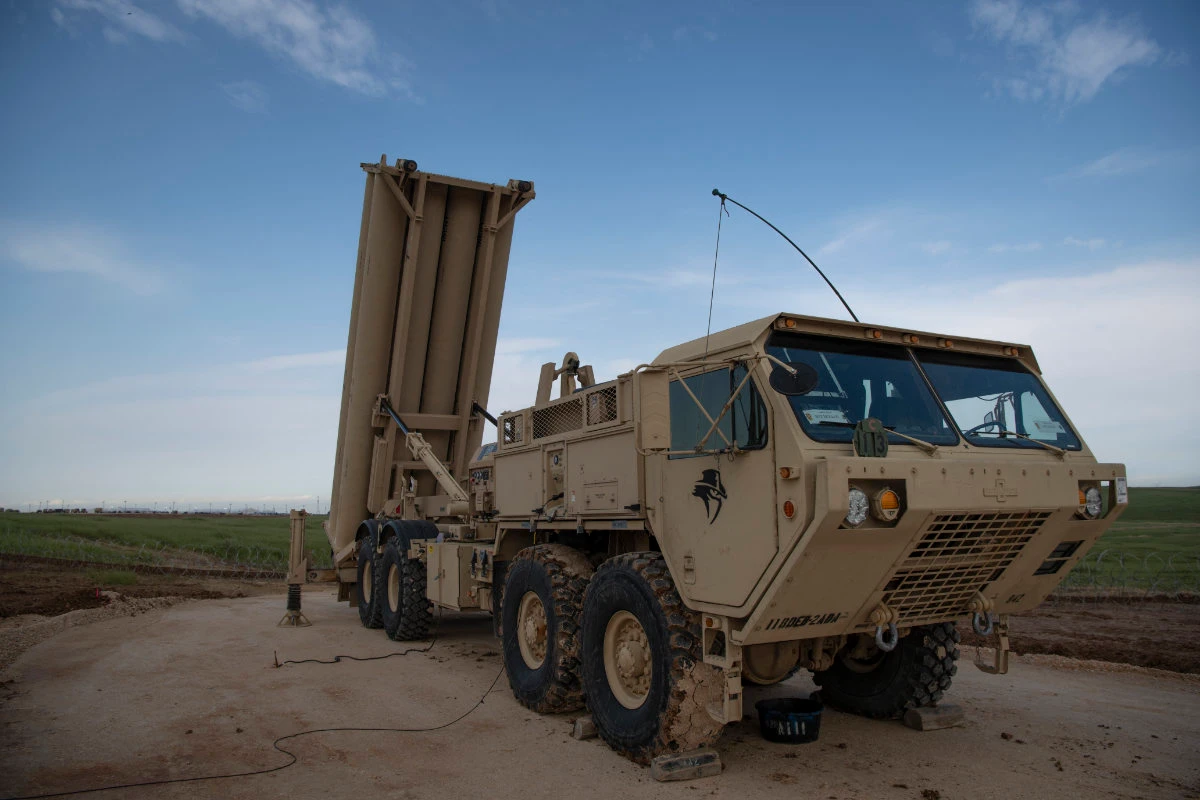
From late February, Iran launched a sustained ballistic missile and drone campaign against targets across the Gulf. Within hours, Patriot and THAAD batteries across the region were engaged. The UAE said its air defenses intercepted 537 ballistic missiles, 2,256 drones and 26 cruise missiles between Feb. 28 and early April. Saudi Arabia, meanwhile, reported 894 intercepted aerial threats between March 3 and April 7, including 86 ballistic missiles and nine cruise missiles. The Kingdom expended about 2,400 PAC-3 interceptors in the conflict’s first 38 days, equivalent to 86 percent of its pre-war inventory.
The systems proved effective, but the scale of their use has raised questions about the sustainability of Gulf air-defense capabilities in a prolonged conflict. The answer offered by Washington has been unambiguous. Facing an estimated depletion of 65 percent of its Patriot interceptor stockpile and 38 percent of its THAAD reserves, the US redeployed batteries from South Korea to the Middle East over Seoul’s objections, and awarded Lockheed Martin a $58.6 billion contract to scale PAC-3 production from 600 to 2,000 units annually. Congress assessed the interception rate against Iranian ballistic missiles at about 90 percent.
Adding to this, there are currently no effective alternatives to Patriot and THAAD for ballistic missile defense. This leaves Gulf states heavily reliant on US capabilities even as the conflict puts pressure on American interceptor stocks. This is the paradox at the center of the regional security equation. The American shield is thinner than it was but the alternatives are not yet equal.
That commitment has a proven record which has a global reach beyond the Gulf. Since 2022, Patriot has been the cornerstone of Ukraine’s strategic air defense against Russian ballistic missiles, and is described by Western officials as the crown jewel of Kyiv’s defensive architecture: a system so critical that Ukraine placed its first direct purchase order in mid-2026 rather than risk relying entirely on allied donations. The Gulf campaign has validated the same lesson at greater scale and intensity, as no other system, Russian, Chinese or European, has been tested and proved against massed, simultaneous, multi-vector attacks of the kind Iran sustained over five months of conflict.
The lesson for the Gulf is therefore not to abandon diversification. It is the opposite; diversification is becoming more necessary. But diversification works best when it strengthens the architecture rather than fragments it.
Egypt is a useful case study. Cairo has spent years deliberately avoiding dependence on a single supplier. Its military inventory combines American aircraft and air-defense equipment with Russian, French, German, and Chinese systems. The approach is strategically understandable. Egypt has one of the region’s largest militaries, controls the Suez Canal, borders Libya, Sudan, and Gaza, and operates in a security environment in which no government would want its entire defense establishment tied to the political decisions of one foreign capital.
The US remains the strongest regional security guarantor with the depth of alliances, infrastructure, and military capacity to rebuild it.
Zaid M. Belbagi
As such, Egypt’s defense procurement choices carry strategic consequences that take into consideration the current context. Egypt receives $1.3 billion per year in US Foreign Military Financing, the second-largest such program globally after Israel, a figure that accounts for an estimated 80 percent of its entire annual military procurement budget. Built over four decades since Camp David, the US-Egypt defense relationship encompasses 220 F-16 Fighting Falcons, Patriot air defense systems, Stinger short-range interceptors and a sustained program of joint exercises, the most recent of which, Bright Star 2025, brought 1,800 US military personnel and forces from 44 countries to Egyptian soil. Since October 2023 alone, the State Department has notified Congress of $12 billion in Foreign Military Sales cases for Egypt.
Egypt has nevertheless pursued a deliberately layered defense architecture, combining its American platforms with Russian S-300VM systems, Chinese HQ-9B surface-to-air missiles, French Rafales and German IRIS-T systems. Cairo has also been reported to be considering the Chinese J-10C fighter, a platform that flew in the two countries’ first joint air exercise. The logic behind this is that no state with Egypt’s strategic exposure wants to depend on a single supplier. But this logic has limits that the Iran war has made harder to ignore.
Russia and China also face limitations as alternative suppliers. Their export systems generally leave buyers dependent on the vendor for upgrades, software and maintenance, while integrating Chinese or Russian platforms into defense networks built around US data links, radar and command-and-control systems can create interoperability challenges. The issue is therefore not simply whether Gulf states diversify their suppliers, but whether different systems can operate effectively within the same defense architecture.
The same logic is becoming increasingly relevant to the Gulf. The Makkah Joint Defense Agreement, signed on Aug. 7 by Saudi Arabia, Turkiye, and Pakistan, has sharpened this question of the region’s security architecture considerably. Turkish Foreign Minister Hakan Fidan has described Egypt as a natural partner and expressed confidence that Cairo will formally join the alliance once technical issues are resolved. If Egypt does so, it will need to operate alongside Saudi and Turkish systems, both of which are built around US and NATO-standard architecture. An Egyptian network that has absorbed Chinese fighters and Russian surface-to-air platforms would sit awkwardly inside any collective defense framework designed for interoperability with Washington, precisely at the moment when the value of that interoperability has been demonstrated at scale across the Gulf.
That is the real meaning of the dwindling shield. The American system has shown that it can defend the region. The war has also shown that it cannot do so indefinitely without reinforcement.
For Gulf states and countries such as Egypt, the strategic answer is not necessarily dependence or decoupling. It is layered resilience, with more suppliers, more domestic production, and more European and Asian partnerships. All of this, coupled with increased interceptor stocks and continued access to the one security architecture that has demonstrated, at scale and under fire, the ability to connect those capabilities to American intelligence and military power.
As such, the shield may be dwindling. But for now, the US remains the strongest guarantor of regional security with the depth of alliances, infrastructure and military capacity to rebuild it.
• Zaid M. Belbagi is a political commentator and an adviser to private clients between London and the Gulf Cooperation Council. X: @Moulay_Zaid