- Reinhold Lopatka outlines trade, security and UN coordination as priorities during three-day visit
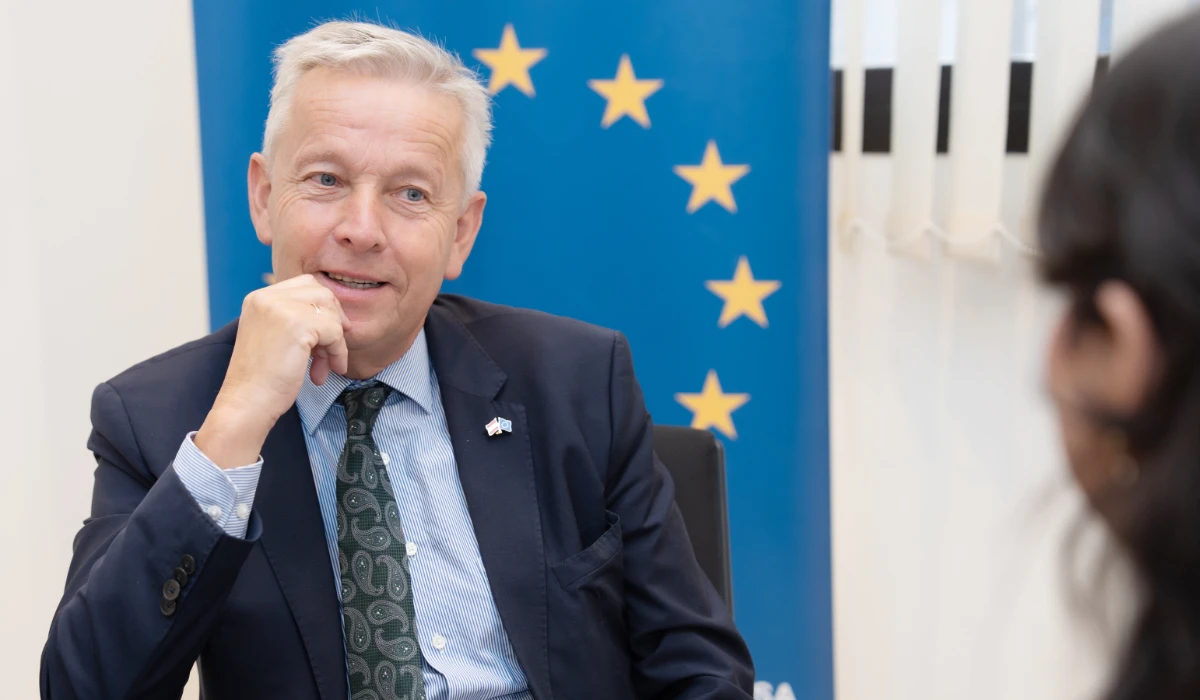
RIYADH: A European Parliament delegation began a three-day visit to Saudi Arabia with its chair, Reinhold Lopatka, saying talks will focus on security cooperation, energy-transition projects, trade priorities and a proposed strategic partnership.
The visit, running from July 19-21 and covering Riyadh and Jeddah, includes the 18th EU–Kingdom of Saudi Arabia interparliamentary meeting and engagements aimed at strengthening parliamentary dialogue.
The European side is part of the European Parliament’s Delegation for Relations with the Arabian Peninsula, which maintains interparliamentary ties with Gulf countries via the Gulf Cooperation Council.
HIGHLIGHT
Europe’s renewed focus on defense is tied to its interest in working more closely with Saudi Arabia on regional security, including efforts to protect commercial shipping and keep trade routes open, Reinhold Lopatka said.
Delegation chair Lopatka told Arab News on Sunday that the trip also follows concern over military strikes affecting the Kingdom earlier this year: “First of all, I have to say that we condemn in the strongest way these discriminatory strikes against Saudi Arabia.”
He added that the episode was “the reason that we had an ad hoc mission already in May.”
Lopatka described the latest visit as a continuation of regular contact with Saudi Arabia’s Shoura Council: “It is now the 18th EU-Kingdom of Saudi Arabia interparliamentary meeting, but under special circumstances.
“In times like this, one thing is to show our solidarity,” he said.
Saudi Arabia is by far the biggest and most important country within the Gulf Cooperation Council.
Reinhold Lopatka, European Parliament member
Lopatka said the EU wants to deepen cooperation beyond traditional files, including on security as well as in newer areas such as artificial intelligence and connectivity.
He outlined three priorities for the relationship: a proposed strategic partnership agreement, progress toward a free-trade agreement and closer international coordination, including at the UN.
Lopatka described Saudi Arabia as a central GCC partner and said the EU wants a deeper partnership with the Kingdom.
“Saudi Arabia is by far the biggest and most important country within the Gulf Cooperation Council.”
He said the delegation’s priority is to strengthen security cooperation and support diplomacy to support deescalation: “Security issues are very important, and we have to discuss what we can do to support dialogue and diplomacy.”
Lopatka also highlighted maritime security in the Red Sea, saying both sides share an interest in keeping commercial routes open. He referenced the EU operation in the area and said cooperation with Saudi Arabia is important for global trade.
“To keep the trade routes open is in the interest of the whole planet, not only in the interest of Europe,” he said.
Energy cooperation is one of the most practical areas for faster EU–Saudi progress, Lopatka added, highlighting solar, wind and hydrogen as priorities where European expertise and Saudi capacity could align through concrete projects.
He added that the next 12 to 24 months should be judged by implementation, with European companies — including Austrian firms — working with Saudi partners on concrete renewables and hydrogen projects.
Lopatka described it as a win-win opportunity if administrative burdens are reduced so investment can translate into delivery.
He highlighted Saudi Arabia’s stability and investment climate as key drivers of EU interest, saying this is where cooperation can translate into practical projects.
“Saudi Arabia is a place where a lot of Austrian and European companies are interested because this country is secure and is stable, which is very important for investment,” he said.
European debates over the pace and cost of decarbonization will influence how quickly companies can commit capital to overseas projects, Lopatka said.
Europe’s renewed focus on defense is tied to its interest in working more closely with Saudi Arabia on regional security, including efforts to protect commercial shipping and keep trade routes open, he said.
He added that priorities had shifted after the end of the Cold War: “After 1989 … we forgot that we also have to spend a lot of money on defense.”
Europe is now correcting that gap, Lopatka said, adding that the EU is planning its next Multiannual Financial Framework for 2028 until 2035, which will highlight a sharp contrast between past and future defense spending.
“In the last seven years, we have spent on the European level for defense only €15 billion ($17.1 billion). Now we will spend €150 billion.”
He said the shift is also institutional: “Now we have, for the first time, a commissioner for defense.”
The European Parliament has also created a defense committee, Lopatka added.