



LONDON: Israel’s row with the UN intensified this month after the world body formally added it to a list of parties accused of conflict-related sexual violence, a move that drew a blistering rebuke from its ambassador and renewed criticism of the UN’s handling of the Gaza war.
At a June 19 General Assembly event marking the International Day for the Elimination of Sexual Violence in Conflict, Israel’s UN Ambassador Danny Danon berated senior UN officials for its inclusion on the list.
The clash came just weeks after reports that the UN had added Israel and Russia to its blacklist for conflict-related sexual violence, citing abuses by security forces, including the rape of male detainees.
Both countries deny their forces used sexual violence.
In a May 28 post on X, Danon denounced the “political decision” that was “disconnected from the facts and reality.” In another post, he wrote: “We are done with the secretary-general’s lies. Equating the democratic State of Israel with Hamas terrorists is a new low.”
The UN had already added Hamas to the sexual violence blacklist following the Oct. 7, 2023 attacks on southern Israel, which triggered the war in Gaza. The group has not acknowledged any cases of sexual violence or held alleged perpetrators accountable.
The listing drew praise from Reem Alsalem, the UN special rapporteur on violence against women and girls, who also called the decision “long overdue.”

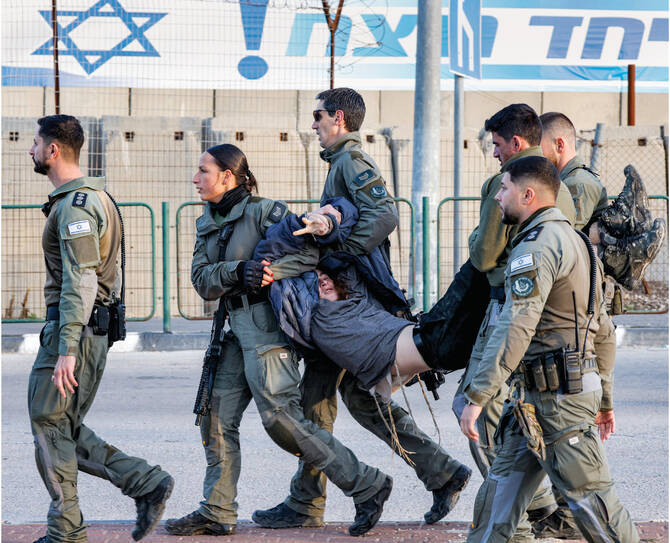
A United Nations annual report says alleged violations against Palestinians occurred mainly during detention and interrogation. (AFP file photo)
Alsalem wrote on X: “This listing could not have come soon enough.
“I had in the past expressed my disappointment that Israel was not listed already, given the systematic, large-scale and horrific sexual violence perpetrated by Israel against Palestinian women, men and children that have been independently documented and verified.”
The Israeli diplomat’s sharp reaction and threat to cut ties with Antonio Guterres, the UN secretary-general, reflects how seriously Israel views such listings, even though experts say the mechanism is largely symbolic on its own.
“Israel has for years felt that the UN has acted in a biased and unfair way against it, and it has seen the UN in an adversarial light,” Brian Katulis, a senior fellow at the Middle East Institute, told Arab News.
“This is a continuation of tensions between Israel and the UN, and the government of Israel is particularly sensitive to criticisms and allegations against it about how it acted in response to the Oct. 7 attack.”

Supporters and family members of Israeli hostages snatched by the Palestinian militant group Hamas in a surprise attack into Israel on Oct. 7, 2023, hang up signs showing their faces and information during a rally outside of the Israeli military base of HaKirya in central Tel Aviv on October 14, 2023. (AFP file photo)
Katulis said the Hamas attack “was a devastating blow to Israel’s security” that also “traumatized Israeli society.
“Because Israel disputes the factual basis of the allegations, it is threatening to cut ties as a means to exercise leverage over how the UN operates and deals with it,” he added.
On Oct. 7, 2023, Hamas launched a surprise attack in southern Israel, killing about 1,200 people and taking 251 hostage.
Israel’s military response in Gaza has since killed more than 73,000 Palestinians, according to the local health authority, displaced roughly 90 percent of the population, destroyed entire neighborhoods and severely damaged critical infrastructure, UN reports show.
At the center of the dispute is the UN’s annual report on conflict-related sexual violence, dated April 21. It said the organization documented “patterns of sexual violence” against Palestinians detained in Israel and the occupied Palestinian territories in 2025.
It also said the UN verified multiple incidents of conflict-related sexual violence, including torture, involving 14 men, seven women, nine boys and one girl from Gaza and the West Bank.
According to the report, 13 cases occurred in 2025 and 18 in 2023 and 2024.
Katulis described the designation as “mostly symbolic on its own.” Still, he said, it “could prompt some countries to take additional measures to cut support or downgrade ties with Israel and could be used as a basis for more measures that isolate or seek to impose costs on Israel.”
More broadly, he said such mechanisms “mostly document alleged abuses after the fact and rarely do much to prevent future instances of similar behavior.”
The report described alleged violations by Israeli personnel as including “rape, including with objects, gang rape, attempted rape, physical violence to the genitals, instances of targeted shooting of the genitals, touching of breasts and genitals, strip and cavity searches conducted without apparent security justification, forced nudity and threats of rape.”
It said among alleged perpetrators were Israeli armed and security forces, including the Israel Defense Forces, the Israel Prison Service, namely the Keter special forces, and the police counterterrorism unit Yamam.
The report said the violations occurred primarily during detention and interrogation at multiple sites, including Sde Teiman, Etzion detention center, Majnunah camp, an unidentified military base, several Israel Prison Service facilities and an Israeli police station.

A group of activists gather in front of Sde Teiman prison in the Negev desert near the Gaza Strip on January 10, 2025, demanding the release of Palestinians arrested by Israeli forces in Gaza without charge. Among the detainees was Dr. Husam Abu Safiyya, the director of Kamal Adwan Hospital in Gaza. (Photo by Mostafa Alkharouf/Anadolu via Getty Images)
Even so, legal experts caution against interpreting the blacklist as a judicial finding.
Harout Ekmanian, a New York-based public international law attorney specializing in cross-border disputes and international arbitration, said the listing “is not a criminal judgment and should not be treated as one.
“It is a reporting and compliance mechanism created through the UN Security Council’s women, peace and security framework, particularly UNSC Resolution 1960, for identifying parties credibly suspected of patterns of rape or other forms of conflict-related sexual violence,” Ekmanian told Arab News.

In this photo taken on February 8, 2025, Israeli security forces gather outside the Ofer military prison in the Israeli-occupied West Bank ahead of a hostages-prisoners swap and a ceasefire deal in Gaza between Hamas and Israel. (Reuters file photo)
“Its legal significance lies in documentation, public attribution and follow-up pressure, not in itself establishing individual criminal responsibility.
“The mechanism applies to parties to armed conflict, including state armed and security forces as well as non-state armed groups.
“Inclusion alongside Hamas or other listed parties is not a statement of legal or moral equivalence between actors.
“Rather, it is a conduct-specific statement that the same reporting framework is being applied to alleged patterns of conflict-related sexual violence by different parties.”
READ MORE:
• UN chief’s report accuses Israeli forces of rape, sexual abuse of Palestinian detainees
• UN expert warns torture has become ‘state doctrine’ in Israel, prisons used as tools of genocide
• The children in Israel’s prisons
Like Katulis, Ekmanian said such mechanisms can influence state behavior, but only gradually.
“Mechanisms like this can still shape state behavior, but unevenly,” he said. “They rarely compel immediate compliance without political will, access, sanctions exposure, prosecutorial risk or diplomatic costs.”
Their practical effect, he said, is “cumulative.
“They create an official record, raise reputational and legal risk, affect engagement with UN bodies and partners, and may inform later accountability processes.
“In today’s wars, they are often more effective at documenting, stigmatizing and gradually constraining conduct than at stopping abuses in real time.”

Palestinian demonstrators hold pictures jailed Palestinians during a rally in Ramallah in the occupied West Bank on April 19, 2026 to mark Prisoners' Day and to protest against Israeli parliament's approval of a new death penalty bill for Palestinians convicted of deadly attacks.
The UN annual report itself underscores that it “does not make any legal determination regarding the existence of armed conflicts under international law, nor does it prejudge the legal status of any non-state actors mentioned.”
Ekmanian, nonetheless, said the listing still carries weight. “The legal effect of listing is indirect but significant. It does not automatically impose sanctions or establish individual criminal responsibility.
“It can, however, create reputational pressure, trigger UN engagement, support demands for action plans or command measures, inform sanctions discussions, and contribute to the documentary record that may later be relevant to accountability processes.”
The allegations against Israel are also not new
Opinion
This section contains relevant reference points, placed in (Opinion field)
A March 2025 report by a UN Independent International Commission of Inquiry found that “sexual and gender-based violence is being perpetrated across the Occupied Palestinian Territory as a strategy of war for Israel to dominate and destroy the Palestinian people.”
Last August, the UN cited “credible information” of sexual violence by Israeli security forces against Palestinian detainees in prisons and other detention centers, and said UN inspectors had been denied access to the facilities.
In its 2025 annual report, the UN said the cases it verified “should be seen as indicative of incidents and patterns over multiple reporting periods rather than comprehensive,” citing continued denial of access by Israel to detention sites and to Gaza.
The report added that “challenges to reporting sexual violence persisted, due to, (among other things), explicit threats made by Israeli armed and security forces coercing detainees not to report abuse.”

Family members and relatives of Palestinian prisoners, wait for their release against the backdrop of Ofer Prison, in the west of Ramallah on January 19, 2025. (AFP file photo)
In May, Israel also dismissed rape allegations against its forces outlined in a column by veteran New York Times journalist Nicholas Kristof and threatened to sue the newspaper. Kristof’s reporting was based on accounts from 14 Palestinian victims, both men and women.
Taken together, the blacklist designation, the public clash at the UN and Israel’s threats to cut ties with Guterres reflect a relationship that has grown increasingly hostile since Oct. 7, 2023.
Israeli authorities have repeatedly condemned Guterres and other UN officials over criticism of the war in Gaza, and the secretary-general was declared persona non grata in Israel in 2024.
And whether or not the UN blacklist produces immediate consequences, it adds to an expanding UN record of alleged abuses that will be more difficult for the international community to ignore.


