

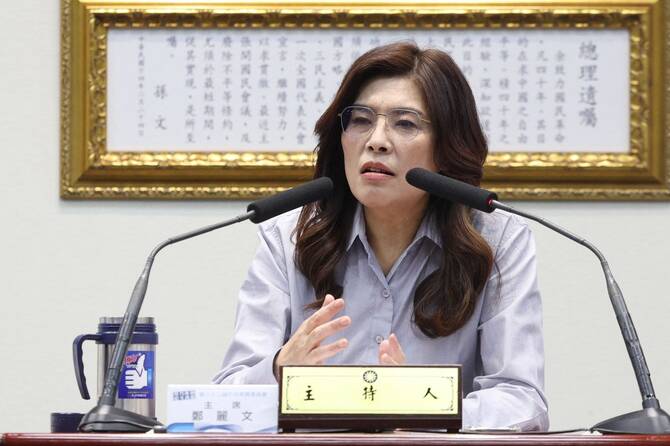

TAIPEI: Taiwan’s main opposition leader said her tour of the United States aimed at mustering support for her stance on China “exceeded expectations,” without detailing any tangible outcomes.
Kuomintang (KMT) chairwoman Cheng Li-wun returned to Taipei this week to sharp questions over the island’s defense spending after her party thwarted the Taiwanese government’s plan to spend nearly $40 billion on critical weapons, including US arms and domestically produced drones.
Cheng said she met US lawmakers, government officials, think tanks and supporters and was “deeply moved and encouraged” during her two-week trip aimed at positioning her party as key in regional peace efforts.
“Our meetings with the US side were very positive,” she told a press conference in Taipei Wednesday, without detailing any agreements or outcomes.
She said many of her talks with the US administration were “confidential” and denied reports that she had failed to meet with top security officials.
Cheng’s reception in the US was “lukewarm,” said Wen-Ti Sung, a political analyst from the Atlantic Council’s Global China Hub.
“Judging by public information, Cheng did not even get to meet working-level officials at, say, Assistant Secretary level — let alone further up the hierarchy,” he said.
“Even if the meetings did take place, the secrecy itself already suggests there may be lingering reservations on the US side.”
Cheng has rocked Taiwanese politics since her unexpected rise to the top of the party last year and drawn criticism for being too pro-China.
The KMT has long advocated closer relations with China, which claims Taiwan is part of its territory and has threatened to use force to seize it.
- KMT and deterrence -
Cheng’s trip came two months after her “peace” visit to Beijing, where she met Chinese President Xi Jinping — the first such meeting in a decade — and came weeks after US President Donald Trump’s summit with Xi in the Chinese capital.
Cheng on Wednesday said that her party placed “great importance to military cooperation with the US and to strengthening Taiwan’s defense capabilities,” adding her interlocutors in the US had shown “profound understanding and support.”
While the United States switched official diplomatic relations from Taipei to Beijing nearly 50 years ago, Washington is Taipei’s most important security backer.
President Donald Trump’s recent suggestion that US arms sales to Taiwan could be a bargaining chip with China has set off alarms across the world.
Cheng aimed to “prove her foreign policy bona fides and demonstrate that she is figuratively and physically on the sides of both China and the US,” said Sung.
Should she succeed, he said, a 2028 presidential run is the “logical next step.”


