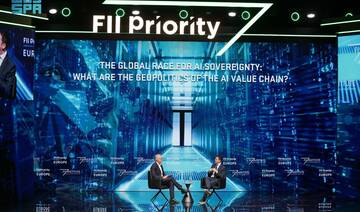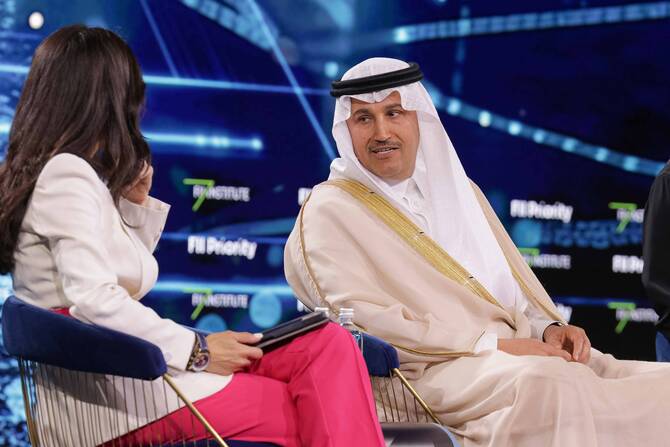

ROME: Saudi Transport Minister Saleh bin Nasser Al-Jasser said the contingency measures activated during the Iran crisis were the result of years of planning, and not reactive.
“What we have been doing is not a reaction to what has happened,” Saleh bin Nasser Al-Jasser said during a panel discussion at FII Priority Europe on Thursday titled “Tariffs, trade and the new geo-economic order.”
“We are progressing on implementing our vision (and) we will continue to implement our plans,” he added.
“Today is this crisis, tomorrow is a pandemic or anything else, we have to be ready for any situation, but we have to be able not to get diverted or derailed from implementing our plans.”
Al-Jasser said the Kingdom had drawn lessons from the 2013 Red Sea disruption, when a security incident involving a passing container ship raised concerns over the waterway and the Suez Canal.
“The region has probably, (and) still is, going through a very difficult situation, and we were really prepared for what’s happening,” he said.
Saudi Arabia had activated 41 business continuity and emergency plans that were “well prepared and tested,” Al-Jasser added.
He said 11 government entities met daily during the crisis to coordinate with the private sector and assess its needs.
“We have been building infrastructure that would help us to navigate in different situations,” he said, citing western Saudi ports with a capacity of 18 million containers a year and trade volume of 10 million containers in 2025.
He said the Kingdom also has a road network of more than 75,000 km, 5,500 km of railways, and more than 500,000 trucks that were mobilized during the crisis. Saudi Arabia is also connected to neighboring countries in the south, west and north, he added.
Speaking on the same panel, Albania’s Prime Minister Edi Rama said he refrained from commenting directly on the Hormuz situation but accused Europe of “inertia” in handling the crisis.
“When it comes to Europe and Europe’s role, everything is said very clearly, what is needed, what Europe has, what is missing,” he said.
“But there is one thing that, in fact, is the No. 1 problem in Europe, and that Europe is not being able to take on, which is politics (and) the capacity to have a common vision, the capacity to take common decisions, the capacity to implement in time everything that is decided,” he said.
“So, when it comes to the Strait of Hormuz, it’s sad to see how Europe is in and out, is there and is not there.”
Rama compared Europe’s hesitation to its response to Russia’s war in Ukraine and said the bloc had struggled to take concrete steps because of its fragmented political system.
He added that despite the bloc’s flaws, Albania remained committed to joining the EU.
“Then, how things will unfold is another story. But we want this marriage. We are obsessed about it, and we’ll get there no matter what, and sooner more than later.”
Rama had a pointed exchange with CNN anchor and correspondent Eleni Giokos, who moderated the panel discussion, over criticism of a luxury tourism project in Albania’s Vjosa-Narta wetland area, a protected nature reserve and flamingo habitat.
The Albanian leader suggested the backlash had been driven largely by the involvement of Jared Kushner and US President Donald Trump, though ecological concerns remain a key part of the opposition.
“The community where the project is going to develop wants the project, so what you see is not exactly what is going on,” he insisted.
“The outrage is there, I understand, but … it will fade away,” he said.
Accusing CNN of airing an “offensive” profile about him in the past and of not being objective in its reporting on him or the situation, the Albanian PM said investors had already bought the land.
“Yes, it’s a private land. Yes, an environmental impact assessment is ongoing. Yes, there is not yet a project being approved. Yes, there is not yet a building permission.”
“And yes, Albania will go forward.”