UK increasing its support for Gulf allies, not the war

https://arab.news/n58rf
Whether or not countries support the US and Israel’s decision to launch an attack on Iran, it has inevitably affected them and they have little choice but to respond to the threat it poses to them and to their friends and allies in the Gulf and elsewhere. The UK is no exception and its decision to deploy more troops and air defense systems in the Gulf to protect both its allies and its own interests was unavoidable.
On a trip to several Gulf nations last week, Defense Secretary John Healey confirmed that the UK would send more Typhoon jets to Qatar, as well as the Sky Sabre anti-drone and missile system to Saudi Arabia, Bahrain and Kuwait. This may not be the decisive factor in ending Iran’s aggression toward the Gulf countries that Tehran has embroiled in the war against their wishes, but it will help to fend off missile and drone attacks, while also reassuring Gulf allies that their security and well-being remain a priority for London.
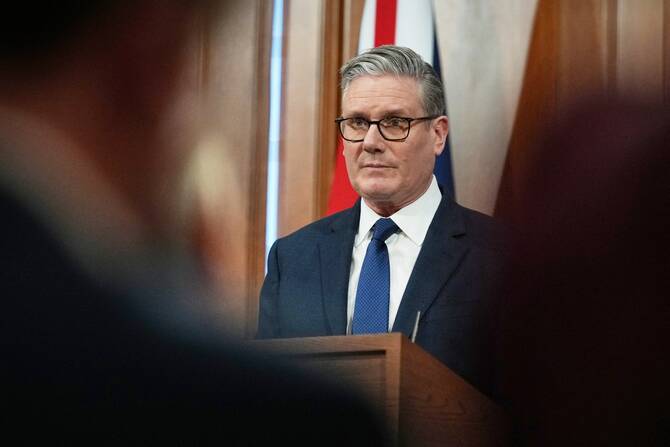
British Prime Minister Keir Starmer, perhaps more than most other European and NATO leaders, has come under immense pressure from US President Donald Trump to enter the war. However, Starmer is cognizant that this is not a war that is popular in Britain, particularly among his own voters and backbench MPs. According to IPSOS, 56 percent of Britons disapprove of US military strikes on Iran.
Starmer is cognizant that this is not a war that is popular in Britain, particularly among his own voters and MPs
Yossi Mekelberg
Yet, according to YouGov, the public is split on the prime minister’s handling of the UK’s response, with 38 percent believing he is doing well and 43 percent saying he is doing badly. It is also clear that the public opposes actively joining the US and Israel in launching attacks across Iran, while remaining more supportive of British forces acting in defense of civilian areas and UK military facilities.
The dilemma facing the British government is how to stay true to its approach at the outset of the war that “this is not our war and we’re not going to get dragged into it,” while still standing by long-standing allies in the Gulf.
These countries have come under sustained attack from Iran, suffering casualties and damage across a wide range of civilian targets, including residential areas, hotels, airports, ports, water desalination plants and oil and gas facilities. This has resulted in a growing human and economic toll. Supporting those under missile and drone attack requires the UK, alongside other European and NATO members, to draw a distinction between a war they did not initiate and the high stakes they nevertheless face.
There is a broad consensus in the UK and across the EU that diplomatic efforts to reach an agreement with Iran are far from exhausted. These countries are also deeply dissatisfied that they were not consulted before the US and Israel embarked on this course of action and are now being pressed by Washington to commit forces. However, if the war continues for much longer, they may not be able to ignore the need to prevent the Iranian regime from causing further harm to both its regional neighbors and wider international interests.
Starmer has been on the receiving end of considerable criticism at home for what some see as contradictory positions: on the one hand, insisting that the UK will not be directly involved in the war, while on the other allowing, under pressure, US forces to use UK bases to launch strikes on Iranian targets, including those affecting the Strait of Hormuz.
He argues that this is necessary to defend Britain’s interests, not without justification, as these positions are not necessarily inconsistent so long as the UK avoids being drawn into either US and Israeli adventurism or Tehran’s attempts to create wider regional instability, even chaos, for its own survival.
It is a fine line to walk but not an impossible one. Following a drone strike on a British airbase in Cyprus — likely launched by Tehran’s Lebanese proxy, Hezbollah — the UK feels further justified in taking a limited role in supporting its allies, while continuing to contribute to diplomatic efforts aimed at ending the conflict.
The UK feels justified in taking a limited role in supporting its allies, while continuing to contribute to diplomatic efforts
Yossi Mekelberg
Despite its reservations about how the war began, including questions over its legality, the UK cannot ignore that Iran began targeting neighboring countries almost immediately after the first US-Israeli attacks, launching hundreds of missiles and thousands of unmanned aerial vehicles across the Gulf states. These actions effectively undermined deals such as the 2023 Beijing Agreement between Iran and Saudi Arabia, which committed both sides to respect the other’s sovereignty and the principle of noninterference in their domestic affairs. Iran has also violated international law by disrupting navigation through the Strait of Hormuz, a critical global shipping route.
Moreover, the war has had what some describe as having “catastrophic” consequences for the UK economy. It has already driven up fuel prices and increased mortgage costs and is expected to add hundreds of pounds to average household energy and food bills. One of the central challenges facing the British government remains the cost of living — an issue it was already struggling to address even before the conflict and which has now been made more acute, especially for Labour ahead of crucial local elections next month.
There is no easy path for the British government in responding to the war in Iran. Yet, as with all conflicts, the key question is not only how to begin, but how to evolve and ultimately end with minimal damage and maximum achievements. At this stage, the issue is no longer simply about responding to Washington’s pressure but about defending Iran’s neighbors, safeguarding energy security and protecting international shipping routes — all of which Tehran has threatened.
In the longer term, the UK’s intention to pursue closer economic and defense ties with the EU, leading to a more coordinated approach to global affairs, will be crucial to address such severe security challenges. In the meantime, given that the British army is already stretched to its limits, any defensive support provided to allies in the Gulf is both morally justified and aligned with the UK’s national interest.
- Yossi Mekelberg is professor of international relations and an associate fellow of the MENA Program at Chatham House.
X: @YMekelberg