

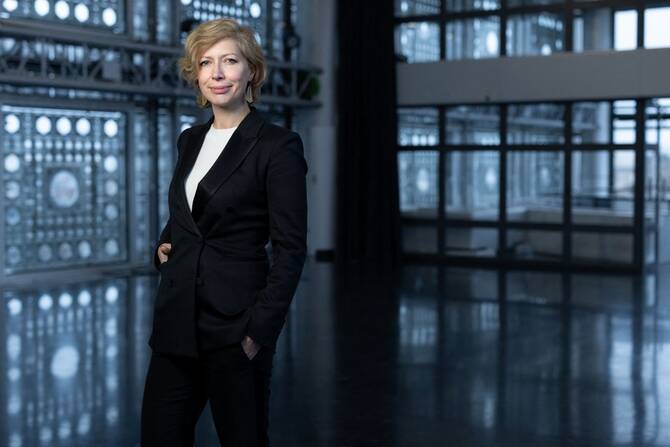

PARIS: In February, the Institut du Monde Arabe in Paris named Anne-Claire Legendre as its new president. She is the first woman to hold this role and was unanimously elected by the 14 members of the IMA’s board of directors which includes 7 representatives from Arab League countries.
Her appointment followed the resignation of previous president Jack Lang on Feb. 7, after French prosecutors announced that they were investigating Lang because of allegations of tax fraud and money laundering linked to convicted sex offender Jeffrey Epstein.

The Institut du Monde Arabe in Paris. (Supplied)
Legendre’s official mandate is threefold: to modernize the governance of the IMA, to streamline its efficiency and to restore a sustainable financial trajectory, increasing transparency and trust in the institution.
Her new role “reunites all my passions; the Arab world, culture and diplomacy, all in one place. I am very grateful to be here,” she tells Arab News.
The career diplomat also brings her own vision to the table. The IMA is a unique institution with a core mission to foster dialogue between the Arab world and Europe through the promotion and archiving of art, music, literature, dance, and much more. Next year, it will celebrate its 40th anniversary. Legendre plans to usher in a dynamic new era, making the IMA a setting for creative expression, dialogue and connection through culture, the arts and the study of Arabic languages.
Legendre, 46, was born in Brittany, western France. Having earned a master’s in literature from the Sorbonne, she pursued further studies in comparative literature, with a particular focus on 10th-century Lebanese poetry in French and Arabic.
“I began studying Arabic without ever having set foot in the Arab world. At 20, I won a scholarship to study Arabic at the National Institute of Oriental Languages and Civilizations in Cairo,” she says. “That moment was key because I saw an Arab country for real, not just through the lens of literature.”
She went on to study French Diplomacy at Sciences Po in Paris, and then spent two years at the French Embassy in Yemen.
In 2016, Legendre became the youngest-ever French Consul General to New York, and was named France’s ambassador to Kuwait in 2020. Her in-depth understanding of the Arab world subsequently saw her become French President Emmanuel Macron’s advisor on Middle East and North African affairs. She was the driving force behind France’s recognition of a Palestinian state in September 2025, and a key negotiator in peace talks in the war between Hezbollah and Israel in Lebanon.
Legendre is passionately committed to attracting younger visitors to the IMA. Around 57,000 school students visit the museum annually.
“We are not an elite institution. We welcome young people, and want to help them take pride in their Arab origins, and understand their history,” she says. “I discussed this with President Macron before leaving my post at the Elysée. He strongly believes that the IMA can provide tools for understanding and dialogue. Reinforcing the social fabric of France is really important for our future.”
Studies show that Arabic is now France’s second language after French. The IMA offers courses in classical Arabic and regional dialects. There are currently around 1,000 students enrolled in these courses. Demand far exceeds available places, and this extends to major cities throughout France. To this end, the IMA has created CIMA, a certification of proficiency in Arabic. The IMA has academic partnerships with King Faisal University in Saudi Arabia, to develop new research in linguistic programs.
Three new awards are being introduced to showcase emerging talent in fashion, design, and contemporary art. Entry for all three is open to both Arab nationals and Europeans of Arab descent.
“These are not simply awards,” said Legendre. “With our partners, we are creating a platform for artists to thrive, connecting them with opportunities for residencies, exhibitions or publication.”
The IMA is also a forum to foster dialogue and exchange, where visitors from France and the Arab region can meet in a discrete and confidential setting.
“As a diplomat myself, I believe that the IMA can also be a place to foster dialogue. We are neighbors — the Mediterranean is our shared sea. We share an interest in the security of the region. We commit loyally to our allies. I’ve been attending a lot of iftars during Ramadan, and I keep hearing appreciation of France’s solidarity during these very dark days,” Legendre says.
“As an art lover, I appreciate being in a position to forge strong links with artists. Art expresses something that is absolutely necessary. When we contemplate what has happened over the last two years, especially in the Israeli-Palestinian conflict, it's not just a question of diplomacy, it’s also a question of narratives. Sometimes, politicians are at a loss because of the trauma of war, the weight of history and memory. When people have lost hope for a peaceful coexistence, we need artists to create hope, to transform pain into creation to help people bridge this gap,” she continues. “Art provides us with the possibility of imagining a brighter future. It’s cultural diplomacy.”
-ENDS-


