

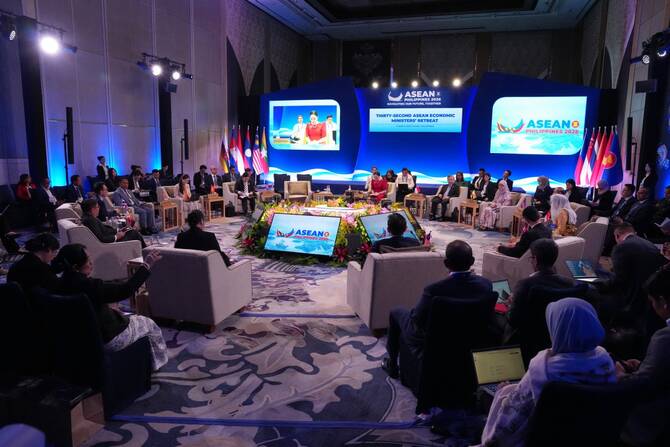

MANILA: Southeast Asian foreign and economic ministers urged on Friday for an immediate end to hostilities in the Middle East, as they agreed to deepen regional resilience and trade to tackle the global impacts of the US-Israeli war on Iran.
Energy and financial markets worldwide have been upended with the Iran war in its second week. With Southeast Asian countries mostly reliant on oil imports, they are at risk of an inflation shock, shortages, and currency volatility.
The Philippines, which is chair of the Association of Southeast Asian Nations this year, convened special meetings to address “serious concern” over the escalation of conflict in the Middle East following US-Israel attacks on Iran, Israeli strikes on Lebanon and Iran’s retaliatory response on US military bases in Gulf countries.
“We expressed serious concern over the situation in the Middle East and its impacts in the region and emphasized the importance of the immediate cessation of hostilities, called on all parties to exercise utmost self-restraint, and resolve differences through diplomacy and dialogue,” Philippine Foreign Affairs Secretary Theresa Lazaro told a press conference after a virtual meeting with ASEAN foreign ministers.
“We also agreed to strengthen our cooperation and work more closely to respond more rapidly to the challenges impacting our region,” Lazaro said.
Discussions among the region’s top diplomats touched on enhancing intra-ASEAN trade, increasing the use of renewable energy as alternatives to fossil fuels, and protecting Southeast Asian nationals in affected areas.
ASEAN, as an entity, has held discussions with members of the Gulf Cooperation Council, as well as on a bilateral basis, Lazaro added.
The US-Israeli war on Iran has effectively led to the closure of the Strait of Hormuz, which funnels more than half of Asia’s oil and a third of the region’s LNG imports, with Brent crude, the international benchmark, hitting nearly $100 a barrel on Friday.
In 2025, an average of 20 million barrels per day of crude oil and oil products were shipped daily, making it one of the world’s most critical oil transit chokepoints, according to the International Energy Agency. The same year also saw almost 90 percent of the total volumes exported destined for the Asian market.
In a separate meeting, ASEAN economic ministers also warned of the impacts of the ongoing geopolitical instability, which are already increasing freight, logistics costs and inflation on energy, food and other essential goods.
“We expressed deep concern over the continued tensions in the Middle East. The escalating conflict has generated broader economic repercussions beyond the region,” a joint statement reads.
“A prolonged period of geopolitical instability could pose sustained challenges to the global economic outlook, which has already been battered by multiple headwinds in recent years. It will also impact economic security and stability, the livelihoods of millions of people in the region, and hinder economic progress in ASEAN.”
Several Southeast Asian nations have already started to roll out measures to counter the economic impact, including conserving energy and stabilizing domestic markets.
The Philippines has introduced a four-day work week among civil servants, as Thailand encouraged public sector officials to work from home where possible and Vietnam urged companies to allow staff to work from home.
Studies conducted by the Economic Research Institute for ASEAN and East Asia suggest that most countries in Southeast Asia can hold oil and gas reserves equivalent to between 20 and 50 days of demand.


