CEBU, Philippines: Southeast Asian countries should steadfastly maintain restraint and adhere to international law as acts of aggression across Asia and “unilateral actions” elsewhere in the world threaten the rules-based global order, Manila’s top diplomat said Thursday.
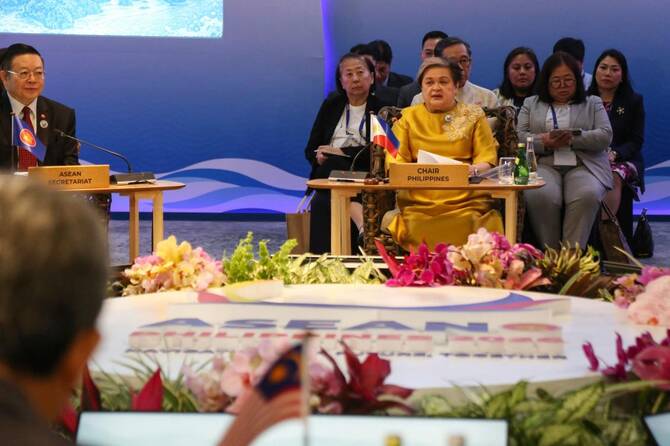
Philippine Foreign Secretary Theresa Lazaro did not provide details of the geopolitical alarm she raised before her counterparts in the 11-nation Association of Southeast Asian Nations who were holding their first major closed-door meetings this year in the Philippines’ central seaside city of Cebu.
Several ASEAN members, however, have expressed deep concern over the secretive US strike that resulted in the arrest of Venezuelan leader Nicolas Maduro on orders from US President Donald Trump. China’s intensifying aggressive stance on Taiwan and in the disputed South China Sea have also troubled the region for years.
Calling out the US and China, among the largest trading and defense partners of ASEAN countries, have been a dilemma and diplomatic tightrope.
“Across our region, we continue to see tensions at sea, protracted internal conflicts and unresolved border and humanitarian concerns,” Lazaro said in her opening speech before ASEAN counterparts.
“At the same time, developments beyond Southeast Asia, including unilateral actions that carry cross-regional implications, continue to affect regional stability and erode multilateral institutions and the rules- based international order,” she said.
“These realities underscore the interim importance of ASEAN’s time-honored principles of restraint, dialogue and adherence to international law in seeking to preserve peace and stability to our peoples.”
The Philippines holds ASEAN’s rotating chair this year, taking what would have been Myanmar’s turn after the country was suspended from chairing the meeting after its army forcibly ousted Aung San Suu Kyi’s democratically elected government in 2021.
Founded in 1967 in the Cold War era, ASEAN has an unwieldy membership of diverse countries that range from vibrant democracies like the Philippines, a longtime treaty ally of Washington, to authoritarian states like Laos and Cambodia, which are close to Beijing.
The regional bloc adopted the theme “Navigating our future, Together” this year but that effort to project unity faced its latest setback last year when deadly fighting erupted between two members, Thailand and Cambodia, over a longtime border conflict.
Aside from discussing the deadly fighting that embroiled Thailand and Cambodia before both forged a US-backed ceasefire last year, the ASEAN foreign ministers will deliberate how to push a five-point peace plan for the war in Myanmar, issued by the regional bloc’s leaders in 2021. The plan demanded, among others, an immediate end to fighting and hostilities, but it has failed to end the violence or foster dialogue among contending parties.
ASEAN foreign ministers are also under pressure to conclude negotiations with China ahead of a self-imposed deadline this year on a so-called “code of conduct” to manage disputes over long-unresolved territorial rifts in the South China Sea. China has expansive claims in the waterway, a key global trade route, that overlap with those of four ASEAN members, the Philippines, Malaysia, Vietnam and Brunei.

ASEAN should adhere to rule of law in face of ‘unilateral actions,’ Philippines’ top diplomat says
Short Url
https://arab.news/5fx8g
ASEAN should adhere to rule of law in face of ‘unilateral actions,’ Philippines’ top diplomat says
- Several ASEAN members have expressed deep concern over the US strike that resulted in the arrest of Venezuelan leader Nicolas Maduro
- Philippines’ top envoy: ‘Across our region, we continue to see tensions at sea, protracted internal conflicts and unresolved border and humanitarian concerns’
In show of support, Canada, France open consulates in Greenland
COPENHAGEN, Denmark: Canada and France, which both adamantly oppose Donald Trump’s wish to control Greenland, will open consulates in the Danish autonomous territory’s capital on Friday, in a strong show of support for the local government.
Since returning to the White House last year, Trump has repeatedly insisted that Washington needs to control the strategic, mineral-rich Arctic island for security reasons.
The US president last month backed off his threats to seize Greenland after saying he had struck a “framework” deal with NATO chief Mark Rutte to ensure greater American influence.
A US-Denmark-Greenland working group has been established to discuss ways to meet Washington’s security concerns in the Arctic, but the details of the talks have not been made public.
While Denmark and Greenland have said they share Trump’s security concerns, they have insisted that sovereignty and territorial integrity are a “red line” in the discussions.
“In a sense, it’s a victory for Greenlanders to see two allies opening diplomatic representations in Nuuk,” said Jeppe Strandsbjerg, a political scientist at the University of Greenland.
“There is great appreciation for the support against what Trump has said.”
French President Emmanuel Macron announced Paris’s plans to open a consulate during a visit to Nuuk in June, where he expressed Europe’s “solidarity” with Greenland and criticized Trump’s ambitions.
The newly-appointed French consul, Jean-Noel Poirier, has previously served as ambassador to Vietnam.
Canada meanwhile announced in late 2024 that it would open a consulate in Greenland to boost cooperation.
The opening of the consulates is “a way of telling Donald Trump that his aggression against Greenland and Denmark is not a question for Greenland and Denmark alone, it’s also a question for European allies and also for Canada as an ally, as a friend of Greenland and the European allies also,” Ulrik Pram Gad, Arctic expert at the Danish Institute of International Studies, told AFP.
“It’s a small step, part of a strategy where we are making this problem European,” said Christine Nissen, security and defense analyst at the Europa think tank.
“The consequences are obviously not just Danish. It’s European and global.”
Recognition
According to Strandsbjerg, the two consulates — which will be attached to the French and Canadian embassies in Copenhagen — will give Greenland an opportunity to “practice” at being independent, as the island has long dreamt of cutting its ties to Denmark one day.
The decision to open diplomatic missions is also a recognition of Greenland’s growing autonomy, laid out in its 2009 Self-Government Act, Nissen said.
“In terms of their own quest for sovereignty, the Greenlandic people will think to have more direct contact with other European countries,” she said.
That would make it possible to reduce Denmark’s role “by diversifying Greenland’s dependence on the outside world, so that it is not solely dependent on Denmark and can have more ties for its economy, trade, investments, politics and so on,” echoed Pram Gad.
Greenland has had diplomatic ties with the European Union since 1992, with Washington since 2014 and with Iceland since 2017.
Iceland opened its consulate in Nuuk in 2013, while the United States, which had a consulate in the Greenlandic capital from 1940 to 1953, reopened its mission in 2020.
The European Commission opened its office in 2024.
Since returning to the White House last year, Trump has repeatedly insisted that Washington needs to control the strategic, mineral-rich Arctic island for security reasons.
The US president last month backed off his threats to seize Greenland after saying he had struck a “framework” deal with NATO chief Mark Rutte to ensure greater American influence.
A US-Denmark-Greenland working group has been established to discuss ways to meet Washington’s security concerns in the Arctic, but the details of the talks have not been made public.
While Denmark and Greenland have said they share Trump’s security concerns, they have insisted that sovereignty and territorial integrity are a “red line” in the discussions.
“In a sense, it’s a victory for Greenlanders to see two allies opening diplomatic representations in Nuuk,” said Jeppe Strandsbjerg, a political scientist at the University of Greenland.
“There is great appreciation for the support against what Trump has said.”
French President Emmanuel Macron announced Paris’s plans to open a consulate during a visit to Nuuk in June, where he expressed Europe’s “solidarity” with Greenland and criticized Trump’s ambitions.
The newly-appointed French consul, Jean-Noel Poirier, has previously served as ambassador to Vietnam.
Canada meanwhile announced in late 2024 that it would open a consulate in Greenland to boost cooperation.
The opening of the consulates is “a way of telling Donald Trump that his aggression against Greenland and Denmark is not a question for Greenland and Denmark alone, it’s also a question for European allies and also for Canada as an ally, as a friend of Greenland and the European allies also,” Ulrik Pram Gad, Arctic expert at the Danish Institute of International Studies, told AFP.
“It’s a small step, part of a strategy where we are making this problem European,” said Christine Nissen, security and defense analyst at the Europa think tank.
“The consequences are obviously not just Danish. It’s European and global.”
Recognition
According to Strandsbjerg, the two consulates — which will be attached to the French and Canadian embassies in Copenhagen — will give Greenland an opportunity to “practice” at being independent, as the island has long dreamt of cutting its ties to Denmark one day.
The decision to open diplomatic missions is also a recognition of Greenland’s growing autonomy, laid out in its 2009 Self-Government Act, Nissen said.
“In terms of their own quest for sovereignty, the Greenlandic people will think to have more direct contact with other European countries,” she said.
That would make it possible to reduce Denmark’s role “by diversifying Greenland’s dependence on the outside world, so that it is not solely dependent on Denmark and can have more ties for its economy, trade, investments, politics and so on,” echoed Pram Gad.
Greenland has had diplomatic ties with the European Union since 1992, with Washington since 2014 and with Iceland since 2017.
Iceland opened its consulate in Nuuk in 2013, while the United States, which had a consulate in the Greenlandic capital from 1940 to 1953, reopened its mission in 2020.
The European Commission opened its office in 2024.
© 2026 SAUDI RESEARCH & PUBLISHING COMPANY, All Rights Reserved And subject to Terms of Use Agreement.


