

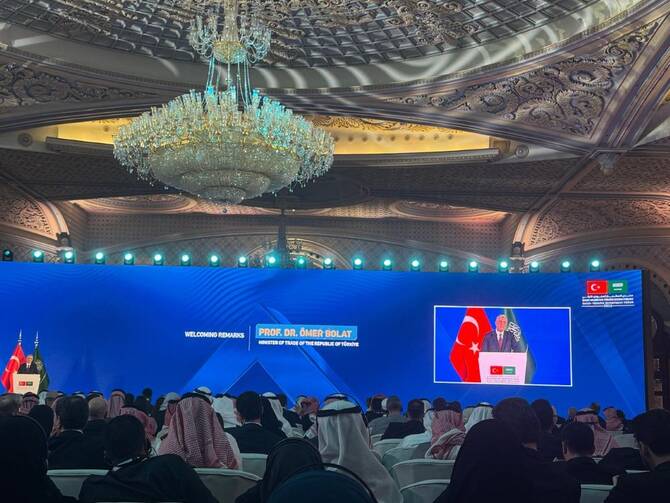
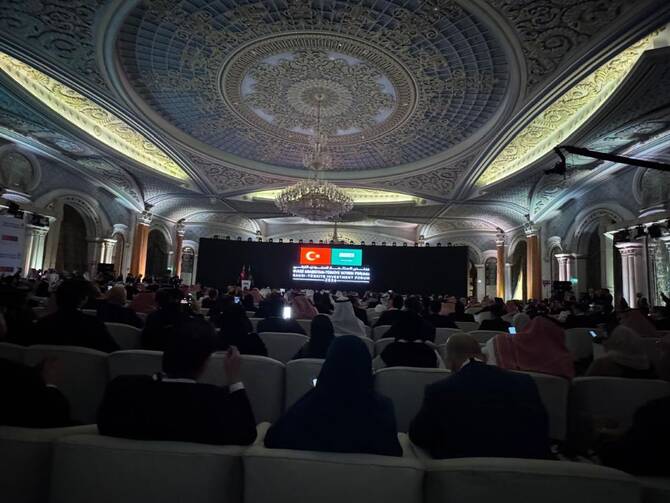

RIYADH: The Saudi-Turkiye Investment Forum in Riyadh on Tuesday reflected an unprecedented level of political and economic alignment between the countries, Saudi Investment Minister Khalid Al-Falih said, and demonstrated the determination of both leaderships to expand their partnership to new strategic horizons.
Speaking at the event, he said the scale of the Turkish participation, including a delegation of more than 200 businesses, underscored the central role of economic cooperation in the growing strategic partnership between the nations.
“Turkish direct investments in the Kingdom have surpassed the $2 billion mark, while total bilateral trade has reached approximately $8 billion, recording a notable growth of 14 percent within just one year,” Al-Falih said.
By the end of last year, the Kingdom had issued 1,473 investment registrations for Turkish companies active in the Saudi market, he added, stressing that these indicators reflect the strength of economic relations and their accelerating growth.
The Kingdom, as the region’s largest economy, and Turkiye, as a leading hub for manufacturing and exports, have complementary economies, which creates diverse investment opportunities, Al-Falih noted.
“We are no longer merely in a phase of dialogue and exploration; we are now decisively transitioning into the phase of actual implementation,” Al-Falih said.
“Thanks to our clear and stable investment environment, we have a clear pathway ahead to transform these ambitions into successful and tangible investment partnerships with our Turkish counterparts.”
Omer Bolat, the Turkish trade minister, said the joint investment forum represented a “historic moment” in the trajectory of bilateral relations, and reflected the depth of the strategic partnership and strong ties that bind the countries.
The volume of trade between Turkiye and Saudi Arabia is steadily growing, he continued, and his country aims to achieve a total value of $10 billion in the medium term, amid the expansion of economic partnerships and opportunities for investment cooperation.
“We aspire to become the largest economic partners in the region,” Bolat added while emphasizing that the growth trajectory of the Turkish economy continues and it remains an attractive environment for investment.
“We see the Gulf Cooperation Council countries, with Saudi Arabia at the forefront, as an essential partner and a strong center for close cooperation,” he said.
Bolat expressed high expectations for the forum and confidence that it would yield fruitful results and ambitious agreements that would help establish a strong economic alliance between the two countries.
He predicted that deals signed during the event would translate into significant joint projects, particularly in priority sectors such as energy, manufacturing and defense, that can help enhance regional economic integration and drive shared growth. The current political and economic momentum represents an exceptional opportunity to turn this vision into a tangible reality that benefits the economies and peoples of both countries, he added.
Cuneyt Saricimen, advisor on Saudi Arabia and Bahrain at the Investment and Finance Office of the Presidency of Turkiye, said the Turkish economy represents “an exceptional success story” — gross domestic product has quintupled to $1.3 trillion over the past two decades, and the country has achieved accelerated and stable growth amid a volatile global environment.
He told Arab News that Turkiye offers investors not only a vibrant domestic market of more than 86 million consumers, it also serves as a strategic launchpad to a broader network of more than 1 billion consumers through its preferential trade agreements and customs union with the EU.
Turkiye’s unique geographical location at the intersection of Europe, the Middle East and Central Asia constitutes a “major competitive advantage,” Saricimen said, enabling companies with production facilities in Turkiye to access markets worth $32 trillion within just four hours of flight time, supported by a sophisticated global aviation network.
He also highlighted Turkiye’s continuous investment in human capital, noting that half of the population is under the age of 34 and benefits from an advanced educational system that is aligned with the needs of modern industries and future technology sectors.
Saricimen said the Turkish government has worked to strengthen the business environment through a comprehensive package of investment incentives, including a competitive 20 percent corporate tax rate, generous support for research and development, and a legal framework that protects investors through 89 bilateral investment treaties.
Investment opportunities in Turkiye are diverse and dynamic, he added, and the country holds advanced global positions in renewable energy, unmanned aerial vehicles, manufacturing, agriculture, and smart infrastructure.
The Turkish presidency’s investment office acts as a “solution partner” for Saudi investors by providing comprehensive support, Saricimen said, from planning and administrative facilitation to partnership development and ongoing post-commencement assistance, to help turn opportunities into successful and tangible partnerships.
Tuesday’s forum featured presentations on investment opportunities in both countries, and panel discussions related to the enhancement of bilateral relations in various sectors.
It also provided a place for representatives of the private sectors in the two countries to meet and explore cooperation, partnership and investment opportunities.


