

Saudi Arabia, Estonia strengthen cyber defense cooperation

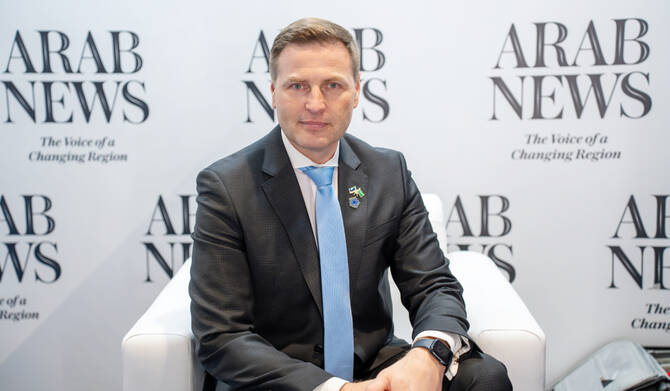
Estonia’s Defense Minister emphasizes cooperation in cybersecurity and artificial intelligence with Saudi Arabia at the World Defense Show 2026. (AN Photo by Jafar Al-Saleh)
Short Url
Updated 09 February 2026
Follow

Saudi Arabia, Estonia strengthen cyber defense cooperation

  • Renowned for its leadership in digital governance, Estonia sees cybersecurity as central to its partnership potential with Saudi Arabia, building on years of regional engagement through its technology firms

RIYADH: Estonia aims to deepen defense, cybersecurity, and artificial intelligence cooperation with Saudi Arabia as both nations look to advance technology‑driven defense and cybersecurity capabilities.

Hanno Pevkur, Estonia’s minister of defense, told Arab News at the World Defense Show in Riyadh on Monday that Estonia’s defense industry is eager to contribute to the Kingdom’s fast‑growing defense ecosystem.

“In the modern world, cooperation built on trust and technology is the best defense,” he said. “It is important for us to be here because we clearly see there is a possibility to increase cooperation, not only bilaterally between Saudi Arabia and Estonia, but across the region.”

At Estonia’s pavilion, a cooperation agreement was signed between an Estonian company and a Saudi firm during the show, he noted.

Pevkur also said Estonia’s defense sector has expanded rapidly in recent years, driven by technological innovation and partnership.

“Our defense industry is growing very rapidly, and we continue to see strong momentum,” he said.

He said Estonia’s strengths lie in digital and smart‑system integration rather than large‑scale weapons production.

“We will not build airplanes or tanks, but what we can do is integrate robotics, automation and drones to make existing systems smarter,” he said.

The minister said effective defense collaboration must link businesses and governments to achieve meaningful results.

“When we want to have real cooperation, we need it on all levels,” he said. “The biggest client for any defense company is the government, so we must treat this as one ecosystem where the public and private sectors work hand in hand.”

Renowned for its leadership in digital governance, Estonia sees cybersecurity as central to its partnership potential with Saudi Arabia, building on years of regional engagement through its technology firms.

Pevkur said several Estonian companies, including Nortal, have already assisted Gulf governments in developing open IT and digital‑service systems.

“As the most digitalized nation in the world, almost every service in Estonia can be done online, except getting married,” he said. “But with such digitalization, we also need strong cyberdefense.”

He said data protection and digital resilience are treated as matters of national sovereignty in Tallinn, the capital of Estonia.

“Data is what we own. When someone steals that data, it becomes a serious threat,” he added. “That is why cyberdefense is not just about technology, it is about trust, sovereignty and protection.”

Pevkur said Saudi Arabia’s advances in AI offer promising opportunities for collaboration.

“I know that Saudi Arabia is doing great work when it comes to AI,” he said. “For us, as a small country with limited human resources, AI is essential not just for defense but for everyday life.”

Pevkur added that Estonia has launched a national AI strategy to promote responsible development and closer coordination between government and industry. One Estonian company, he said, has developed a system that allows a single operator to control hundreds of drones through AI.

“It is quite easy to put a weapon into the hands of a robot, but we also need to define who is accountable for its actions,” he said.

“The big question for the future is whether we can allow a war to be fought entirely by AI, or if humans must always make the final ethical decisions.”

He said in his conclusion that governments must reach a common understanding on how AI will be used and regulated on the battlefield.


Islamabad family opens their home to hundreds during Ramadan

Syed Mohammad Omar Shah has been running a daily iftar during Ramadan for almost a decade. (Supplied)
Updated 7 sec ago
Follow

Islamabad family opens their home to hundreds during Ramadan

  • Initiative runs on personal savings, avoids public donations and zakat restrictions
  • Even after Pakistan’s record 38% inflation peak in 2023, family refused to stop serving

ISLAMABAD: As the sun dipped toward the horizon in Islamabad earlier this week, Syed Mohammad Umar Shah’s modest apartment building quietly transformed. Pots simmered, oil crackled and trays of dates and fritters were lined up with care.

Inside, Shah, his wife and their children moved with practiced rhythm — not preparing a private family meal but dinner for more than 100 strangers gathered downstairs to break their Ramadan fast.

Shah, a 45-year-old salaried employee, has been running this daily iftar for almost a decade. He calls those who arrive each evening “Guests of Allah.”

In Ramadan, the Islamic holy month marked by fasting from dawn to sunset, hunger is meant to foster empathy.

Across Pakistan, communal meal spreads known as dastarkhwans are laid out nightly to feed laborers, passersby and the poor. Many are organized through mosques, charities or neighborhood committees.

The Shah family’s initiative operates differently. It runs from their own kitchen, funded largely through personal savings and a small circle of relatives and friends. There are no banners, no institutional sponsorship and no public donation boxes.

“We started from home. Whatever food we cooked at home, we simply began cooking a little extra and started giving it to those people,” Shah said.

“Our effort is always to cook properly, food that we ourselves eat at home. The quality must be clean and good.”

The family’s commitment endured through one of Pakistan’s most punishing economic periods in decades. Inflation peaked at 38 percent in May 2023, according to official data, driven by energy price adjustments, currency depreciation and fiscal reforms tied to a $7 billion IMF stabilization program.

Food prices surged, pushing millions closer to the poverty line. Even middle-income households felt the strain. “As inflation keeps rising, it is becoming difficult for us too because I am a salaried employee,” Shah said. “In the past, we offered a lot of variety … but now, since inflation is rising and salaries are not increasing proportionally, we serve within our means.”

Where the menu once featured dishes such as nihari and chapli kebabs, it has since been simplified. Today, the iftar spread includes pakoras, samosas, jalebis, bread, curry, dates and sharbat.

The family rotates meals every two weeks to avoid repetition and ensure variety. “People should step forward, especially in this inflation, when it is becoming difficult for many to afford food,” Shah added.

“They should see how they can help others.”

The work begins long before sunset. Preparation starts at sahoor, the pre-dawn meal before fasting commences, and continues through the day.

“Our work begins from sehri time because many items must be prepared,” said Mrs. Omer Shah, who managed the kitchen logistics. “For example, pakoras and samosas need preparation. For samosas, we knead the dough, roll it and prepare them in advance. We boil potatoes, chop onions; all this work begins at sehri time.”

Years of constant cooking has taken a toll. She previously required surgery on her hand to remove a lump developed from repetitive strain. Still, she continues overseeing the operation.

Mohammad Bhutta, a cook who had learned under her guidance, helps manage the scale.

“Baji (Mrs. Omer) taught me the work,” Bhutta said as he dipped jalebis into hot oil. “I cook food, bread and curry. We prepare jalebis, pakoras, samosas, dates, sharbat.”

Each evening, as the call to prayer marks sunset, plates are distributed outside. Laborers, sanitation workers and passersby sit shoulder to shoulder.

In a capital often defined by politics and bureaucracy, the daily gathering beneath Shah’s building offers a quieter portrait of Ramadan, one built not on institutional charity, but on family labor, personal sacrifice and the belief that generosity should mirror what one serves at one’s own table.

Unlike many Ramadan initiatives, the family chooses not to collect zakat, the obligatory Islamic alms that must be distributed to specific eligible categories under religious guidelines.

Accepting zakat would have required screening recipients, something Shah did not want to do.

“We have not placed any donation box outside, nor do we collect funds publicly,” Shah said.

And the goal, he insisted, went beyond feeding hunger: “When food is unique, good, not repetitive, and served with love and kindness and when you speak gently to people, heartfelt prayers naturally come out.”